

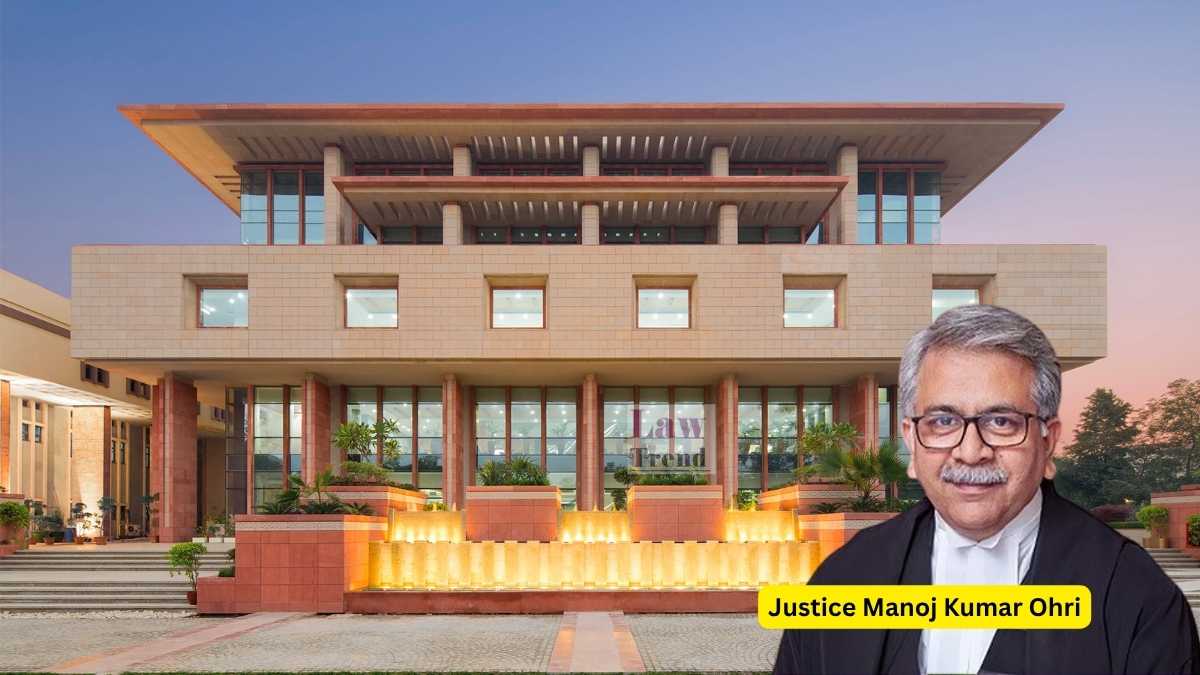
The Delhi High Court, presided over by Justice Manoj Kumar Ohri, has held that the absence of direct eyewitnesses or contemporaneous reports received by railway personnel cannot be converted into evidence that an accidental fall from a train did not occur. Setting aside the dismissal of a compensation claim by the Railway Claims Tribunal, the High Court held that the deceased was a bona fide passenger who died in an “untoward incident” and remanded the matter back to the Tribunal for the assessment and disbursement of compensation.
Background of the Case
The appeal was preferred by Phooli Devi under Section 23 of the Railway Claims Tribunal Act, 1987, challenging an order dated October 21, 2021, passed by the Railway Claims Tribunal, Principal Bench, Delhi. The Tribunal had dismissed her claim application seeking statutory compensation for the death of her son, Ramesh Meena.
On November 13, 2019, the deceased was travelling with his brother-in-law, Babulal, from Jatusana to Kund via Rewari. A single journey ticket (Ticket No. UDA23916912) was purchased for two adult passengers. After reaching Rewari, they boarded Passenger Train No. 59720 bound for Kund. While Babulal deboarded at Kund, the deceased remained aboard the train. Later that day, the deceased’s body was discovered lying near the railway tracks between Rewari and Khori.
Arguments of the Parties
Counsel for the appellant argued that the Tribunal had adopted an overly strict and restrictive approach towards appreciating the evidence. It was submitted that the journey ticket for two passengers had been verified by Jatusana Railway Station and that the testimony of Babulal could not have been discarded merely due to his familial relationship with the deceased. The appellant highlighted that the site where the body was discovered, the post-mortem findings, and the police investigation records consistently supported an accidental fall. Citing the Supreme Court judgment in Union of India v. Rina Devi, the appellant contended that the initial burden placed upon a claimant is not onerous and must be evaluated on the touchstone of preponderance of probabilities.
Opposing the plea, counsel for the Union of India argued that there was no reliable evidence establishing that the deceased fell from Train No. 59720. The respondent pointed out that neither the Loco Pilot nor the Guard received any report of a passenger falling, no alarm-chain was pulled, and Khori Railway Station registered no contemporaneous record of the event. Furthermore, the respondent emphasized that no ticket was recovered directly from the deceased’s person and that the ticket was produced subsequently by Babulal, whose credibility had been questioned by the Tribunal.
Court’s Analysis and Findings
Examining the evidence, Justice Manoj Kumar Ohri first addressed whether the deceased was a bona fide passenger. The Court noted that Ticket No. UDA23916912 was verified by the issuing railway station, and its genuineness remained undisputed. The Court held that the non-recovery of the ticket from the physical possession of the deceased did not negate his status, particularly when the valid ticket was produced by his travel companion, Babulal. Consequently, the initial burden was discharged.
The Court also rejected the Tribunal’s finding that Babulal was a false witness, holding that his familial relationship and the circumstances under which he deboarded at Kund could not render his testimony false when it was corroborated by the journey ticket and surrounding records.
Addressing the question of an “untoward incident” under Section 123(c) read with Section 124-A of the Railways Act, 1989, the Court observed that an accidental fall from a moving train is inherently an event that might not be witnessed by fellow passengers or noticed by train crew:
“The absence of direct evidence of the precise moment of the fall, therefore, cannot be converted into positive evidence against the claimant.”
The Court stressed that Section 124-A of the Act creates a statutory scheme of strict, no-fault liability that does not require claimants to establish negligence. Referring to the Supreme Court’s ruling in Union of India v. Prabhakaran Vijaya Kumar, the High Court reiterated that the provision is beneficial legislation requiring a liberal and purposive interpretation rather than a narrow and technical one. The Court also cited its earlier decision in Union of India v. Amit Parashar, which established that the absence of direct evidence demonstrating how a fall took place cannot be treated as evidence that the passenger did not fall from the train.
Reaffirming the evidentiary standard governing such claims, the Court noted:
“The fact that the fall was not witnessed, or that no immediate information was received by the railway authorities, may explain the absence of direct or contemporaneous evidence, but cannot be elevated into positive evidence against the occurrence of the accident.”
Because the respondent presented no cogent material establishing an alternative cause or manner of death, the Court held that the absence of eyewitnesses or contemporaneous administrative reports could not defeat the statutory claim.
The Decision
The High Court allowed the appeal and set aside the Tribunal’s judgment dated October 21, 2021. The matter was remanded to the Railway Claims Tribunal to assess the compensation payable to the appellant in accordance with law and to direct the concerned authorities to disburse the amount within two months of receiving the order. The parties were directed to appear before the Tribunal on October 15, 2026.
Case Title: Phooli Devi v. Union of India
Case No.: FAO 77/2022
Bench: Justice Manoj Kumar Ohri
Date: September 21, 2026




