

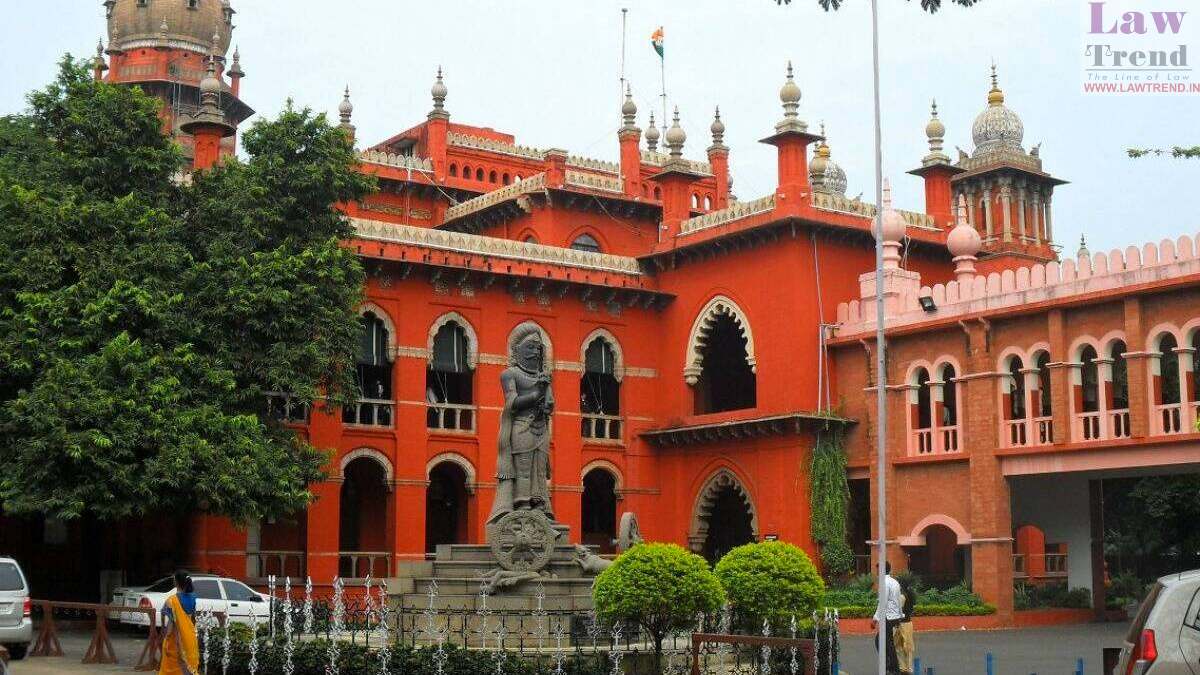
The Madras High Court has held that a father cannot claim maintenance from his son under Section 125 of the Code of Criminal Procedure merely because he has allegedly been neglected or deprived of moral and family support. Justice Sunder Mohan set aside an order directing a son to pay ₹75,000 per month to his elderly father after finding that the evidence showed the father had rental and business income and was not living in vagrancy or destitution.
The Court said that while the circumstances surrounding the relationship between the father and son were disturbing, such considerations could not alter the statutory requirements governing a claim for maintenance under Section 125 CrPC.
“The facts in the case are definitely disturbing. But, that would hardly be a reason to interpret the law differently.”
Background
The case arose from a maintenance petition filed by the father against his son. The father stated that he was around 80 years old and unable to maintain himself. He said that he had built M/s Conjap Electronics Industries from the age of 17, acquired several properties from his business income and provided education to his children.
According to the father, his son expressed a desire to join the business in 2021, following which he gave him a 50% share. He alleged that the son subsequently incorporated M/s Conjap Electronics Private Limited along with his wife and diverted the business of the proprietorship concern.
The father further alleged that his son prevented him from attending the office and stopped paying electricity bills, maintenance charges and property tax concerning the apartment that had been settled in the son’s favour. He claimed that these circumstances left him without any source of income.
The son contested the claim. He said that his father owned several commercial properties at Mount Road and a residential property at Purasawalkam, received substantial rental income, continued to earn from his proprietorship business and had fixed deposits exceeding ₹10 lakh.
The VI Additional Judge, Family Court, Chennai, however, found that the father was incapable of maintaining himself and directed the son to pay ₹75,000 per month as maintenance.
Son Challenged ₹75,000 Monthly Maintenance
Before the High Court, Senior Advocate P.R. Raman, appearing for the son, argued that the father had earlier approached the authorities under the Maintenance and Welfare of Parents and Senior Citizens Act seeking cancellation of a settlement deed concerning two flats settled in the son’s favour.
It was argued that after failing to secure cancellation before the authorities and the appellate authority, the father filed the maintenance proceedings. The son pointed out that the father continued to reside in the flats as he had retained a life interest in them.
The son’s counsel also relied upon rental agreements concerning five commercial properties. According to him, the documents showed that the father was receiving rental income. His bank account was also relied upon to show business income, while an income-tax challan for Assessment Year 2023-24 showed payment of ₹52,728 towards income tax.
The son further questioned the declarations made by his father in two separate affidavits of assets and liabilities and argued that material information concerning his properties and income had not been properly disclosed.
Counsel for the father, Rohini Ravikumar, defended the Family Court’s decision. She submitted that the Family Court had correctly considered his financial condition and the son’s obligation to maintain a father who had worked throughout his life for the family’s welfare. She also referred to the son’s alleged conduct in abandoning his father in old age.
Court Examines Father’s Income and Assets
The High Court found that rental agreements marked as Ex.R7 to Ex.R11 were undisputed and indicated that the father was receiving ₹82,000 as rent from commercial properties. These agreements were executed between 2020 and 2022, but the income had not been disclosed in his first assets and liabilities affidavit filed on December 22, 2023.
The Court also examined the second affidavit filed on March 18, 2024 and found discrepancies in the rental income disclosed by the father.
For a property referred to as Tony Vision, the father disclosed ₹16,000 per month as rent, whereas Ex.R7 showed rent of ₹30,000 per month as on November 11, 2024. The Court found the explanation offered during cross-examination for the reduction in rent unacceptable.
The Court further examined bank entries relating to other properties and the explanations offered by the father during cross-examination. It observed that the answers given in cross-examination were contradicted by the rental agreements on record.
On the overall evidence, the High Court found that the father was living in his own flats, earning income from commercial shops and receiving business income. It also noted that he had the capacity to give substantial amounts to his grandchildren.
“The evidence therefore, suggests that he is not a man who is living in vagrancy or destitution.”
Neglect or Lack of Moral Support Not Enough for Section 125 CrPC
The High Court referred to the Supreme Court’s decision in Chaturbhuj v. Sita Bai, where it was held that the object of maintenance proceedings is not to punish a person for past neglect but to prevent vagrancy and destitution.
The Court observed that the Family Court had been influenced by the circumstance that the father, after bringing up his children and providing for them, had allegedly been neglected in his old age.
However, the High Court said that it was not deciding whether the son or the other children had neglected their father or whether such conduct was morally justified. The question was confined to whether the statutory requirements for maintenance under Section 125 CrPC had been established.
“This Court is not called upon to decide whether the respondent has been neglected by the petitioner or by his other children and whether they are morally justified in doing so. This Court has to only consider whether the respondent in the facts of the case would be entitled to maintenance in terms of Section 125 of the Cr.P.C.”
The Court further held that the allegation that the father had been deceived into executing a settlement deed, his failure to secure its cancellation, and the fact that he was living alone without moral support could not constitute grounds for awarding maintenance under Section 125 CrPC.
Courts Must Apply Law, Not Moral or Sentimental Considerations
Justice Mohan referred to an article titled “A hard case should not make a bad law” by former Madras High Court judge Justice S.A. Khader. The judgment noted the principle that hardship or sentimental considerations concerning a party cannot substitute or override statutory provisions.
Endorsing that view, the High Court observed:
“The Courts are to administer justice according to law and not according to moral values, equitable principles and sentimental considerations.”
The Court further said that courts are required to declare what the law is rather than what it ought to be, adding that courts have to construe the law and not construct it.
Decision
The High Court acknowledged that the case presented difficult circumstances, particularly because the son was accused of obtaining his father’s self-acquired property through a settlement and then failing to provide him moral support. However, it held that these circumstances did not entitle the father to maintenance unless the conditions under Section 125 CrPC were satisfied.
The Court consequently allowed the criminal revision and set aside the Family Court’s October 15, 2025 order awarding ₹75,000 per month as maintenance.
It clarified that any maintenance amount already paid by the son to his father would not be recovered. The connected criminal miscellaneous petitions were also closed.
Case Title: Suraj Goyal v. C.M. Goyal @ Chandrakumar M. Goyal
Case No.: CRL RC No. 97 of 2026
Bench: Justice Sunder Mohan
Date: September 16, 2026




