

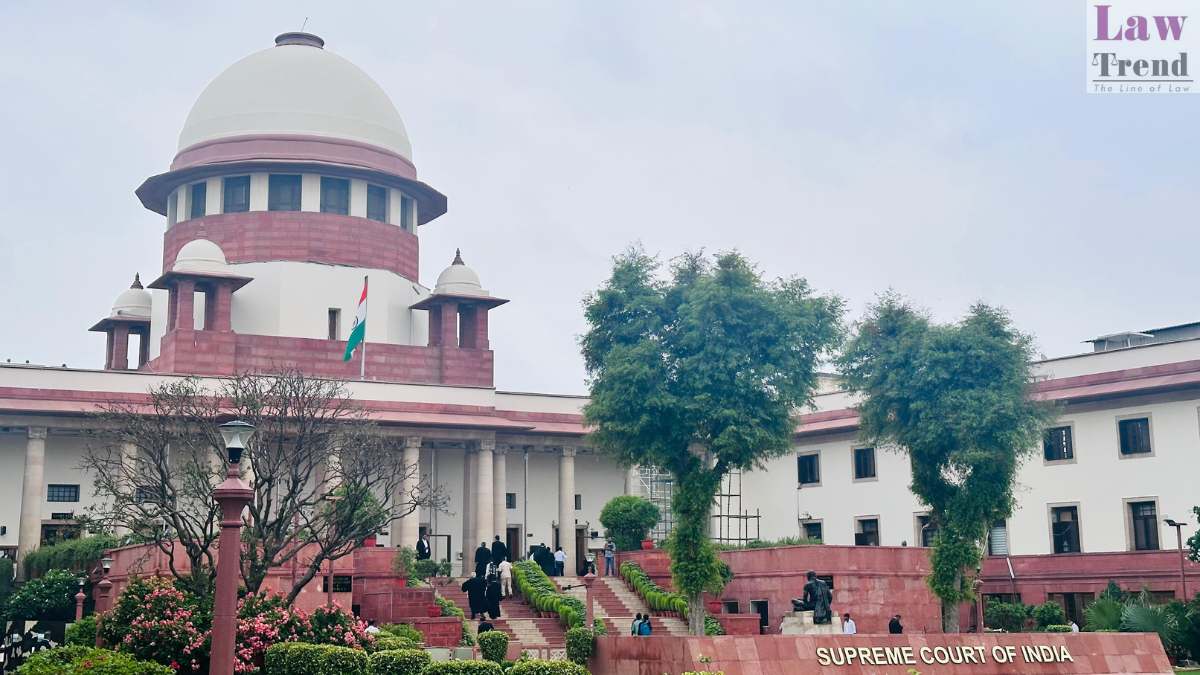
In a significant ruling clarifying the finality of tax settlements under Chapter XIX-A of the Income Tax Act, 1961, the Supreme Court of India has held that an Assessing Officer has no statutory jurisdiction to issue a reassessment notice under Section 148 in respect of an assessment year finalized by the Income Tax Settlement Commission. A Bench comprising Justice S.V.N. Bhatti and Justice N.V. Anjaria dismissed the appeal preferred by the Revenue against real estate developer M/s. Omaxe Limited, affirming that once a conclusive settlement order is rendered under Section 245D(4), the regular assessment and reassessment machinery under Section 147 stands permanently displaced, leaving the Revenue with no independent avenue to reopen the assessment other than establishing fraud or misrepresentation before the Commission itself under Section 245D(6).
Background of the Dispute
The respondent-assessee, M/s. Omaxe Limited, is a public limited real estate company. On September 22, 2005, the Revenue conducted search and seizure operations under Section 132 of the Income Tax Act, 1961, across the business and associate premises of the assessee and the residential premises of its directors. Following the search, on November 30, 2006, the assessee filed its return of income for the Assessment Year (AY) 2006-07, declaring a taxable income of Rs. 89,20,76,630/- after claiming a deduction of Rs. 78,99,00,509/- under Section 80IB(10) in relation to its housing projects.
While regular assessment proceedings were pending, the assessee approached the Income Tax Settlement Commission (ITSC) on May 31, 2007, filing an application under Section 245C for AY 2000-01 to 2006-07. On March 17, 2008, the ITSC passed a final settlement order under Section 245D(4). For AY 2006-07, the Commission accepted an additional income surrender of Rs. 18,00,000/- and determined the net taxable income at Rs. 89,38,76,630/- after factoring in the statutory deductions claimed under Section 80IB(10).
Subsequently, on December 17 and 18, 2009, the Investigation Wing of the Revenue conducted a survey under Section 133A at the assessee’s premises. During the survey, the department impounded minutes of a meeting attended by senior company executives and auditors, which allegedly indicated plans to transfer commercial portions of projects (such as Omaxe City Lucknow and Omaxe City Sonepat) to wholly owned subsidiaries to comply with the commercial built-up area caps under Section 80IB(10)(vi).
Relying on this survey material, the Assessing Officer issued a notice under Section 148 on June 30, 2010, proposing to disallow Section 80IB(10) deductions amounting to Rs. 55,58,96,486/- on the premise that commercial areas exceeded permissible statutory limits. The assessee lodged preliminary objections contending that the ITSC order dated March 17, 2008, was conclusive under Section 245-I, thereby barring reassessment. The Assessing Officer rejected these objections on October 3, 2011, and proceeded to pass a reassessment order on November 8, 2011, under Section 147 read with Section 143(3), adding back Rs. 65,65,17,999/- to the assessee’s total income.
Simultaneously, the Revenue moved an application under Section 245D(6) before the ITSC seeking to declare the settlement order void on allegations of misrepresentation. On December 16, 2011, the ITSC rejected the Revenue’s plea, finding no suppressed material facts or misrepresentation, and held that a divergence of view on what constitutes a project under Section 80IB(10) was a legal dispute.
The assessee challenged the reassessment notice and order before the High Court of Delhi in Writ Petition (C) No. 7975 of 2011. On July 13, 2012, the High Court quashed both the Section 148 notice and the reassessment order, holding that the settlement order had attained finality and left no jurisdiction with the Assessing Officer. The Revenue then appealed to the Supreme Court.
Arguments Before the Supreme Court
Appearing for the Revenue, learned Senior Counsel Mr. Arijit Prasad submitted that under Section 245C read with Section 245D, settlement proceedings are confined strictly to undisclosed income not previously disclosed to the Assessing Officer. It was argued that the assessee did not specifically disclose or approach the ITSC to adjudicate upon the deduction under Section 80IB(10). Therefore, the Revenue contended, the reassessment notice did not sit in appeal or reopen any issue concluded by the ITSC, as the escapement of income came to light only during the subsequent survey in December 2009. The Revenue relied upon the Supreme Court decision in CIT v. Damani Brothers (2003) 259 ITR 475 to argue that the ITSC lacks jurisdiction over matters not forming part of the settlement disclosure.
Opposing the appeal, learned Senior Counsel Ms. Kavita Jha, appearing for Omaxe Limited, contended that the Revenue misconstrued the statutory scheme of Chapter XIX-A. She pointed out that the settlement application in Form No. 34B accounted for the net taxable income after claiming statutory deductions under Section 80IB and offered additional tax on undisclosed income. The Settlement Commission admitted the plea, called for reports from the Commissioner, and finalized the total income after hearing both sides. Counsel stressed that under Section 245-I, orders passed under Section 245D(4) are conclusive, and the Assessing Officer is denuded of authority to reopen concluded matters. She emphasized that the Revenue’s only statutory remedy was an application under Section 245D(6), which had already been heard and rejected by the ITSC on December 16, 2011. The assessee placed reliance on Jyotendrasinhji v. S.I. Tripathi & Ors. (1993) Supp (3) SCC 389, CIT, Madras v. Express Newspapers Ltd. (1994) 2 SCC 374, Brij Lal & Ors. v. CIT, Jalandhar (2011) 1 SCC 1, and Kotak Mahindra Bank Ltd. v. CIT & Anr. (2023) 458 ITR 113 (SC).
Analysis of the Court and Statutory Framework
Examining the statutory design of Chapter XIX-A, the Supreme Court observed that settlement proceedings operate as an alternative dispute resolution mechanism that intersects with and temporarily overrides regular assessment proceedings under Sections 142 to 156.
The Court reviewed the explicit principles established in prior rulings:
- In Jyotendrasinhji, it was recognized that the finality clause under Section 245-I bars ordinary challenges, leaving judicial review under constitutional jurisdiction (Articles 226, 32, and 136) confined strictly to decision-making processes, bias, fraud, malice, or direct statutory contraventions.
- In Express Newspapers Ltd., the Court had settled that once an application is admitted under Section 245C, the Commission withdraws the entire case for that assessment year from the assessing authority, dealing with both disclosed and undisclosed income comprehensively.
- In Brij Lal, a Constitution Bench affirmed that Chapter XIX-A is a self-contained code aimed at the “settlement of liability” rather than a regular “determination of liability,” wherein the Commission assumes exclusive jurisdiction under Section 245F(2) upon admission.
- In Kotak Mahindra Bank Ltd., the Court reiterated the narrow scope of judicial review over the Commission’s discretionary orders, holding that courts cannot act as appellate bodies reassessing factual sufficiency.
The Court also agreed with the High Court’s reference to the Bombay High Court’s ruling in Major Metals Ltd. and the Allahabad High Court’s decision in CIT v. Smt. Diksha Singh, which held that the statute does not permit parallel or piecemeal assessments by different authorities for the same assessment year. The Bench noted that the Revenue’s reliance on Damani Brothers was misplaced, as that precedent addressed only the preliminary admission stage under Section 245D(1), whereas once an application is admitted, the Commission assumes plenary jurisdiction over the entire assessment year.
Characterizing the unique nature of the settlement forum, the Court observed:
“The facility of resolution through Chapter XIX-A can be said to be summed up as a purification of accounts from distorted, suppressed and misrepresented entries of income and expenditure by an Assessee. This is not a simple holy shower but an opportunity to purge by paying the tax, penalty, and interest as may be determined by the ITSC.”
Addressing the Revenue’s argument regarding Section 245C, the Bench held that the department ignored the statutory requirement that the assessee must disclose “the manner in which such income has been derived.” In the present case, the assessee had set out its gross total income and arrived at the net taxable income after claiming statutory deductions, which the ITSC approved after calling for a report from the Commissioner.
The Court emphasized that reopening avenues cannot be resurrected at the whim of the Assessing Officer once an order under Section 245D(4) attains finality:
“If the jurisdiction of the AO under Sections 143(2), 148, 154, etc., is made independent and available for exercise again, the finality attached to the Settlement Commission will be defeated. Parliament did not envisage this course.”
Illustrating the reciprocal bargain at the heart of the settlement framework, the Court explained:
“The Assessee and the Revenue must take the Crust and the Crumb together.”
The Bench elaborated that while the Revenue secures immediate tax realization on undisclosed income without prolonged litigation, the assessee obtains finality and immunity from penalties and prosecution. Once this compromise is reached, neither side can reopen closed issues:
“Once the crust is avoided and the crumb is accepted, further crust and crumb are not the intention of Chapter XIX-A of the Act, 1961.”
The Court highlighted that the Revenue’s sole remedy against an order obtained through suppression or false disclosure was under Section 245D(6). Having invoked that provision and failed before the Commission vide its order dated December 16, 2011—which attained finality—the Revenue was completely precluded from falling back on Section 148.
Decision of the Court
Finding no jurisdictional error in the judgment of the Delhi High Court, the Supreme Court held that the Assessing Officer had no authority to issue the Section 148 notice or pass the reassessment order dated November 8, 2011. The Civil Appeal filed by the Revenue was accordingly dismissed, and all pending applications were disposed of.
Case Title: Assistant Commissioner of Income Tax & Another v. M/s. Omaxe Limited
Case No.: Civil Appeal No. 9190 of 2013
Bench: Justice S.V.N. Bhatti and Justice N.V. Anjaria
Date: September 16, 2026




