

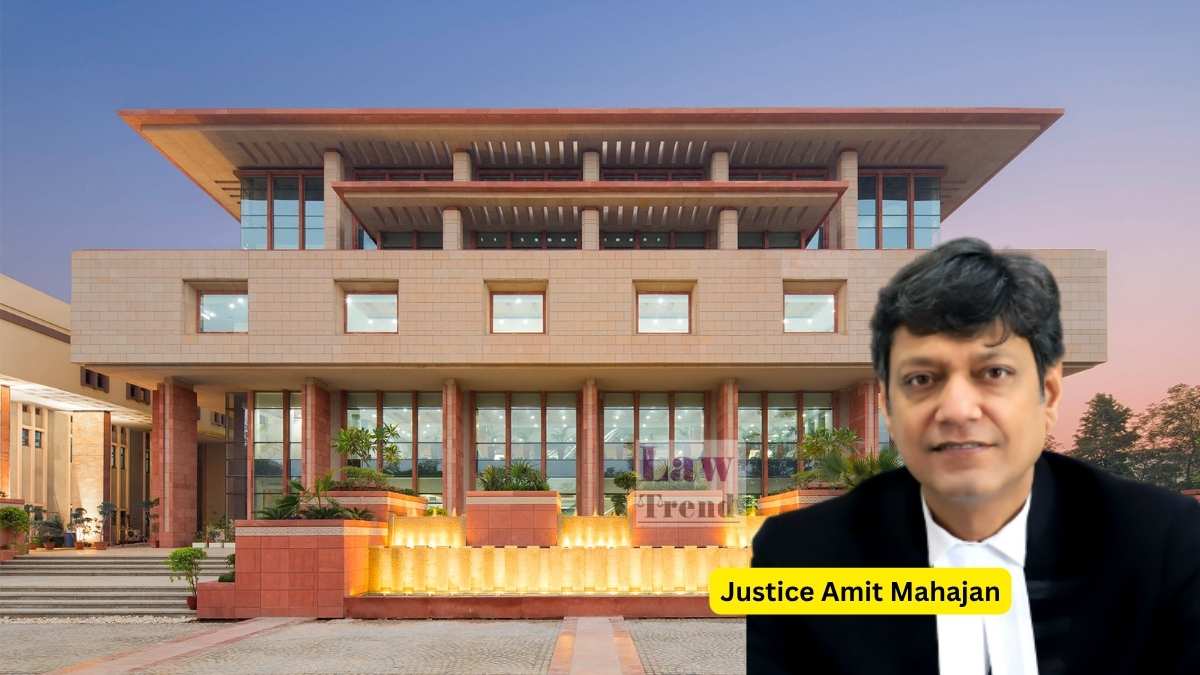
The Delhi High Court has held that landowners whose compensation has already been re-determined under Section 28A of the Land Acquisition Act, 1894 can claim the benefit of a subsequent enhancement granted by the High Court to similarly situated landowners. Justice Amit Mahajan allowed three connected appeals and held that the appellants were entitled to the enhanced compensation awarded by the High Court in Jamna v. Union of India & Ors.
The Court set aside the view of the Reference Court that an earlier re-determination under Section 28A, based on an award of the Reference Court, prevented the appellants from seeking the benefit of a later enhancement granted in appeal.
Background
The appellants, Sky High Agro Expo Pvt. Ltd., Monika Garg and Superb Agro Expo Pvt. Ltd., owned land in the Revenue Estate of Village Bakkarwala, Delhi. Their land was acquired pursuant to a Section 4 notification dated June 17, 2005 and a Section 6 notification dated May 31, 2006. The Land Acquisition Collector fixed the land value at ₹15,70,000 per acre under Award No. 1/DC(W)/2006-07.
Other landowners covered by the same notification and award sought references for higher compensation. In Kailashwati v. Union of India & Ors., the Additional District Judge, by a judgment dated April 26, 2010, enhanced compensation to ₹20,35,255 per acre along with statutory benefits. The appellants then moved separate applications under Section 28A seeking re-determination on the same basis.
While those applications remained pending, the Delhi High Court, in Jamna v. Union of India & Ors., decided on July 8, 2011, further enhanced compensation for land in Village Bakkarwala acquired under the same notification and award. After earlier writ proceedings, the Land Acquisition Collector eventually allowed the appellants’ Section 28A applications on May 29, 2013, but granted compensation only on the basis of Kailashwati, without extending the subsequent enhancement in Jamna.
The appellants consequently sought references under Section 28A(3). They claimed entitlement to compensation of ₹23,93,227.20 per acre in terms of Jamna. The Reference Court, however, rejected their claim, reasoning that they had already received the benefit of Section 28A on the basis of Kailashwati.
Arguments Before The High Court
Counsel for the appellants argued that their lands were situated in the same village and acquired under the same notification and award as the land involved in Jamna. It was contended that the earlier re-determination based on Kailashwati could not prevent them from receiving the benefit of the subsequent enhancement granted by the High Court.
The respondents opposed the appeals, contending that the compensation payable to the appellants had already been determined and the decision had attained finality. They further submitted that the appellants had already received fair market value and there was no justification for another enhancement.
High Court Finds Reference Court’s Approach Incorrect
The High Court held that the Reference Court had erred in relying upon Girimallappa v. Special Land Acquisition Officer M and MIP and another. The appellants’ applications under Section 28A(1) had already been allowed and that determination had attained finality because the respondents did not challenge it.
The Court pointed out that the question before the Reference Court was not whether the appellants were initially entitled to invoke Section 28A(1), but whether they could receive further enhancement following the subsequent High Court judgment.
The High Court relied on the Supreme Court’s 2026 judgment in Andanayya and Others v. Deputy Chief Engineer and Others, where the Supreme Court held that even a second Section 28A application after an award of the High Court is maintainable. The Supreme Court had also held that receipt of compensation on an earlier Section 28A application based on the Reference Court’s award does not bar further re-determination following enhancement by the High Court or Supreme Court.
Referring to the doctrine of merger and the objective of maintaining parity among similarly placed landowners, the Supreme Court had observed:
“Ultimately, the object of Section 28-A of the Act is to maintain parity and equality between the similarly placed landowners in the payment of compensation.”
Applying that principle, the Delhi High Court held that the legal position was settled that a person satisfying the requirements of Section 28A is entitled to the same relief granted to other landowners who obtain enhanced compensation in further appeals.
The Court observed:
“Thus, since the appellants have already been held to be entitled to compensation under Section 28A of the LA Act, they shall also be entitled to the enhanced compensation awarded to similarly situated persons.”
Decision
The High Court held that all three appellants were entitled to the enhanced compensation granted by the coordinate Bench in Jamna v. Union of India & Ors. The appeals were accordingly allowed with consequential reliefs, and all pending applications were disposed of.
Case Details
Case Title: Sky High Agro Expo Pvt. Ltd. v. Union of India & Anr. and connected matters
Case No.: LA.APP. 76/2019, LA.APP. 77/2019 & LA.APP. 78/2019
Bench: Justice Amit Mahajan
Date: September 14, 2026




