

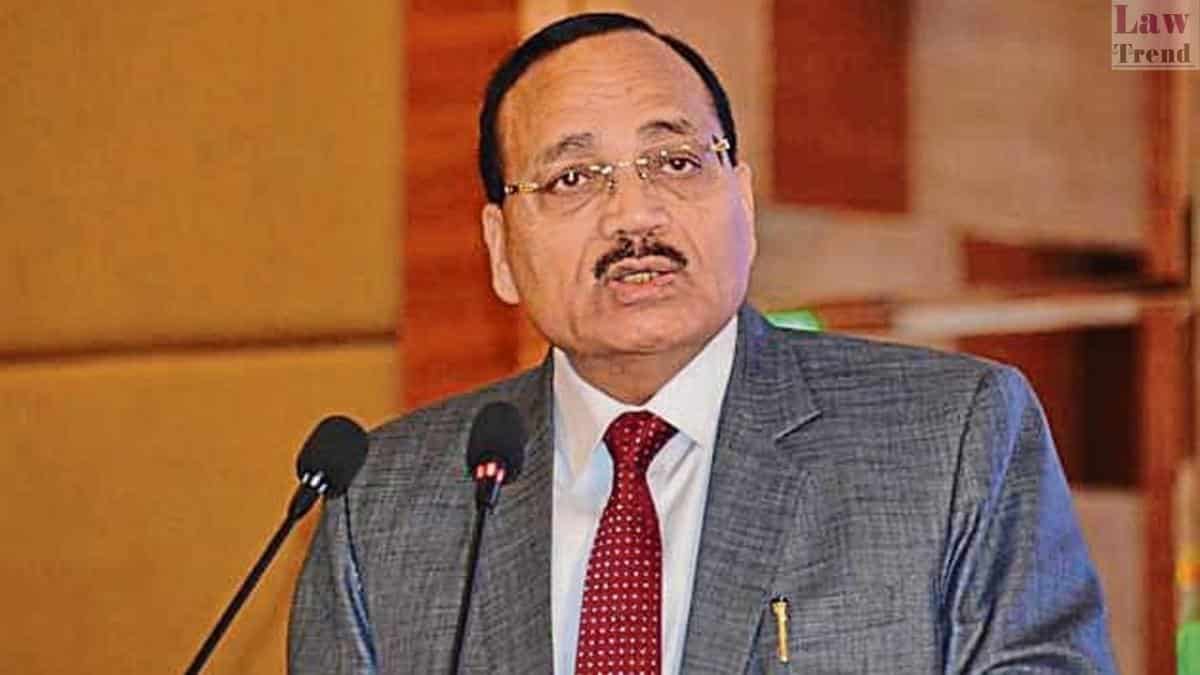
Chief Justice of India Surya Kant on Monday defended the administrative procedures governing judicial conduct, stating that the Supreme Court and high courts maintain a robust, responsive, and prompt internal framework to address complaints filed against judges.
Speaking in the national capital at the Sixth Ram Jethmalani Memorial Lecture, titled “Justice Seen to Be Done: Transparency and Public Trust as Pillars of the Legal System,” the Chief Justice emphasized that institutional evolution must remain an enduring priority, while cautioning against subjecting every allegation to public disclosure.
His remarks followed interventions by senior advocates Mahesh Jethmalani and Harish Salve, who raised issues regarding administrative accountability within the judiciary during the event. Jethmalani specifically pointed to the controversy involving former Delhi High Court judge Justice Yashwant Varma, whose official premises yielded wads of burnt currency notes during an inquiry last year. Justice Varma subsequently resigned in April while facing impeachment proceedings for his removal on corruption charges.
Internal Accountability Versus Public Disclosure
Responding to the debate on oversight, Justice Kant acknowledged that no institution can sustain itself or take pride in remaining rigid, reiterating that reform must always serve as the guiding standard. However, he maintained that judicial duties inherently draw grievances, noting that litigants routinely raise objections whether a judge delivers a preliminary interlocutory ruling or a conclusive decree.
The Chief Justice stated that whether each of these grievances should be published on an online portal remains a deeply debatable question. He argued instead for preserving a well-established, dispassionate internal apparatus capable of evaluating claims with complete objectivity and responsibility, while remaining open to ongoing qualitative enhancements.
Scrutiny And The Nature Of Judicial Transparency
Addressing public evaluation of the courts, Justice Kant recalled a recent Supreme Court observation affirming that the legal system does not resist scrutiny. He observed that balanced, well-informed, and constructive criticism represents an essential component of a constitutional democracy that aids institutional correction. A court, he noted, cannot cultivate public confidence if it shields itself from external examination.
Clarifying the definition of transparency, the Chief Justice explained that open proceedings and accessible courtrooms alone do not fulfill the requirement. He stressed that genuine institutional openness requires that the rationale underlying any ruling—and not merely the final verdict—remains fully accessible to public inspection, especially to litigants who do not receive a favorable outcome.
Earning Public Trust Through Fair Process
Justice Kant further distinguished public trust from popular satisfaction, pointing out that judicial credibility is not generated by dispensing preferred results or courting public favor. Instead, he noted, trust develops when unsuccessful parties depart the courtroom convinced that their matters were adjudicated through an equitable and unbiased procedure.
Touching upon structural accessibility, the Chief Justice acknowledged that traditional court procedures have frequently presented steep procedural complexities that disproportionately favored affluent litigants who could engage specialized legal counsel. While admitting the historic disconnect between courts and ordinary citizens, he stated that technological initiatives under the e-Courts project have begun bridging this gap.
Concurring that access is incomplete without prompt adjudication, Justice Kant described public confidence as the sole foundation of institutional legitimacy, describing it as the only currency in which authority is transacted.
Paying tribute at the lecture, the Chief Justice also remembered late senior advocate Ram Jethmalani as an eminent legal figure whose career was deeply intertwined with the development of Indian law.




