

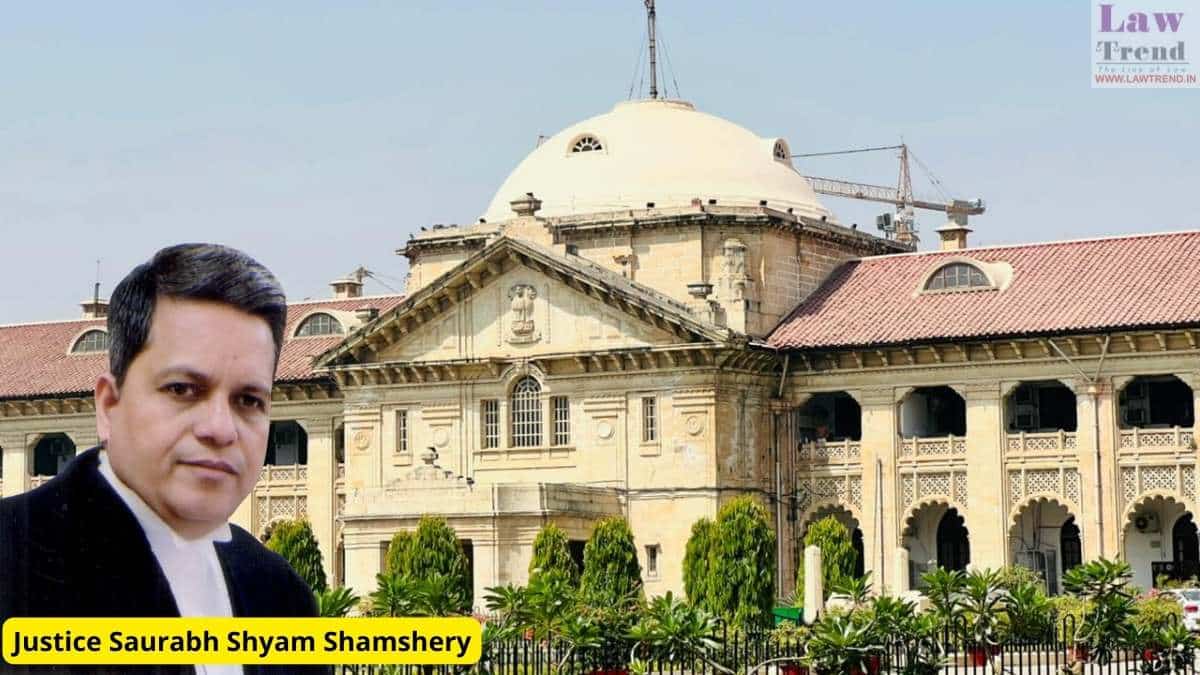
The Allahabad High Court has held that the absence of permission to institute a suit in a representative capacity under Order 1 Rule 8 of the Code of Civil Procedure (CPC) does not entail the outright dismissal of the suit, but merely restricts the binding nature of the final outcome inter se to the parties to the litigation. Delivering the verdict, Justice Saurabh Shyam Shamshery dismissed a 45-year-old second appeal filed by a defendant-purchaser, affirming the concurrent findings of the lower courts that an entire 18.14-acre land had functioned as a Muslim graveyard for over 300 years and could not be claimed for private construction.
Background of the Dispute
The litigation originated from an original suit filed in 1970 by plaintiff-respondents on behalf of the local Muslim community of Kasba Mahoba and Mauja Fatehpur Bajariya. The plaintiffs instituted the suit claiming that plot no. 262/4/1, measuring 18.14 acres, had been continuously used as a Muslim graveyard for more than 300 years and contained numerous graves. They sought an injunction to restrain the defendant-appellant, Babu Lal, from excavating trenches or raising unauthorized construction on the disputed parcel. Although the plaint expressly asserted that the suit was being preferred in a representative character under Order 1 Rule 8 CPC to protect the religious and burial rights of the community, no formal permission under Order 1 Rule 8 CPC was ever sought from or granted by the Trial Court.
The defendant opposed the claim, asserting that he had purchased the land and had lawful authority to carry out construction. He contended that the land had never been utilized as a graveyard, or at most, that such use was confined to an insignificant portion.
The Trial Court initially partly decreed the suit on January 29, 1976, carving out areas for the graveyard and for the defendant. On appeal, the District Judge, Hamirpur set aside that decree on October 5, 1977, and remanded the suit for fresh adjudication. Upon rehearing, the Trial Court on April 26, 1978, decreed the suit in its entirety, concluding that the full 18.14 acres stood dedicated as a graveyard. The defendant’s first appeal was subsequently dismissed on March 2, 1981, with the appellate court affirming the spot inspection reports which demonstrated that graves were spread across the entire property, that revenue entry omissions do not extinguish dedication to God, and that absence of fresh burials for decades does not terminate customary burial rights. Aggrieved, the defendant filed the second appeal before the High Court in 1981.
Submissions of the Parties
Before the High Court, counsel for the appellant conceded that the two questions of law framed at the time of admission in 1981 were mixed questions of fact and law. He instead urged a fresh substantial question of law regarding maintainability:
“Whether in absence of a permission for filing a suit under representative capacity, as required under Order 1 Rule 8 C.P.C., it would only result in dismissal of a suit filed under representative capacity?”
Relying on the Supreme Court ruling in Kalyan Singh vs. Smt. Chhoti and others, the appellant argued that because the plaintiffs specifically declared the suit to be in a representative capacity under Order 1 Rule 8 CPC, the absence of mandatory leave rendered the suit defective and liable to dismissal at the threshold.
Opposing the plea, counsel for the plaintiffs-respondents argued that this technical objection had never been raised before either the Trial Court or the First Appellate Court and could not be permitted for the first time in a second appeal. He further emphasized that both courts below had thoroughly adjudicated the suit on its merits, relying on material evidence and spot inspection reports establishing the continuous, exclusive use of the property as a graveyard.
The Court’s Analysis
Addressing the threshold test for second appeals under Section 100 CPC, the Court referred to the Supreme Court decisions in Rabindranath Panigrahi vs. Surendra Sahu and Sheikh Mohd. Murtaza vs. Sheikh Wajid Ali, alongside the landmark Constitution Bench principles in Sir Chunilal V. Mehta & Sons Ltd. v. Century Spg. & Mfg. Co. Ltd. and Hero Vinoth v. Seshammal. The Court reiterated that where legal principles are well-settled and the issue merely involves their application to particular facts, no substantial question of law arises.
Examining the merits of the Order 1 Rule 8 CPC objection, the High Court relied directly on the Supreme Court’s ruling in Hari Ram vs. Jyoti Prasad and another, which had analyzed Kalyan Singh vs. Smt. Chhoti. The Court highlighted that any affected individual or member of a community can initiate an action to protect community property or seek removal of an encroachment without mandatorily complying with the formalities of Order 1 Rule 8 CPC.
Justice Shamshery observed:
“As referred above, purpose of Order 1 Rule 8 C.P.C. is that if the permission is sought and granted the suit will be considered to be filed in representative capacity and in case permission is rejected, it would be considered that outcome of suit will be final between parties only.”
Applying this legal position to the dispute, the Court ruled:
“Therefore, when in the present case though suit was filed purportedly under the provisions of Order 1 Rule 8 CPC but since no permission was sought, therefore, no permission was granted and, therefore, suit shall be considered to be filed by plaintiffs only and list shall remain between parties to suit only. The suit will not be considered to be filed in representative capacity or for entire Muslim community. Therefore, question of law sought to be framed cannot be framed since not being a substantial question of law. In case no permission is granted under Order 1 Rule 8 CPC or not sought, the only effect would be that outcome of suit will be final between the parties to suit only.”
The Court also observed that both lower courts had minutely evaluated the factual record, witness depositions, and commissioner inspection reports confirming that graves were present across the entire 18.14 acres and that it had been used as a Muslim graveyard for centuries, finding no perversity or illegality in those concurrent conclusions.
Final Decision
Holding that the proposed plea did not constitute a substantial question of law and that the factual findings of the courts below suffered from no illegality, the High Court dismissed the second appeal.
Case Details: Case Title: Babu Lal v. Shahabuddin And Others
Case No.: Second Appeal No. 1289 of 1981
Bench: Justice Saurabh Shyam Shamshery
Date: September 10, 2026




