

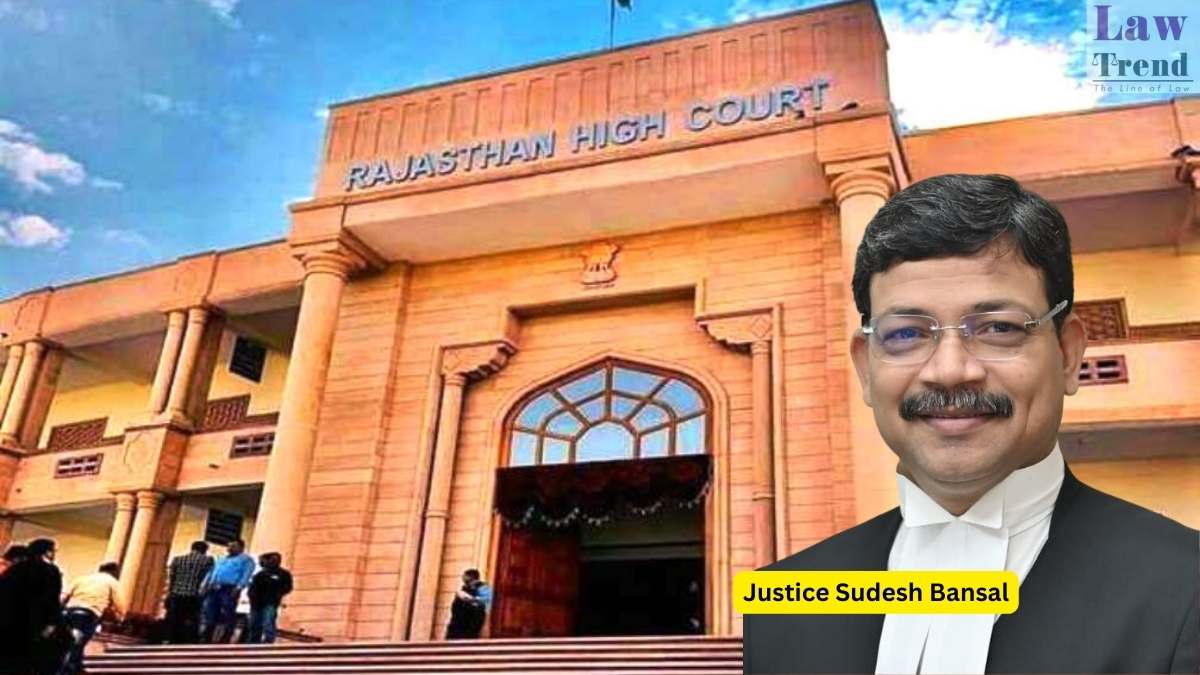
The Rajasthan High Court has ruled that the statutory bar under Order XXIII Rule 3A of the Code of Civil Procedure, 1908 (CPC), which prohibits a separate suit to challenge a compromise decree, applies only to parties to the suit or compromise and does not preclude a stranger claiming independent rights from instituting an independent civil suit. In an order passed by Justice Sudesh Bansal, the court held that while a party on record who disputes a compromise must first approach the trial court under the proviso to Order XXIII Rule 3 CPC, a third party whose rights are prejudiced has the option to file an independent civil suit, file an appeal under Section 96 CPC after obtaining leave of the court, or approach the trial court under Section 151 CPC. Consequently, the High Court held that a trial court acting under Section 151 CPC cannot adjudicate complex, disputed questions of marital status and inheritance rights, setting aside such factual findings as perverse and without jurisdiction.
Background of the Case
The dispute arose in respect of the self-earned immovable properties left behind by late Shri Dinesh Mishra, who died intestate on August 21, 2024. Following his death, his sister, Sushila Maharshi (Respondent No. 1), instituted a civil suit for partition and permanent injunction against his surviving brother, Shyam Manohar Lal Mishra (Respondent No. 2), and the legal heirs of another deceased brother (Respondents No. 3 to 5). The plaintiff pleaded that the deceased left behind no natural Class-I heirs under the Hindu Succession Act, 1956, and that the parties, as Class-II heirs, were entitled to equal one-third shares.
During the partition suit, the respondents entered into a written compromise on October 19, 2024. Based on this agreement, the Additional District and Sessions Judge No. 6, Jaipur Metropolitan-II, decreed the suit on November 25, 2024. In the order recording the settlement, the trial court specifically noted that the compromise would bind only the parties to the suit and their legal representatives, and would not affect the rights of any third party.
Subsequently, the petitioner, Kusum Sharma, moved an application under Section 151 CPC on December 20, 2024, seeking to set aside the compromise decree. She asserted that she was the legally wedded wife and sole surviving Class-I heir of the deceased, thereby solely inheriting the suit properties. She alleged that the respondents had colluded behind her back to partition the estate without impleading her.
The respondents resisted the application, contending that the deceased had married one Smt. Sudha Mishra in 1984, which marriage was dissolved by mutual consent by the Family Court under Section 13-B of the Hindu Marriage Act, 1955, on September 12, 2019. They denied that the petitioner had ever married the deceased or acquired the status of his wife, pointing out that in his death certificate, the wife’s name was recorded as “Smt. Sudha Mishra.”
On May 31, 2025, the trial court dismissed the petitioner’s application on the merits, recording a finding of fact that she had failed to establish her marriage with the deceased after the dissolution of his prior marriage on September 12, 2019. Aggrieved, the petitioner approached the High Court under Article 227 of the Constitution of India.
Arguments of the Parties
Counsel for the petitioner contended that the compromise decree directly prejudiced her rights and title in the suit properties. Relying on the Supreme Court ruling in Triloki Nath Singh v. Anirudh Singh (D) through LRs., counsel submitted that since statutory provisions under Order XXIII Rule 3A and Section 96(3) CPC bar an independent suit or appeal against a consent decree, an application under Section 151 CPC before the decreeing court was her only remedy. The petitioner asserted that she had married the deceased in 1996 and had remarried him in September 2019 following the formal dissolution of his earlier marriage, placing reliance on a ration card, Aadhaar card, a 2009 sale deed, and police statements.
Conversely, senior counsel and counsel appearing for the respondents argued that the petitioner failed to prove any lawful marriage ceremony solemnized after September 12, 2019, under Hindu rites and customs. They argued that the claim of remarriage was an unpleaded afterthought. Moreover, respondents contended that because the petitioner was neither a party to the partition suit nor a party to the compromise, her application under Section 151 CPC was not maintainable. They submitted that her appropriate course, if any, was to file an independent title suit rather than seeking to undo an inter se compromise that already protected third-party rights.
Analysis of the Court
The High Court observed that the deceased died intestate leaving self-earned properties, meaning succession is governed by the Hindu Succession Act. The court noted that the admitted dissolution of the deceased’s earlier marriage on September 12, 2019, made it incumbent upon the petitioner first to establish that she contracted a valid marriage after that date before claiming status as a Class-I heir.
Justice Bansal held that had the factum of marriage been undisputed, an application under Section 151 CPC challenging the compromise as unlawful might have been maintainable. However, once marital status became a highly disputed question of fact, it generated an independent cause of action requiring full adjudication upon evidence in a regular civil suit. The court found that the trial court exceeded its jurisdiction by delving into and determining such complex questions of fact within the summary confines of an application under Section 151 CPC.
The court then comprehensively delineated the legal framework governing challenges to compromise decrees, distinguishing between remedies available to parties on record and remedies available to strangers.
Civil Remedies Available to a Party to the Compromise Decree
The court clarified that following the CPC Amendment Act 104 of 1976:
- An independent suit by a party to challenge a compromise decree is expressly barred under Order XXIII Rule 3A CPC.
- Any party disputing the compromise on grounds of lawfulness, voidness, fraud, want of authority, or other vitiating elements must approach the trial court under the proviso to Order XXIII Rule 3 CPC.
- A first appeal under Section 96(1) CPC read with Order XLIII Rule 1A CPC is maintainable only sequentially, after the trial court has adjudicated upon and recorded findings regarding the validity of the compromise. When the factum of compromise is not disputed, the absolute bar under Section 96(3) CPC operates.
Civil Remedies Available to a Third Party
Addressing the rights of strangers to the litigation, the court held:
“Thus, it can safely be held that a person who is not a party to the suit or compromise decree, nor derives any right, title or interest in the properties through any of the parties to the suit or compromise decree, rather claims right, title or interest in the properties independently, yet is aggrieved by the compromise decree, may avail the civil remedies against the compromise decree, (i) either by way of filing an independent suit and/ or (ii) by way of filing an appeal under Section 96 CPC, after obtaining leave of the Court, or (iii) may also approach the same Court which recorded the compromise and passed the compromise decree, by way of filing an application under Section 151 CPC, purportedly invoking the scope within the proviso to Order XXIII Rule 3 CPC, at his/her option and wisdom, according to facts and circumstances of the case.”
The court held that neither Order XXIII Rule 3A CPC nor Section 96(3) CPC bars a third party from seeking legal redress.
In drawing these distinctions, the High Court relied directly on the Supreme Court’s pronouncement in Sakina Sultanali Sunesara (Momin) v. Shia Imami Ismaili Momin Jamat Samaj & ors. (2025), where the Apex Court observed that post-1976 CPC provisions create two distinct tracks: parties to the suit must return to the trial court under the proviso to Order XXIII Rule 3 CPC, whereas non-parties whose rights are affected may approach the appellate court under Section 96 with leave, or seek other established civil remedies.
The court also cited with approval the Karnataka High Court decision in Sushila v. Vijay Kumar (2020), which emphasized:
“Thus, the bar contemplated under Rule 3A would be applicable only to the persons who were parties to the compromise thereby meaning parties to the suit and it would have no application to the persons who are not parties to the suit.”
“If the arguments of the Learned Counsel were to be accepted, then a compromise entered into between two parties to a suit, would bind not only the parties to the compromise but also to all other persons who may possess an independent and distinct right over the property, which was the subject matter of the compromise, even if they are not parties to a compromise. This would result in an anomalous result and nullify the rights of persons who have an independent right over the property which was the subject matter of a compromise and that cannot be the intent of the law.”
Addressing the petitioner’s reliance on Triloki Nath Singh v. Anirudh Singh (D) through LRs. (2020), the High Court explained that in Triloki Nath Singh, the appellant claimed rights derived from a judgment debtor who was already a party to the suit, which is why an independent suit was barred. The Apex Court had not restricted strangers asserting independent titles from pursuing a regular civil suit. The court noted that other precedents—including Banwari Lal v. Smt. Chando Devi (1993), Pushpa Devi Bhagat (D) v. Rajinder Singh (2006), R. Rajanna v. S.R. Venkataswamy (2014), R. Janakiammal v. S. K. Kumarasamy (2021), and M/s. Sree Surya Developers and Promoters v. N. Sailesh Prasad (2022)—reiterate that the bar against a fresh suit restricts only the parties to the compromise decree, not independent third parties.
Decision of the Court
The High Court concluded that the petitioner’s application under Section 151 CPC to set aside the compromise decree was unmaintainable because she could not challenge the decree without first establishing her status as the legally wedded wife, an issue outside the scope of the proviso to Order XXIII Rule 3 CPC.
While sustaining the ultimate dismissal of the Section 151 CPC application, the High Court held that the trial court had committed manifest illegality, jurisdictional error, and perversity in adjudicating and rendering findings on the petitioner’s marital status. The High Court declared those findings to be without jurisdiction and perverse, expressly leaving the question of her locus standi and marital status open.
The court clarified that if the petitioner pursues appropriate legal remedies to establish her status and property rights, the respondents may raise all available legal objections, and the matter will be adjudicated on its own merits without being influenced by the trial court’s order or the High Court’s observations.
With these directions and liberties, the writ petition was disposed of, and the interim stay order dated September 16, 2025, was vacated.
Case Title: Kusum Sharma v. Sushila Maharshi and Others
Case No.: S.B. Civil Writ Petition No. 13175/2025
Bench: Justice Sudesh Bansal
Date: 31/08/2026




