

Quo Warranto Inapplicable If Appointee Possesses Minimum Statutory Eligibility; Supreme Court Orders Fresh Inquiry Into Allegedly “Fake” Ph.D. Under Article 142
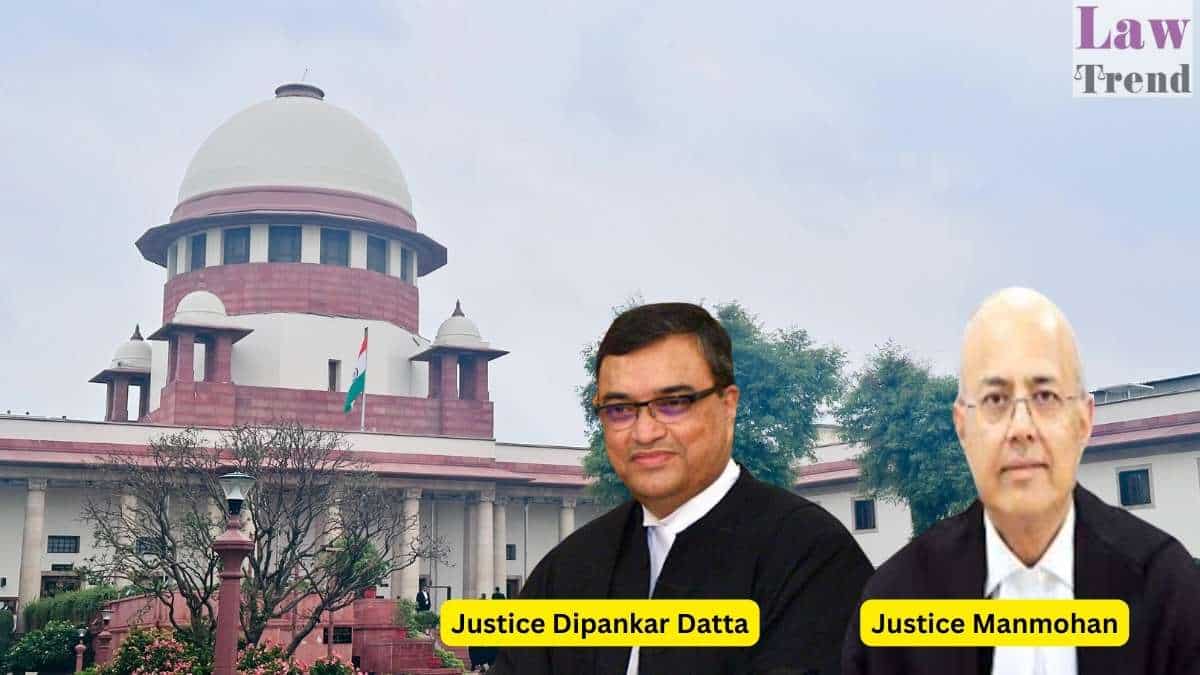
A writ of quo warranto cannot be issued to oust an appointee who possesses the mandatory minimum statutory eligibility for a public office, the Supreme Court has held, even as it invoked its extraordinary powers under Article 142 of the Constitution to direct an inquiry into allegations that an Assistant Professor secured appointment using a forged Ph.D. degree. A Bench comprising Justice Dipankar Datta and Justice Manmohan affirmed the Punjab and Haryana High Court’s dismissal of a challenge brought by unsuccessful candidates, ruling that because the candidate had qualified the UGC-NET examination, he fulfilled the baseline eligibility criteria prescribed for the post.

Background

The dispute stems from a recruitment notification issued on February 14, 2018, by Sat Jinda Kalyana College in Rohtak, Haryana, affiliated with Maharshi Dayanand University. The college advertised a vacancy for the post of Assistant Professor in Physical Education. The appellants, along with the sixth respondent and 17 other candidates, applied for the position. Upon completion of the selection process, the sixth respondent emerged as the most-qualified candidate and was appointed to the post, whereas the appellants failed to figure in the merit list.

Following the appointment, the brother of the first appellant filed an application under the Right to Information Act, 2005, inquiring into the authenticity of the sixth respondent’s Ph.D. degree from Bundelkhand University, Jhansi. In its response dated July 11, 2018, Bundelkhand University stated that the sixth respondent had never attended any Ph.D. course there, as no Ph.D. programme was conducted by the university between 2011 and 2014—the period during which the candidate claimed to have obtained his doctorate.

The appellants then approached the High Court of Punjab and Haryana seeking a writ of quo warranto, asserting that the appointee had usurped public office through a forged doctorate. Both a Single Judge bench and subsequently a Division Bench dismissed their challenge, prompting the appellants to appeal before the Supreme Court.

Proceedings Before the High Court

Before the High Court, the Single Judge dismissed the writ petition after considering Maharshi Dayanand University’s counter-affidavit, which stated that an independent verification had found the Ph.D. degree to be in order. The Single Judge observed that the recruitment criteria published by the Government of Haryana required a candidate to either possess a Ph.D. or be qualified in the UGC-NET examination. As the sixth respondent had undisputedly cleared the UGC-NET—a qualification that stood unchallenged—he fulfilled the eligibility criteria irrespective of the Ph.D. dispute. The Single Judge noted that these averments remained uncontroverted by the appellants.

READ ALSO  Order VII Rule 11 CPC: Plaint Cannot be Rejected Merely Due to Inconsistencies in Averments, Rules SC

On intra-court appeal, the Division Bench dismissed the challenge on the grounds of maintainability and locus standi. It observed that the appellants did not figure among the top three recommended candidates on the merit list and held that unsuccessful candidates could not invoke the extraordinary jurisdiction of quo warranto to redress personal grievances arising from a selection process. The Division Bench rested its reasoning on established precedents, including A.N. Shastri v. State of Punjab, R.K. Jain v. Union of India, Dr B. Singh v. Union of India, and B. Srinivasa Reddy v. Karnataka Urban Water Supply & Drainage Board Employees Association.

Legal Analysis and Findings on Quo Warranto

Examining the statutory framework, the Supreme Court evaluated the minimum qualifications governing the recruitment. The Bench noted that although the University Grants Commission filed a counter-affidavit annexing the UGC Regulations, 2018, those regulations came into effect on July 18, 2018—subsequent to the recruitment advertisement dated February 14, 2018. Consequently, the earlier 2010 Regulations applied. Under the 2010 framework, qualifying the UGC-NET or accredited tests (SLET/SET) served as the mandatory minimum qualification, while candidates holding a Ph.D. in accordance with the UGC Ph.D. Regulations, 2009 were exempted from NET/SLET/SET.

On the nature of a writ of quo warranto, the Court held:

“To seek and succeed in a proceeding for a writ or in the nature of quo warranto, it is absolutely necessary for the writ petitioner, who could even be a stranger, to establish that an appointee, not having the requisite qualification for occupying a public office or suffering from such other disability, thereby attracting a disqualification to hold such office, was appointed and, in the process, has usurped a public office.”

The Bench explained that a writ petitioner must discharge the initial burden of proof by producing unimpeachable evidence, which then shifts the onus onto the appointer and appointee to demonstrate the legality of the process. Applying this principle, the Supreme Court found that a Ph.D. was merely a desirable qualification that conferred 10 additional marks, rather than an indispensable requirement, since the appointee held a valid UGC-NET qualification. The Court observed:

“Thus, in the absence of a Ph. D. degree, the aspirants were mandatorily required to qualify the UGC-NET examination which the sixth respondent did, in fact, qualify. Ergo, by no stretch of reasoning can it be concluded that he lacked a mandatory qualification; although, we hasten to observe that it is quite possible that he stole a march over the second and the third candidates in the merit list by dint of marks being awarded for the questionable Ph. D. degree.”

Because the appellants did not rank in the top positions and the essential statutory eligibility was satisfied, the Supreme Court affirmed the High Court’s refusal to issue a writ of quo warranto.

Article 142 Directions and Inquiry Into “Fake and Farzi” Degree

While refusing to quash the appointment directly in quo warranto proceedings, the Supreme Court expressed grave concern over materials produced before it. Pursuant to an order dated January 24, 2025, the Registrar or Controller of Examinations of Bundelkhand University had filed an affidavit before the Court. The Bench observed that the contents of this affidavit “would seemingly leave none in doubt that the degree claimed by the fourth respondent is ‘fake and farzi.'” Bundelkhand University also asserted that a verification letter dated September 15, 2018, and an accompanying certificate were forged and fabricated.

READ ALSO  Allahabad HC Refuses to Probe CBI in Killing of Gangster Jeeva in Lucknow Court Premises

Emphasizing that it could not ignore these disclosures, the Bench exercised its plenary jurisdiction under Article 142 of the Constitution:

“If the sixth respondent has indeed secured an appointment by deceit, at the very inception of the process, mere disposal of these appeals without any positive order as claimed by the appellants will not be a protective shield for such appointment to be sustained.”

The Court granted full liberty to Maharshi Dayanand University to conduct a fresh inquiry “to sift the grain from the chaff.” Under the Court’s directives, the inquiry must adhere to the principles of natural justice:

  • The sixth respondent must produce his original Ph.D. degree in the presence of Bundelkhand University officials.
  • Bundelkhand University officials must produce the documentary evidence supporting their affidavit.
  • The sixth respondent must be afforded an effective defense and the right to cross-examine witnesses.
READ ALSO  नागालैंड शहरी स्थानीय निकाय चुनाव: सुप्रीम कोर्ट ने केंद्र से पूछा कि क्या संवैधानिक योजना का उल्लंघन किया जा सकता है

The Supreme Court further clarified that if the inquiry establishes that the Ph.D. degree is forged, it shall be open to Maharshi Dayanand University, Sat Jinda Kalyana College, Bundelkhand University, or any other person to lodge a police complaint to prosecute the sixth respondent under criminal law.

With these directions, the appeals stood disposed of, leaving the parties to bear their own costs.

Case Title: Annu Kumar & Anr. Versus Maharshi Dayanand University Rohtak & Ors.
Case No.: Civil Appeal Nos. of 2026 (@ Special Leave Petition (C) Nos. 24737-24739/2023)
Bench: Justice Dipankar Datta and Justice Manmohan
Date: September 08, 2026

Law Trend
Law Trendhttps://lawtrend.in/
Legal News Website Providing Latest Judgments of Supreme Court and High Court

Related Articles

Latest Articles
