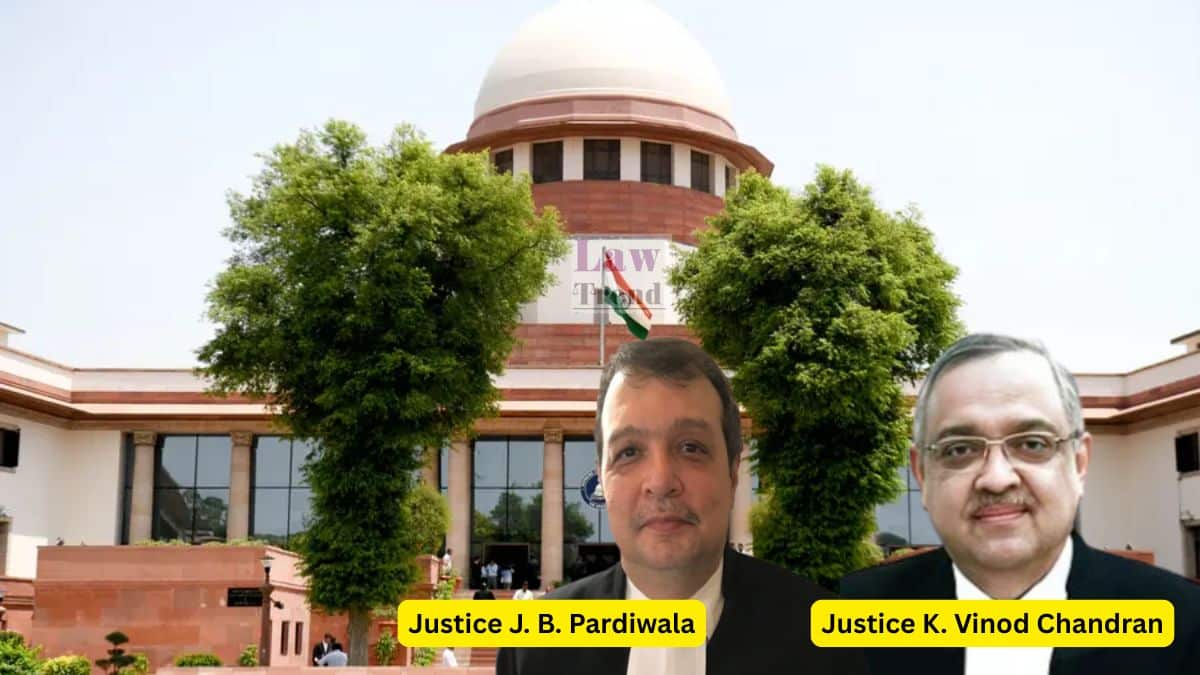
The Supreme Court has set aside the conviction and sentence of an accused convicted of kidnapping and murder, ruling that the prosecution’s failure to establish ownership of the apartment or tenancy of the accused completely dismantles the adverse presumption under Section 106 of the Indian Evidence Act, 1872. A Bench of Justice J.B. Pardiwala and Justice K. Vinod Chandran held that apart from the post-mortem report and the recovery of the body, there was no substantive evidence connecting the appellant to the murder or to the flat where the body was discovered.
Background of the Case
The prosecution’s case began when a person left his home for Hyderabad and became unreachable by phone the following day. Two days later, his father (PW1) received a ransom call directing him to deposit Rs. 2,00,000 in a bank account. PW1 subsequently lodged a police complaint (Exhibit P1) and deposited Rs. 1,50,000 into a bank account opened under the name of Geetanjali.
The Investigating Officer (PW11), upon analyzing call details between two telephone numbers, arrested accused A6. Following his arrest, A6 allegedly pointed out Flat No. 402 at ARK Residency in Uppal, where the missing person’s body was recovered tucked away inside a refrigerator. A6 also confessed to the complicity of five others (A1 to A5).
Six individuals were arrayed as accused. A4 died during the trial, while the Trial Court convicted and sentenced A1, A2, A3, A5, and A6. On appeal, the High Court acquitted A2, A3, A5, and A6, but confirmed the conviction and sentence of A1 based on the testimony of a watchman (PW3) and the adverse inference under Section 106 of the Evidence Act for failing to explain the presence of the body in the leased apartment. A1 subsequently appealed to the Supreme Court.
Story Based Solely on Uncorroborated Confessions
The prosecution alleged that A1 was a habitual offender who met A4 in jail, resided in Siricilla, and entered politics. It was alleged that A1 formed an intimate relationship with A2, who was a tenant of the deceased. A1 and A2 allegedly conspired to kidnap the victim for ransom because his father was affluent. Later, A1 reportedly married A3, and alongside A3 to A6, hatched the plan that resulted in the kidnapping and murder.
The Supreme Court rejected this narrative outright, observing:
“We have to immediately notice that there was nothing to substantiate the above story but for the confessions, which definitely cannot be relied on to inculpate any of the accused.”
Earlier Findings and Discarded Evidence
The High Court had previously discredited multiple aspects of the prosecution’s case:
- ATM CCTV Footage: The footage showing withdrawal of funds could not be relied upon because the accused could not be identified from it, and no mandatory certificate under Section 65B of the Evidence Act was produced.
- Call Records: Call details produced by the Investigating Officer could not be considered as the Nodal Officer was not examined and no Section 65B certificate was brought on record.
- Test Identification Parade (TIP): The TIP of A1, A3, and A5 was deemed untrustworthy because PW3 admitted during his testimony that police showed him photographs of the suspects before taking him to the jail for identification.
Court’s Analysis: Breakdown of Section 106 and Last Seen Circumstances
In scrutinizing the remaining grounds relied upon by the High Court—the testimony of PW3 and the application of Section 106 of the Evidence Act—the Supreme Court found foundational defects.
PW3, who claimed to work as a watchman at ARK Residency, testified that A1 took Flat No. 402 on lease on June 17, 2011, and that he saw A1 bringing the victim to the apartment two days prior to A3 and A5 leaving. However, the bench observed that no evidence was placed on record to show PW3 was ever employed as a watchman, no visitors’ register was produced, and no lease deed between A1 and the flat owner was submitted. Additionally, the prosecution failed to examine any residents of the 17-flat complex to prove the presence of A1 and the other accused.
Similarly, PW4, who claimed ownership of the flat and stated he entrusted PW3 to let it out, produced no title or ownership documents. PW4 admitted in cross-examination that police never sought documents to prove his ownership.
Discarding the invocation of Section 106 of the Evidence Act, the Court held:
“The absence of prooof of ownership of the flat from which the corpus delicti was recovered and the employment of PW3 as a watchman in the flat, debunk the theory of lease to A1 and consequently reliance placed on Section 106 of the Evidence Act; ie: no proper explanation for the dead body’s presence in the apartment occupied by A1, on lease. It also casts a long shadow of doubt insofar as the last seen theory of A1 having taken the deceased to the apartment from where his body was recovered.”
The Bench severely criticized the manner of investigation, noting:
“As we noticed at the outset, there was no substantive evidence led before the Trial Court by the prosecution. The investigation was shoddy and merely relied on the confessions and the lewd story coming out of the confessions connecting A1 to A2 & A3 and A2 to the deceased.”
Evaluating other elements of the case, the Court highlighted:
- Call Records: Because the call records were not proved through the service provider’s Nodal Officer and lacked a Section 65B certificate, “the entire story of careful analysis of the call records, falls flat.”
- Discovery and Statement of A6: A6 was acquitted, and his statement leading to discovery could not incriminate A1, especially when no independent witness was examined regarding the statement or recovery.
- Money Trails: The recovered cash was not connected to the crime of kidnapping and ransom demand. Although money was deposited into the account of Geetanjali, no investigation was carried out regarding her, the account holder was not brought to the dock, and bank officials were not examined to prove account statements or ATM withdrawals.
While the post-mortem established that the deceased died of “asphyxia due to smothering, associated with strangulation,” the Court concluded:
“That the deceased died of ‘asphyxia due to smothering, associated with strangulation’, is established by the post-mortem report and the dead body was detected, tucked away in a refrigerator inside an apartment. But for these, there is no scrap of evidence, worthy of reliance, to connect A1 to A6 to the murder or even the flat. The I.O definitely was led by the confessions and failed to collect any substantive evidence connecting the accused to the crime.”
Decision of the Court
The Supreme Court found no reason to sustain the order of conviction entered against A1 by the High Court and set aside the conviction and sentence. The Court allowed the appeal and directed that if the appellant is still in custody, he shall be released forthwith, provided he is not required in any other case. If already released, the bail bonds executed shall stand cancelled.
Case Title: Kondapaka Sridhar @Shekar @Madhu @Gopi @Chinna v. The State of Telangana
Case No.: Criminal Appeal No. 4512 of 2025
Bench: Justice J.B. Pardiwala and Justice K. Vinod Chandran
Date: September 03, 2026