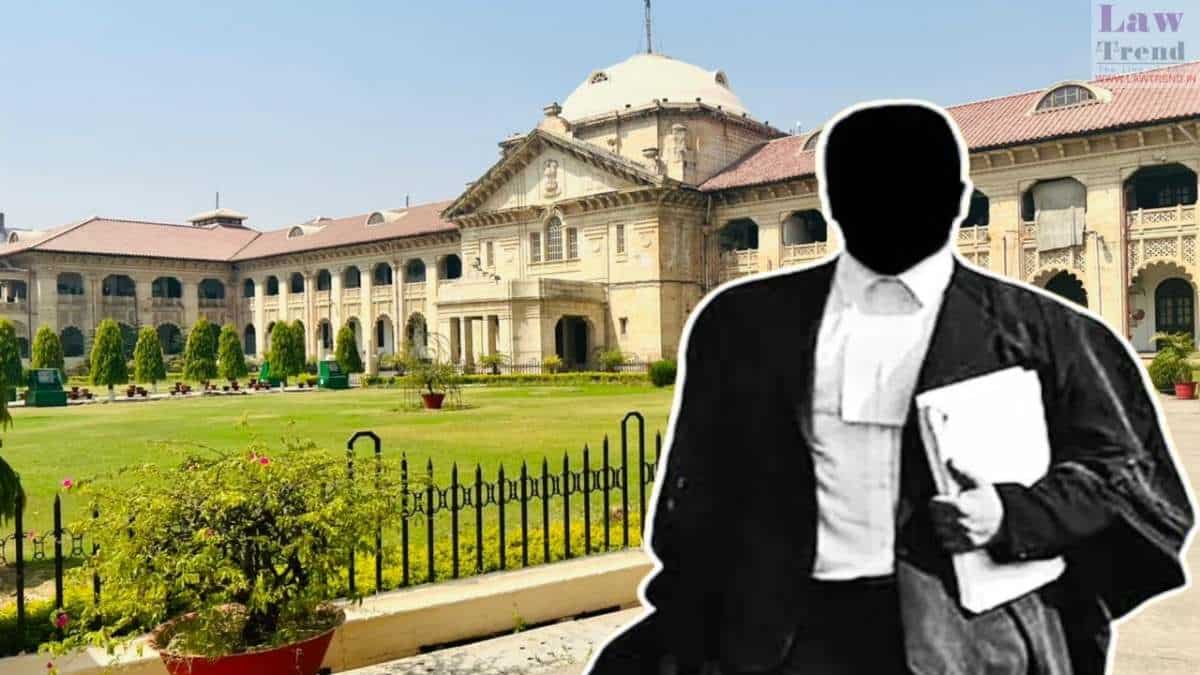
The High Court of Judicature at Allahabad, presided over by Justice Siddharth Nandan, has held that active concealment of material facts by an advocate misleads the court and amounts to direct interference with the administration of justice. Exercising its inherent powers under Section 151 of the Code of Civil Procedure, 1908, the Court recalled its earlier order dated May 5, 2026, which had directed fresh elections for the Committee of Management of Nehru Vidyapeeth Intermediate College, Ghazipur, on the false premise that past elections were undisputed. Taking a stringent view of the abuse of judicial process, the Court imposed exemplary costs of ₹50,000 each on both the writ petitioner and the review applicant, while requesting the Chief Justice on the administrative side to consider amending Chapter XXII, Rule 5 of the Allahabad High Court Rules, 1952, to make supporting affidavits mandatory for lodging caveats.
Background of the Case
The proceedings stem from a long-running dispute over the Committee of Management of Nehru Vidyapeeth Intermediate College, Reotipur, Ghazipur. On May 5, 2026, the High Court disposed of Writ-C No. 17384 of 2026 by directing the educational authorities to conduct elections within two months on the basis of an electoral list from 2009, recording that both sides agreed the 2009 elections were undisputed.
Subsequently, Shiv Shankar Singh (Yadav), who had served as the institution’s Manager since 1973 and was arrayed as respondent no. 6, filed a review application through a new counsel. He contended on oath that he had never executed a Vakalatnama, engaged advocate Sri R.C. Dwivedi to appear in the writ petition, or authorized the lodging of any caveat application. He claimed that the writ petitioner, who was not even a member of the General Body, filed the writ petition with ulterior motives to capture the institution. Earlier, a Special Appeal filed by the applicant against the May 5 order had been dismissed by a Division Bench on May 27, 2026, granting liberty to pursue appropriate legal remedies.
Arguments and Factual Matrix
In response to the allegations, advocate Sri R.C. Dwivedi, practicing for over thirty years, filed personal affidavits asserting that Shiv Shankar Singh had been his regular client since 2015 across multiple litigations. He stated that the applicant, accompanied by his nephew Sri Bhola Yadav (a retired Head Clerk of the institution), visited his office, handed over the Joint Director of Education’s order dated April 10, 2026, along with a signed Vakalatnama, and paid a fee of ₹2,500 to his clerk, Sri Rajesh Yadav, to lodge a caveat. While Sri R.C. Dwivedi acknowledged a procedural lapse—admitting his clerk appended the verification of the signature on the Vakalatnama—and tendered an unconditional apology, he maintained that he acted under bona fide instructions.
Sri Bhola Yadav filed a supporting affidavit confirming that he had accompanied his maternal uncle to Allahabad in April 2026 to deposit the fee and Vakalatnama.
Appearing in person, Shiv Shankar Singh admitted engaging Sri R.C. Dwivedi in earlier litigations up to January 2026, but argued that he had severed all relations with his nephew in 2024 after discovering alleged collusion between Bhola Yadav and the petitioner Awadhesh Rai. He insisted he did not authorize the caveat in the writ petition.
On the issue of the election, petitioner’s counsel Sri S.C. Dwivedi argued that the elections of October 25, 2009, were undisputed because subsequent elections were conducted in July 2012 and the manager’s signatures were duly attested.
Forensic Examination and Analysis of the Court
To ascertain the veracity of the disputed Vakalatnama, the Court directed the Deputy Director of the Forensic Science Laboratory (FSL), Prayagraj, to compare the signatures with specimen signatures, bank records, and admitted signatures across previous writ petitions. The FSL report revealed that even the admitted signatures of Shiv Shankar Singh from past court records did not match his newly provided sample signatures or his bank records. As no party filed objections, the expert report attained finality.
Evaluating the forensic findings, the Court dismissed the review applicant’s claim of forgery:
“As such the assertions made in the affidavit filed along with the Review Application cannot be accepted, to the effect that Shri Shiv Shankar Singh @ Yadav did not sign the Vakalatnama, which was filed along with the Caveat Application filed by Shri R.C. Dwivedi, Advocate.”
The Court then turned its scrutiny to the conduct of petitioner’s counsel, Sri S.C. Dwivedi. Judicial records revealed that an order dated April 16, 2016, passed by the Joint Director of Education, had held that the 2009 election conducted by the Authorized Controller was doubtful and directed fresh elections. A challenge to this order in Writ-C No. 19276 of 2016 was dismissed as infructuous on August 18, 2023. Furthermore, the then District Inspector of Schools, Smt. Malti Rai, had submitted a written report dated July 23, 2016, explicitly denying that any 2009 election proceedings were conducted under her signatures.
The Court observed that these decisive records were within the knowledge of Sri S.C. Dwivedi, who had represented the petitioner throughout. The Court held that Sri S.C. Dwivedi and petitioner Awadhesh Rai actively concealed these material facts to give a false impression that the 2009 election was undisputed:
“There is a distinction between active concealment and mere inadvertence or wrong interpretation of the factual or the legal position. Once the petitioner has approached this Court, he is expected to disclose all relevant facts and material which may constitute a bundle of fact giving rise to a cause of action.”
Applying the legal maxim “suppressio veri, expressio falsi” (suppression of the truth is equivalent to the expression of a falsehood), the Court held:
“The active concealment of fact means a truth is sought to be hidden on purpose to mislead the court; but however statement in ignorance means you share false information by mistake because you do not know the real truth.”
Finding that Sri S.C. Dwivedi had misguided the Court, the Bench observed:
“Shri R.C. Dwivedi, Advocate was a respondent counsel in the present writ petition and since the petitioner was willing to get the elections conducted, he may not have ventured into the fact, since the documents demonstrating the elections of the year 2009 to be doubtful, were never placed on record; and as such this Court has no hesitation in holding that there was an active concealment of fact on the part of Shri S.C. Dwivedi, Advocate and his client, which lead to the interference with the administration of justice.”
Precedents Cited on Professional Misconduct and Judicial Sanctity
The Court underscored the paramount duty of advocates as officers of the Court, examining several key precedents on professional ethics, unauthorized filings, and suppression of facts:
- Bhagwan Singh vs. State of U.P. and others (2025) 6 SCC 416: The Supreme Court referred a fraudulent Vakalatnama matter to the CBI, observing: “No court can allow itself to be used as an instrument of fraud and no court can allow its eyes to be closed to the fact that it is being used as an instrument of fraud.”
- Saumya Chaurasia vs. Enforcement Directorate (2024) 6 SCC 410: The Supreme Court highlighted that an advocate’s “duty to diligently verify the facts from the record of the case, using their legal acumen for which they are engaged, cannot be obliviated.”
- Kunj Bihari (Dead) through LR Dilip Tripathi Vs. Jhinguri @ Dausiya & others ILR 2025 MP 1238: The Madhya Pradesh High Court held that “No lawyer can represent a party on the basis of a forged Vakalatnama” and cautioned advocates against filing unverified authorizations.
- Narain Pandey Vs. Pannalal Pandey (2013) 11 SCC 435: The Supreme Court suspended an advocate for three years for filing unauthorized Vakalatnamas and compromises, stating that fraudulent conduct compromises the dignity of the profession.
- J.S. Jadhav Vs. Mustafa Haji Mohamed Yusuf and Ors. (1993) 2 SCC 562: The Apex Court noted that “Advocacy is not a craft but a calling; a profession wherein devotion to duty constitutes the hallmark” and cited George Sharswood’s observation that a lawyer’s character must be “not only without a stain, but without suspicion.”
- Bar Council of Maharashtra and Goa vs. Rajiv Nareshchandra Narula and others (2025) SCC OnLine SC 2063 and Narendra Singh vs. Chhotey Singh and another (1983) 4 SCC 131: Emphasizing disciplinary accountability regarding unverified affidavits and unauthorized compromises.
- Bar Council of Maharashtra Vs. M.V. Dabholkar (1976) 2 SCC 291: Quoting Justice Krishna Iyer that the Bar is “not a private guild… but by bold contrast, a public institution committed to public justice.”
Decision and Directives
Exercising judicial self-restraint from initiating criminal contempt or referring the counsels to the Bar Council, the High Court issued the following operative directions:
- Recall of Order: In exercise of inherent powers under Section 151 of the Code of Civil Procedure, 1908, the order dated May 5, 2026, was reviewed and recalled due to active concealment regarding the 2009 elections. The writ petition was directed to be placed before the appropriate bench for fresh adjudication.
- Imposition of Costs: A cost of ₹50,000 each was imposed on petitioner Awadhesh Rai and review applicant Shiv Shankar Singh for misleading the Court and abusing judicial process. The amount must be deposited with the High Court Legal Services Committee within one month, failing which the Registrar General shall initiate contempt proceedings.
- Caveat Rule Amendment: Observing that Chapter XXII, Rule 5 of the Allahabad High Court Rules, 1952, allows caveats without supporting affidavits—thereby exposing advocates to vulnerability—the Court directed a copy of the order to be placed before the Chief Justice on the administrative side to consider making supporting affidavits mandatory for lodging caveats.
Case Title: Shiv Shankar Singh Versus Committee of Management Nehru Vidyapeeth Inter College and another
Case No.: Civil Misc Review Application No. – 106 of 2026 (in Writ-C No. 17384 of 2026)
Bench: Justice Siddharth Nandan
Date: 24.08.2026