

Defect In Served Form-25 Affidavit Copy Not Fatal To Election Petition Maintainability If Original Duly Attested: Supreme Court
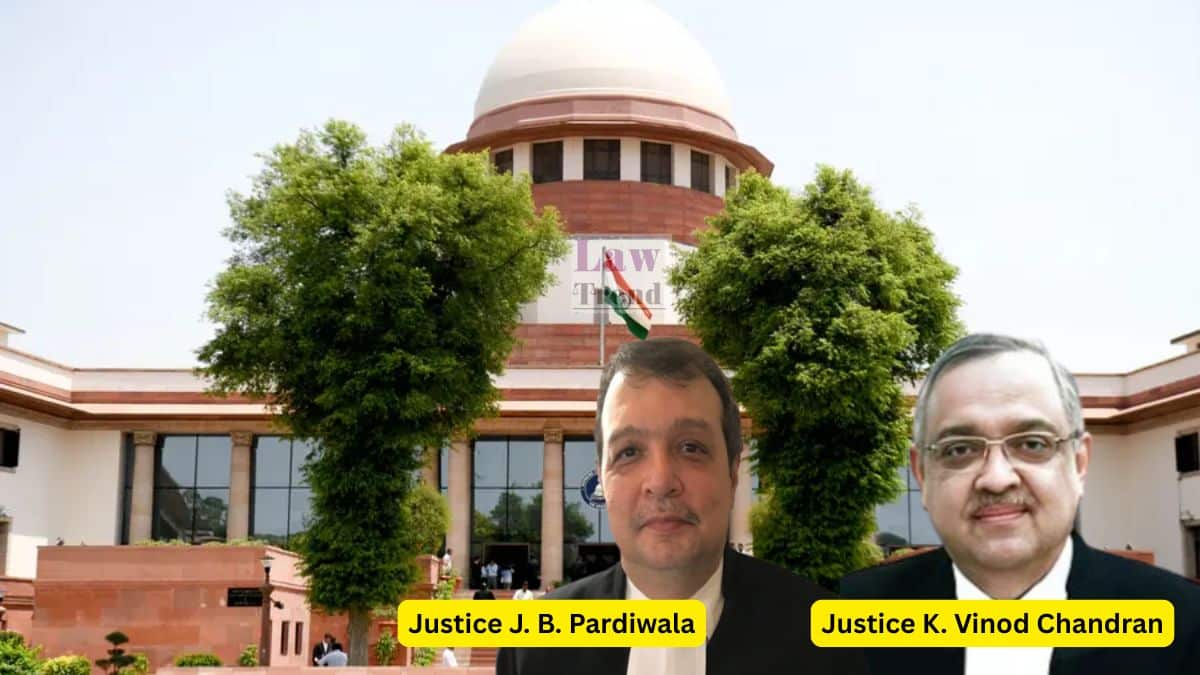

The Supreme Court of India, comprising Justice J.B. Pardiwala and Justice K. Vinod Chandran, has held that an election petition cannot be dismissed at the threshold under Section 86 of the Representation of the People Act, 1951, merely because the copy of the Form-25 affidavit served on the elected candidate lacks endorsement of notarization or attestation, provided the original affidavit filed in court was duly affirmed on oath. Reversing an order of the High Court, the bench ruled that technical variations in attestation seals on petition copies do not render the petition maintainable-in-limine invalid, and restored the election petition for consideration on merits.

Background of the Case

The legal controversy arose from an election petition filed by Hafiz Rashid Ahmed Choudhury, challenging the election of Kripanath Mallah, who was elected to the Lok Sabha from No. 7 Karimganj Parliamentary Constituency in Assam during the 2024 general elections.

The returned candidate, Kripanath Mallah, filed an application under Section 86 of the Representation of the People Act, 1951 (RoP Act), seeking rejection of the election petition on three preliminary grounds:

  1. The copy of the election petition served on him did not indicate notarization of the affidavit in Form-25, required under Rule 94A of the Conduct of Elections Rules, 1961, in support of allegations of corrupt practices.
  2. The attestation across pages of the petition copy was inconsistent—pages 1 to 84 bore a rubber stamp reading “attested to be true copy of the petition” under signature, whereas pages 85 to 185 bore a stamp reading “certified to be true copy”, which the respondent argued was not strict attestation under Section 81 of the RoP Act.
  3. Four pages (pages 11, 16, 21, and 22) were missing from the copy served upon him.

The High Court accepted the challenge regarding improper attestation seals, made no finding on the Form-25 notarization, and rejected the contention of missing pages. Aggrieved by the dismissal of his election petition, the election petitioner approached the Supreme Court.

Arguments of the Parties

Senior Counsel Harin Pravinkant Raval, representing the appellant, submitted that the High Court’s finding on attestation was contrary to settled precedents of the apex court, specifically F.A. Sapa v. Singora (1991). He argued that if an election petitioner signs at the foot of every page taking responsibility for the copy being a true copy, Section 81(3) of the RoP Act is fully satisfied, as no specific form of attestation is prescribed by law. He further contended that any defect in the copy of Form-25 falls under the proviso to Section 83, which does not attract peremptory dismissal under Section 86. Relying on T.M. Jacob v. C. Poulose (1999) and T. Phungzathang v. Hangkhanlian (2001), counsel argued that the principles of substantial compliance and curability apply.

READ ALSO  Section 9(2) JJ Act: When a Claim Is Raised Before a Court Other Than Juvenile Justice Board, an Enquiry Should Be Made and Evidence May Also Be Taken: Orissa HC

Advocate on Record Wajeeh Shafiq, appearing for the respondent, argued that the copy of Form-25 served showed no indication of attestation by an Oath Commissioner or Notary. Relying on Dr. Shipra (Smt) v. Shanti Lal Khoiwal (1996), he contended that a defect in Form-25 accompanying corrupt practice allegations is a vital defect in presentation under Section 81. He also argued that the rubber stamp “certified to be true copy” could only be valid if certified copies had been supplied to the respondent.

Court’s Analysis and Precedents

The Supreme Court, in an opinion authored by Justice K. Vinod Chandran, evaluated the three grounds raised:

1. Missing Pages: The Supreme Court affirmed the High Court’s finding, agreeing that the claim of missing pages was an afterthought because the respondent had not raised this issue during initial appearances following summons.

2. Attestation under Section 81(3): Concurring with the decision in F.A. Sapa v. Singora, the bench reiterated that Section 81(3) of the RoP Act imposes two requirements: supplying as many copies as there are respondents, and attestation by the petitioner under their own signature certifying it as a true copy. The court held that using different rubber stamps—whether “attested to be true copy of the petition” or “certified to be true copy”—conveys the same meaning, and signing at the foot of each page satisfies the statutory requirement.

READ ALSO  'Safer for him to stay in jail,' says AP court rejecting Chandrababu Naidu's plea seeking house custody

3. Attestation of Form-25 Affidavit: Examining the requirement under Rule 94A of the Conduct of Elections Rules, 1961, the court noted that Form-25 must be signed by the petitioner and attested by a First Class Magistrate, Notary, or Oath Commissioner.

The court addressed past precedents, noting that while Dr. Shipra (Smt) had treated the absence of attestation in the served copy as fatal, the Constitution Bench in T.M. Jacob distinguished Dr. Shipra (Smt) rather than overruling it. The court pointed out that the three-judge bench in T. Phungzathang erred in its understanding of T.M. Jacob when it observed that “the defect pointed out in Dr Shipra (Smt) case pertains to those in the original affidavit filed before the court in support of the allegations of corrupt practice and not with reference to the copies supplied to the respondents”. The court clarified that in Dr. Shipra (Smt), “the true copy of the Election Petition furnished to the respondent gave an impression that Election Petitioner’s affidavit supporting his allegations of corrupt practice had not been duly shown and verified by the Election Petitioner before the notary”.

To settle the legal position, the court relied on the earlier Constitution Bench judgment in Murarka Radhey Shyam Ram Kumar v. Roop Singh Rathore (1963), which holds binding precedent under the rules of stare decisis reaffirmed in National Insurance Co. Ltd. v. Pranay Sethi (2017).

In Murarka Radhey Shyam, the Constitution Bench explicitly held that “it is impossible to accept the contention that a defect in verification which is to be made in the manner laid down in the Code of Civil Procedure, 1908 for the verification of pleadings as required by Clause (c) of Sub-Section (1) of Section 83, is fatal to the maintainability of the petition.”

The test laid down by the Constitution Bench is whether “the copy is a true one and the variation from the original is calculated to mislead an ordinary person.” Applying this test, the court held that if the original affidavit filed before the court was affirmed before a Commissioner of Affidavits, the absence of an endorsement on the served copy does not mislead the returned candidate and is not fatal to maintainability under Section 86.

Furthermore, the bench highlighted that under Section 83, if Form-25 does not strictly conform, only the allegations relating to corrupt practices are liable to be struck off, while other independent grounds raised in the petition must be tried on their merits.

READ ALSO  चेक बाउंस मामलों का निस्तारण के लिए कानून में संशोधन करे केंद्र: सुप्रीम कोर्ट

Supreme Court Decision

The Supreme Court allowed the appeal, set aside the High Court’s dismissal order, and restored the election petition to the files of the High Court.

The apex court directed the High Court to verify whether due attestation of affirmation on oath exists in the original file before the court. If available, the High Court must proceed with the election petition on merits. If such attestation is absent in the original, the High Court shall disallow the allegations of corrupt practices from being urged, but must proceed to decide the election petition on the merits of any other grounds pleaded.

Case Title: Hafiz Rashid Ahmed Choudhury v. Kripanath Mallah & Ors.
Case No.: Civil Appeal No.7474 of 2025
Bench: Justice J.B. Pardiwala and Justice K. Vinod Chandran
Date: August 24, 2026

Law Trend
Law Trendhttps://lawtrend.in/
Legal News Website Providing Latest Judgments of Supreme Court and High Court

Related Articles

Latest Articles

