

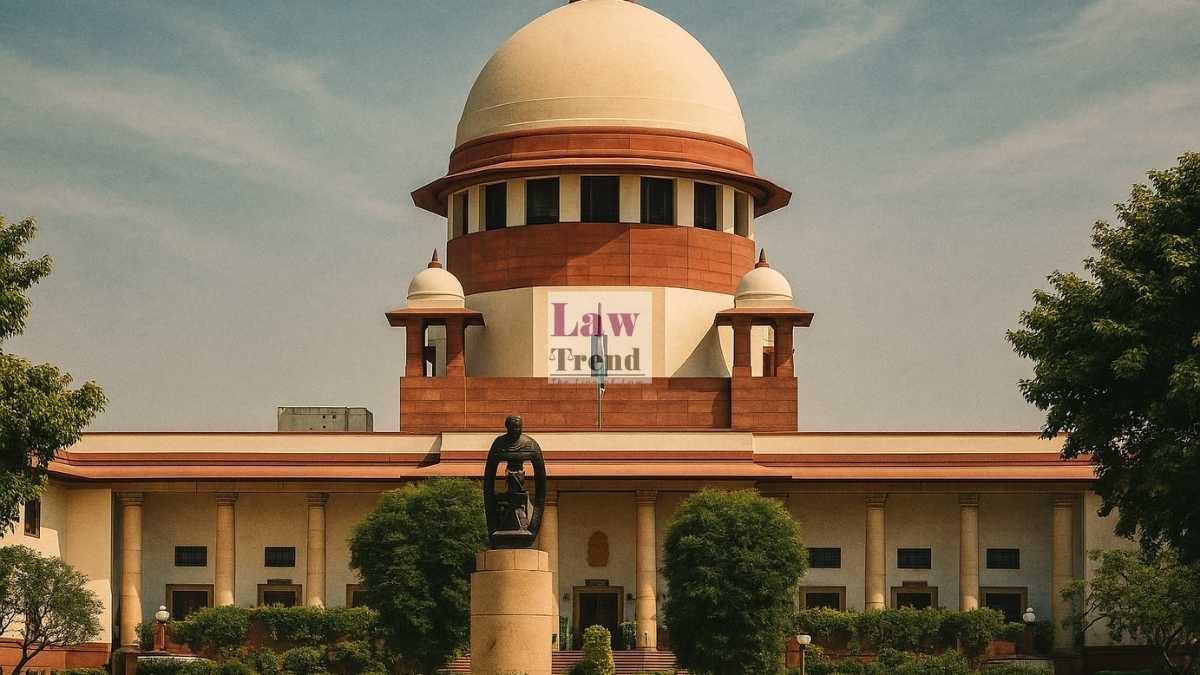
Illegal Absorption Cannot Be Regularized By Judicial Sympathy: Supreme Court Quashes Absorption Of Four Haryana Officers In PWD, Orders Repatriation

The Supreme Court of India has held that an illegal absorption obtained through political influence cannot be cured or regularized by lapse of time or judicial sympathy. A Bench comprising Justice Manoj Misra and Justice Ujjal Bhuyan set aside a High Court directive that had protected the services of four officers absorbed into the Public Works Department (Building and Roads Branch) of Haryana. Ruling on the core legal issue concerning the validity of deputation, absorption, and inter se seniority under the Punjab Service of Engineers, Class II, P.W.D. (Buildings and Roads Branch) Rules, 1965, the top court declared the absorption of all four officers non est and void ab initio, directing their immediate repatriation to their parent department.

Background of the Case

The case stems from the appointment of four officers—Shri Pradeep Atri, Shri Praveen Chaudhary, Shri Pankaj Gaur, and Shri Arun Bhatia—who were originally recruited in 2004 and 2005 as Sub-Divisional Officers (Panchayati Raj) on probation in the Development and Panchayat Department, Government of Haryana.

Within months of their probationary appointments, moves were initiated to send them on deputation to the PW (B&R) Department. Shri Pradeep Atri directly petitioned the Engineer-in-Chief for deputation. In the case of Shri Praveen Chaudhary, recommendatory letters were issued by the state Revenue Minister and Transport Minister shortly after his appointment. Though initially brought in as stopgap arrangements against vacant posts earmarked for direct recruitment, all four officers subsequently sought permanent absorption in the PW (B&R) Department.

Despite departmental objections and the failure of three of these officers (Shri Atri, Shri Gaur, and Shri Bhatia) to qualify in the open competitive selection process conducted by the Haryana Staff Selection Commission for direct recruitment in 2006, the state government issued orders absorbing them as Assistant Engineers/Sub-Divisional Engineers between 2006 and 2009. These absorptions were purportedly executed by invoking Rule 10 of the 1965 Rules, which permits appointment by transfer under special circumstances.

Subsequent seniority lists placed these absorbed officers above directly recruited engineers appointed in 2007 and 2009. This led to multiple writ petitions before the High Court of Punjab and Haryana by direct recruits challenging both the absorption and the seniority rankings. On March 15, 2023, the High Court held that the deputation and absorption were bad in law and a product of political machinations. However, taking a sympathetic view because the officers had served for over 18 years and lacked a lien in their parent department, the High Court refrained from disturbing their absorption, though it restricted their seniority advantages over direct recruits. Both rival factions—the direct recruits, the absorbed deputationists, and the State of Haryana—appealed the verdict to the Supreme Court.

READ ALSO  JJ Act | Child Found Fit for Trial in Heinous Offence Can Be Sentenced Up to 3 Years in Place of Safety: Chhattisgarh High Court

Arguments of the Parties

Appealing on behalf of the direct recruits, learned senior counsel Mr. Ranjeet Kumar and Mr. Gurminder Singh argued that the deputation and absorption were pure backdoor entries designed to bypass regular competitive examination procedures in violation of Articles 14 and 16 of the Constitution of India. They contended that once the High Court found the entry unlawful, it erred in using judicial sympathy to sustain illegal appointments. They relied on Secretary, State of Karnataka v. Umadevi and M.P. State Cooperative Bank Limited v. Nanuram Yadav to emphasize that those entering through the backdoor must exit through that door. Learned senior counsel Mr. V. Giri, representing the 2009 direct recruit batch, urged that protecting illegal entrants unfairly prejudiced regularly recruited engineers who faced stagnation.

Conversely, learned senior counsel Mr. Patwalia (for Shri Pradeep Atri), Mr. Nidhesh Gupta (for Shri Praveen Chaudhary), and Mr. Guru Krishna Kumar (for Shri Pankaj Gaur and Shri Arun Bhatia) maintained that appointment by transfer is a legally recognized mode under Rules 2(9)(b), 2(12), 7(4), and 10 of the 1965 Rules. They submitted that an acute shortage of engineers and ongoing litigation restricting fresh direct recruitments constituted special circumstances justifying their transfer and absorption. They cited Chief Engineer v. K.S. Brar, PM Bayas v. Union of India, State of Rajasthan v. Anand Prakash Solanki, K. Madhavan v. Union of India, and Sub Inspector Rooplal v. Lieutenant Governor to argue that Rule 12(5) permits the government to grant seniority credit for past service rendered in equivalent ranks.

Additional Solicitor General Mr. Bijender Chahar, appearing for the State of Haryana, supported the state’s exercise of executive discretion under Rules 10 and 12, submitting that public work requirements and staff shortages constituted valid grounds for absorption, and that concurrence from the Haryana Public Service Commission had been obtained.

The Court’s Analysis and Key Observations

Justice Ujjal Bhuyan, authoring the judgment for the Bench, undertook an extensive analysis of service jurisprudence governing deputation and transfer, along with the provisions of the 1965 Rules.

READ ALSO  When a Prosecution at Initial Stage Is Asked to Be Quashed, Test to Be Applied by Court Is As to Whether Uncontroverted Allegations As Made Prima Facie Establish the Offence: Allahabad HC

The Court reiterated the established legal definitions of deputation by citing landmark precedents. Referencing State of Punjab v. Inder Singh, the Bench noted:

“Deputation” has a different connotation in service law and the dictionary meaning of the word “deputation” is of no help. In simple words “deputation” means service outside the cadre or outside the parent department. Deputation is deputing or transferring an employee to a post outside his cadre, that is to say, to another department on a temporary basis.

The Bench further analyzed decisions in Umapati Choudhary v. State of Bihar, Kunal Nanda v. Union of India, and CBI v. Ramesh Chander Diwan, reinforcing that deputation is an interim consensual arrangement to meet public service exigencies, leaving the employee’s lien intact with the parent department.

Examining Rule 6 and Rule 10 of the 1965 Rules, the Supreme Court clarified that regular recruitment under Rule 6 is strictly split 50 percent by direct recruitment and 50 percent by promotion. While Rule 10 permits appointment by transfer under special circumstances, the Court held that normal administrative staff shortages do not satisfy this criterion. Explaining the legal standard for special circumstances, the Bench observed:

‘Special circumstances’ in our understanding means something which is more than normal or routine. Accrual of vacancies in a cadre is a routine phenomenon; this is not something which is unusual or abnormal.

The Court criticized the process through which the officers gained entry into the PW (B&R) Department, pointing out that probationary officers had bypassed departmental protocols and secured ministerial interventions to orchestrate their own deputations and absorptions. The Bench observed that allowing officers who failed the open recruitment exam to enter through transfer amounted to accomplishing indirectly what could not be achieved directly.

READ ALSO  Doctrine of Non-traverse: When the Respondent Has Not Controverted the Statements Made in the Petitions, the Same Are Deemed to Have Been Admitted-SC

Addressing the High Court’s refusal to quash the absorption on sympathetic grounds, the Supreme Court held that the High Court committed a grave legal error. The Bench cited Secretary, State of Karnataka v. Umadevi and distinguished illegalities from irregularities:

Illegality means something which is contrary to law; something which is wrong right from the inception. It is void ab initio. Illegality cannot be cured and made legal and valid by lapse of time. Illegality, which is distinct and different from irregularity, cannot be regularized by taking a sympathetic view on the ground of long continuance in service.

Regarding the loss of lien, the Supreme Court referred to Ramlal Khurana v. State of Punjab and ruled that when an illegal absorption is set aside, the employee’s lien on their substantive post in the parent department automatically revives.

Final Decision

The Supreme Court held that the deputation of Shri Pradeep Atri and Shri Praveen Chaudhary was illegal, while the deputation of Shri Pankaj Gaur and Shri Arun Bhatia was irregular. Crucially, the Court held that the permanent absorption of all four officers in the PW (B&R) Department was illegal, non est, and void ab initio.

Consequently, the apex court set aside the High Court’s directions allowing the officers to remain in the PW (B&R) Department. The Supreme Court ordered the immediate repatriation of all four officers to the Development and Panchayat Department, Government of Haryana. The authority in the parent department was directed to determine their cadre and seniority by placing them immediately above the candidates who were junior to them in order of seniority in their original cadre of Sub-Divisional Officer (Panchayati Raj). All connected civil appeals were disposed of accordingly.

Case Title:Hemant Kumar & Ors. v. State of Haryana
Case No.: SLP (C) Nos. 12017-12018 of 2023
Bench: Justice Manoj Misra and Justice Ujjal Bhuyan
Date:August 18, 2026

Law Trend
Law Trendhttps://lawtrend.in/
Legal News Website Providing Latest Judgments of Supreme Court and High Court

Related Articles

Latest Articles

