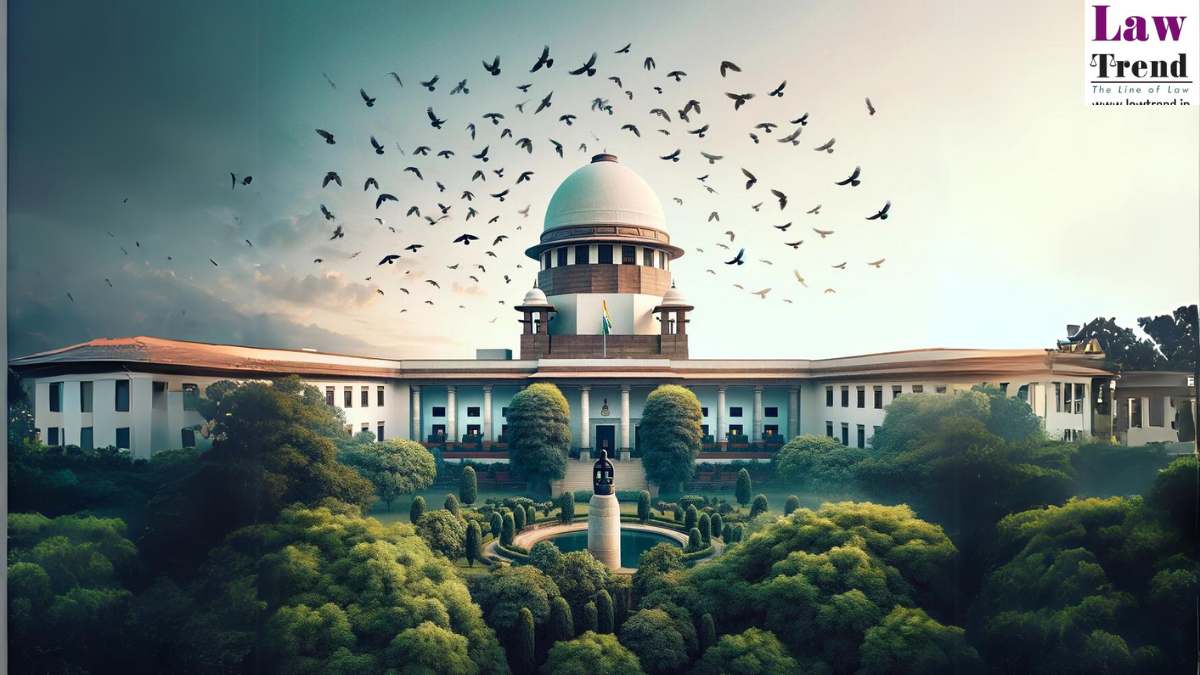
The Supreme Court of India, in a Bench comprising Justice K. V. Viswanathan and Justice Arun Palli, has held that Section 12 of the Uttar Pradesh Gangsters and Anti-Social Activities (Prevention) Act, 1986 is not intended to freeze or halt other criminal trials against an accused. The apex court set aside an order of the Allahabad High Court that had stayed a murder trial pending the outcome of a trial under the Gangsters Act. The Supreme Court clarified that Section 12 only mandates that in the event of a clash of dates between proceedings, the trial under the Gangsters Act shall receive priority.
Background of the Case
The matter originated from an FIR lodged on September 30, 2023, by Keshvendra Singh, the brother of the deceased Raghvendra Singh, at Police Station Talbehat, District Lalitpur, Uttar Pradesh. The FIR alleged that Raghvendra Singh was brutally beaten to death with lathis, stones, and metal rods by nine accused persons, including Shankar Singh (Respondent No. 1). Following investigation, charge sheets were filed against seven accused persons under Sections 147, 323, 504, 506, 302, and 427 of the Indian Penal Code (IPC). Cognizance was taken, and the case was committed to the Additional District and Sessions Judge, Lalitpur, registered as Session Trial No. 0934 of 2023.
In November 2023, the Station House Officer (SHO) submitted a report stating that the crime was committed as part of a constituted gang, leading to the preparation of a Gang Chart. On January 1, 2024, an FIR was registered under Section 2(b)(i) of the Gangsters Act against the same accused persons. On February 20, 2024, the High Court while disposing of a bail application directed day-to-day hearings to conclude the IPC murder trial within one year.
However, on January 18, 2025—after the prosecution had completed its evidence in the murder trial and the case was fixed for recording statements under Section 313 CrPC—the accused applied to keep the IPC trial in abeyance under Section 12 of the Gangsters Act.
The trial court dismissed the application on March 3, 2025, observing that the trial under the Gangsters Act had not yet commenced and Section 12 could not be used to stall a trial that was near completion. Upon revision, the Allahabad High Court reversed the trial court’s order on August 25, 2025, directing that the murder trial be kept in abeyance and the Gangsters Act trial be expedited. The de facto complainant then appealed to the Supreme Court.
Arguments of the Parties
- Appellant (Complainant): Counsel argued that the High Court misinterpreted Section 12 of the Gangsters Act. The provision only ensures priority in case dates conflict, preventing trial delays, but does not mandate staying an ongoing murder trial that was near completion while the Gangsters Act trial was still at its threshold.
- Respondent No. 1 (Accused): Defense counsel defended the High Court order, contending that Section 12 gives precedence to trials under the Gangsters Act over any other cases against the accused in other courts.
- State of Uttar Pradesh: The State submitted that trial completion in a brutal murder case should not be put into temporary oblivion by a rigid application of Section 12, citing the principle of mitigating the rigors of law to prevent stalling atrocious murder proceedings.
Court’s Analysis and Reasoning
The Supreme Court examined the scope of Section 12 of the Gangsters Act alongside Section 346 of the Bharatiya Nagarik Suraksha Sanhita, 2023 (BNSS) [formerly Section 309 of the Code of Criminal Procedure, 1973] and Article 21 of the Constitution of India.
1. Scope of Section 12 of the Gangsters Act
The Court affirmed that the objective of Section 12 is to ensure speedy trials without schedule conflicts, not to freeze other proceedings. Referring to the precedent in Dharmendra Kirthal v. State of U.P. & Anr. (2013), the Court noted:
“The provision clearly mandates that the trial under this Act of any offence by the Special Court shall have precedence and shall be concluded in preference to the trial in such other courts to achieve the said purpose. The legislature thought it appropriate to provide that the trial of such other case shall remain in abeyance. It is apt to note here that ‘any other case’ against the accused in ‘any other court’ does not include the Special Court. The emphasis is on speedy trial and not denial of it. The legislature has incorporated such a provision so that an accused does not face trial in two cases simultaneously and a case before the Special Court does not linger owing to clash of dates in trial.”
The Bench also cited Mobin Iftikhar Zaidi v. State of U.P. (2011), emphasizing:
“Its intent was that the dates fixed in the other trials and in the case under the Gangsters Act should not clash together, in order to ensure that the trial under the Gangsters Act does not get unduly delayed or hampered with and reaches to its logical conclusion at the earliest. It can not be the intention of the legislature that if a person is required in other cases in crimes of such heinous nature such as murder, dacoity, loot and rape etc, the trial of those offences should not proceed further till conclusion of trial under Gangsters Act.”
2. Mandate of Day-to-Day Trial under Section 346 BNSS
Harmoniously reading Section 12 of the Gangsters Act with Section 346 of the BNSS (Section 309 CrPC), the Supreme Court observed that criminal proceedings must continue on a day-to-day basis. Section 12 only comes into play to resolve a direct conflict of hearing dates.
3. Victim’s Right to Speedy Trial under Article 21
The Court emphasized that the right to a speedy trial under Article 21 is not exclusively for the accused, but extends equally to the victim and society. Referring to Rattiram and Others v. State of M.P. (2012) and Mangal Singh v. Kishan Singh (2009), the Bench highlighted:
“The entitlement of the accused to speedy trial has been repeatedly emphasised by this Court. It has been recognised as an inherent and implicit aspect in the spectrum of Article 21 of the Constitution. The whole purpose of speedy trial is intended to avoid oppression and prevent delay. It is a sacrosanct obligation of all concerned with the justice dispensation system to see that the administration of criminal justice becomes effective, vibrant and meaningful.”
Quoting further from Rattiram:
“Any inordinate delay in conclusion of a criminal trial undoubtedly has a highly deleterious effect on the society generally, and particularly on the two sides of the case. But it will be a grave mistake to assume that delay in trial does not cause acute suffering and anguish to the victim of the offence. In many cases the victim may suffer even more than the accused. There is, therefore, no reason to give all the benefits on account of the delay in trial to the accused and to completely deny all justice to the victim of the offence.”
The Court noted that accepting the interpretation advocated by the accused would render Section 12 unconstitutional under Article 21, creating a tool for accused persons to delay proceedings while evidence degrades and memories fade.
Decision
The Supreme Court set aside the High Court order dated August 25, 2025. It noted that pursuant to its interim direction dated April 13, 2026, the trial court had already concluded Session Trial No. 934 of 2023 and convicted all accused under Section 302 IPC along with other sections. The appeal was accordingly allowed.
Case Details
Case Title: Keshvendra Singh v. Shankar Singh And Anr.
Case No.: Criminal Appeal No. of 2026 (@ Special Leave Petition (Crl.) No. 2815/2026)
Bench: Justice K. V. Viswanathan, Justice Arun Palli
Date: August 17, 2026