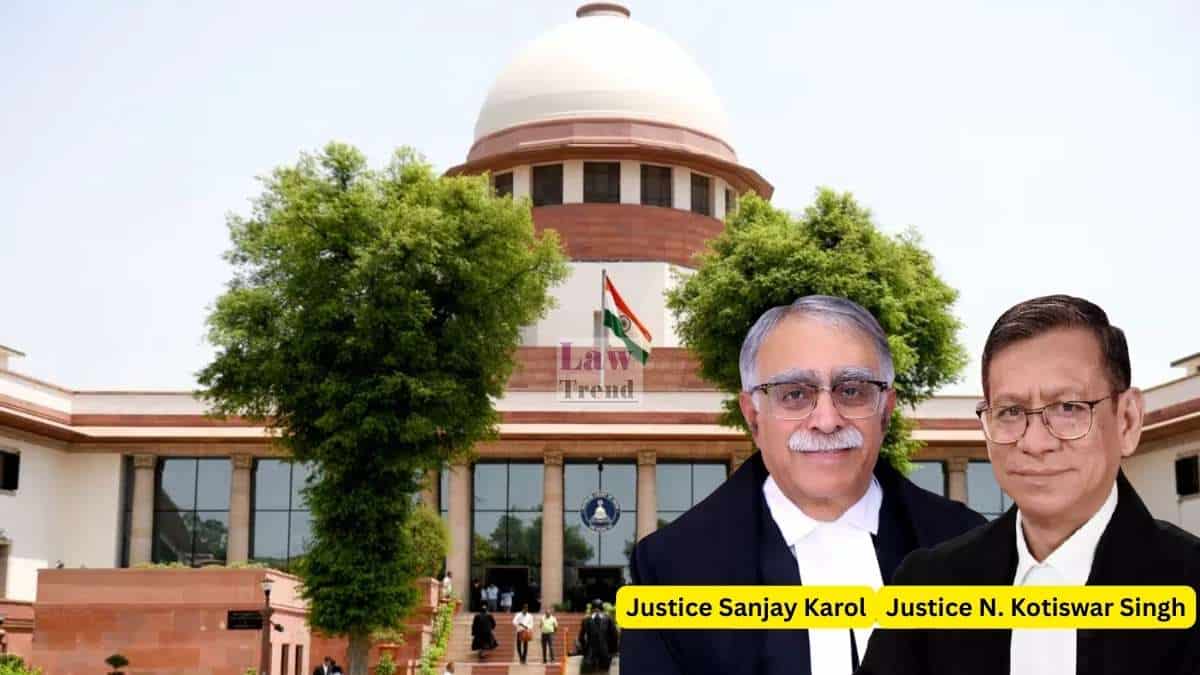
The Supreme Court of India, comprising a Bench of Justice Sanjay Karol and Justice N. Kotiswar Singh, has ruled that Section 69 of the Indian Evidence Act, 1872 cannot be freely chosen as an alternative mode of proving a Will without first establishing that no attesting witness can be found or produced. Setting aside a judgment of the Madras High Court, the apex court restored a Trial Court partition decree, holding that a propounder cannot bypass the statutory requirements of Section 68 of the Evidence Act merely by claiming that attesting witnesses are deceased without providing satisfactory evidence for each witness.
Background of the Case
The dispute centers on a family succession and partition claim over properties originally owned by one Vaiyapuri Gounder, who died around 1925. Vaiyapuri Gounder had three wives: Mottaiammal (first wife, predeceased), Pappammal (second wife, predeceased), and Arukkaniammal (third wife, who survived him without issue and died on September 18, 1985).
Mottaiammal left behind two daughters, Ramathal and Chellammal (whose legal heirs are the Appellants). Pappammal left behind one daughter, Alamathal (whose four sons are the Respondents).
Following Arukkaniammal’s death in 1985, the Appellants filed a partition suit (O.S. No. 665 of 1985) seeking a 2/3 share in the ‘A-schedule’ agricultural lands and ‘B-schedule’ house property, arguing that Arukkaniammal died intestate and without issue. Under Section 15(2)(b) of the Hindu Succession Act, 1956, property inherited by a female Hindu from her husband reverts to the husband’s legal heirs in equal branches.
The Respondents resisted partition regarding the A-schedule property, claiming that Arukkaniammal executed a registered Will dated December 15, 1976 (Ex.B-13) bequeathing the entire agricultural land to Alamathal’s four sons. They also filed a cross-suit (O.S. No. 1344 of 1990) for a permanent injunction to restrain the Appellants from interfering with their possession.
The Trial Court (Additional Subordinate Judge – III, Coimbatore) held that the Will was shrouded in unremoved suspicious circumstances and was not proved in accordance with law. It decreed partition in favour of the Appellants for a 2/3 share and dismissed the injunction suit. On appeal, the Madras High Court reversed the Trial Court, upholding the Will under Section 69 of the Evidence Act and granting the injunction. The Appellants then approached the Supreme Court.
Arguments of the Parties
The Appellants argued that the High Court erred in accepting the Will without strict proof under Section 63(c) of the Indian Succession Act, 1925 and Sections 68 and 69 of the Evidence Act. They contended that neither of the two named attesting witnesses (Marappa Gounder and Avanashi Gounder) was examined. While Marappa’s death was proved by his son (D.W.3), no credible evidence or search efforts were presented to prove that Avanashi Gounder was dead or unavailable. They further argued that the scribe (D.W.2) signed strictly as a scribe without animus attestandi, and therefore could not be treated as an attesting witness.
The Respondents maintained that the registered Will had remained unrevoked during Arukkaniammal’s lifetime (she lived nearly nine years after its execution). They argued that D.W.1 (a beneficiary) stated both attesting witnesses were dead, which was not cross-examined. Thus, Section 69 was rightly invoked, with D.W.3 identifying his father Marappa’s signature and D.W.2 testifying to the execution.
Court’s Analysis
The Supreme Court examined four primary issues surrounding the proof, capacity, and suspicious circumstances of the Will.
1. Execution, Attestation, and the Role of the Scribe
The Court emphasized that Section 63(c) of the Indian Succession Act requires proof of signing by the testatrix and attestation by at least two witnesses in her presence. Section 68 of the Evidence Act mandates examining at least one attesting witness if alive and available.
Referring to N. Kamalam v. Ayyasamy (2001) and Janki Narayan Bhoir v. Narayan Namdeo Kadam (2003), the Court reiterated that one attesting witness can prove a Will only if that witness can satisfy the statutory requirement of attestation by both witnesses.
“The one attesting witness examined, in his evidence has to satisfy the attestation of a will by him and the other attesting witness in order to prove there was due execution of the will. If the attesting witness examined besides his attestation does not, in his evidence, satisfy the requirements of attestation of the will by the other witness also it falls short of attestation of will at least by two witnesses for the simple reason that the execution of the will does not merely mean the signing of it by the testator but it means fulfilling and proof of all the formalities required under Section 63 of the Succession Act…”
Addressing the scribe’s testimony, the Court relied on M.L. Abdul Jabbar Sahib v. H.V. Venkata Sastri & Sons (1969), highlighting that attestation requires animus attestandi—the intention to bear witness to the execution.
“It is essential that the witness should have put his signature animo attestandi, that is, for the purpose of attesting that he has seen the executant sign or has received from him a personal acknowledgment of his signature. If a person puts his signature on the document for some other purpose, e.g., to certify that he is a scribe or an identifier or a registering officer, he is not an attesting witness…”
Since D.W.2 expressly admitted in cross-examination that he signed only as a scribe and not as an attesting witness, his signature could not be counted as attestation.
2. Improper Invocation of Section 69 Evidence Act
Analyzing Section 69 of the Evidence Act, the Court held that the opening words, “if no such attesting witness can be found”, constitute a non-negotiable condition precedent.
Citing Babu Singh v. Ram Sahai (2008), the Court noted that the reason for the non-examination of an attesting witness must be proved before strict proof is relaxed. While Marappa Gounder’s death was established through his son, the Respondents failed to offer any proof regarding Avanashi Gounder’s death or unavailability—such as a death certificate, testimony from family members, or village records—even though D.W.3 hailed from the same village. The Supreme Court held that the High Court erred in shifting the burden onto the Appellants merely due to an unparticularised statement by an interested beneficiary.
3. Testamentary Capacity and Free Agency
Citing H. Venkatachala Iyengar v. B.N. Thimmajamma (1959), the Court recalled the foundational test for establishing a Will:
“Even so, in dealing with the proof of Wills the Court will start on the same enquiry as in the case of the proof of documents. The propounder would be called upon to show by satisfactory evidence that the Will was signed by the testator, that the testator at the relevant time was in a sound and disposing state of mind, that he understood the nature and effect of the dispositions and put his signature to the document of his own free will.”
The Court found that while the Appellants failed to prove positive mental incapacity under Section 59 of the Indian Succession Act or direct fraud/coercion under Section 61, the Respondents also failed to provide cogent independent evidence that the illiterate testatrix understood the specific recitals and dispositions in the document.
4. Unremoved Suspicious Circumstances
Relying on Bharpur Singh v. Shamsher Singh (2009) regarding suspicious circumstances, the Court reviewed key factors that can shroud the execution of a Will:
“Suspicious circumstances like the following may be found to be surrounded in the execution of the Will: (i) the signature of the testator may be very shaky and doubtful or not appear to be his usual signature (ii) the condition of the testator’s mind may be very feeble and debilitated at the relevant time (iii) the disposition may be unnatural, improbable or unfair in the light of relevant circumstances like exclusion of or absence of adequate provisions for the natural heirs without any reason (iv) the dispositions may not appear to be the result of the testator’s free will and mind (v) the propounder takes a prominent part in the execution of the Will vi) the testator used to sign blank papers (vii) the Will did not see the light of the day for long (viii) incorrect recitals of essential facts.”
The Court pointed to nine cumulative suspicious circumstances that remained unexplained by the propounders:
- Inaccurate recitals stating the property was Arukkaniammal’s “self-acquired” property when it was inherited from her husband.
- Describing step-daughter Alamathal as “my daughter” and her sons as “my grandsons” without clarifying the step-relationship.
- Unexplained complete exclusion of the Ramathal and Chellammal lines.
- One attesting witness (Marappa) was the father-in-law of a beneficiary (Nataraja).
- Both attesting witnesses belonged to another village (Karacheri) three kilometers away.
- The beneficiary branch was in exclusive possession and practical control of the property.
- Withholding Alamathal from the witness box despite her being alive and capable of testifying.
- Unexplained custody of the original Will prior to delivery four months before Arukkaniammal’s death.
- A defective foundation for invoking Section 69 of the Evidence Act.
Decision of the Court
The Supreme Court concluded that the Will (Ex.B-13) was not proved to be the valid last Will and testament of Arukkaniammal. Consequently, Arukkaniammal died intestate.
Under Section 15(2)(b) of the Hindu Succession Act, the property inherited from her husband devolved upon the heirs of Vaiyapuri Gounder. The Court set aside the Madras High Court judgment and restored the Trial Court’s preliminary decree, declaring the Appellants collectively entitled to a 2/3 share in both A and B schedule properties, while dismissing the Respondents’ injunction suit.
Case Details:
Case Title: Pazhanathal (Dead) Through LRs. & Ors. v. Alamathal (Dead) Through LRs. & Ors.
Case No.: Civil Appeal Nos. 10169-10170 of 2013
Bench: Justice Sanjay Karol, Justice N. Kotiswar Singh
Date: August 13, 2026