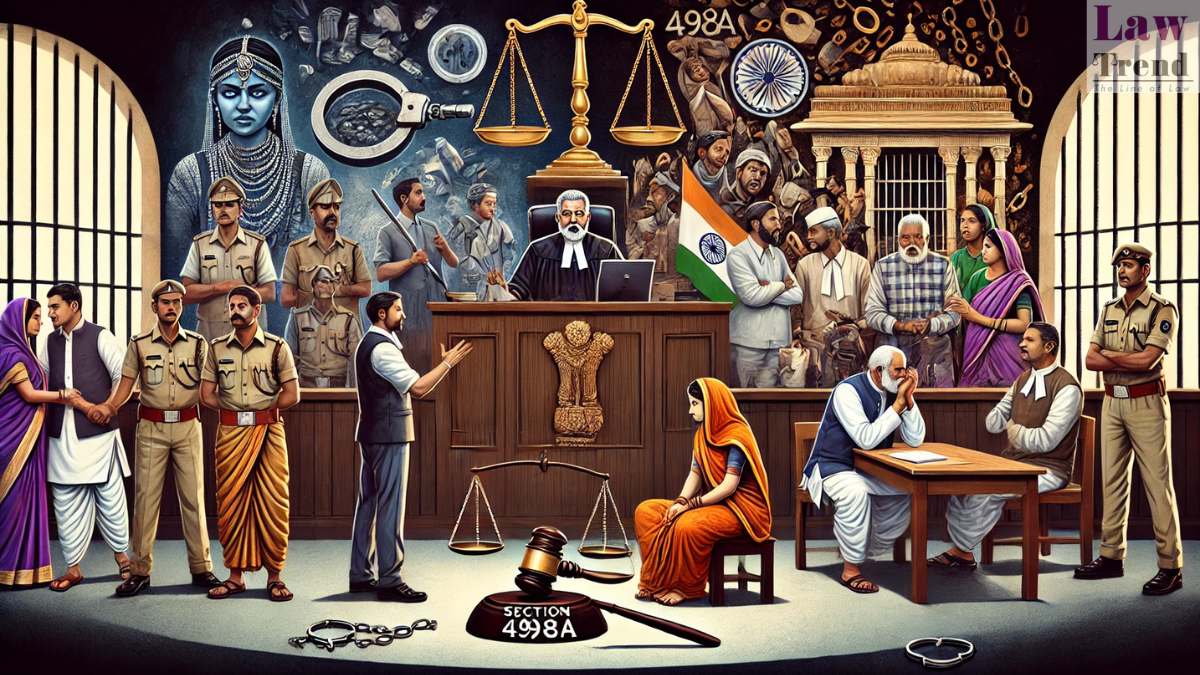
The High Court of Judicature at Allahabad (Lucknow Bench), presided over by Justice Indrajeet Shukla, has held that taunting a wife regarding childlessness or calling her a “barren woman” during mutual altercations arising out of matrimonial discord does not satisfy the legal requirements of cruelty under Section 498-A of the Indian Penal Code (IPC). Exercising its jurisdiction under Section 482 of the Code of Criminal Procedure (CrPC), now Section 528 of the Bharatiya Nagarik Suraksha Sanhita (BNSS), the High Court allowed the petition, set aside a summoning order dated January 17, 2023, and quashed the entire criminal proceedings pending against the husband before the Special Chief Judicial Magistrate (Custom), Lucknow.
Background of the Case
The matter arose from a criminal complaint initiated by the wife against her husband, a government doctor. The couple was married on December 14, 2015, according to Hindu rites and customs. After three years of marriage without a child, disputes arose between the spouses. The complainant alleged that her mother-in-law taunted her by calling her a “barren woman” and that her husband refused to undergo medical examination, suggesting instead that she establish physical relations with his brother to conceive.
According to the complainant, on the night of November 23, 2020, following a quarrel in which she termed her husband impotent, her husband, father-in-law, and brother-in-law physically assaulted her. She alleged that her husband locked her in a room, where her father-in-law and brother-in-law sexually assaulted her sequentially. She stated that she escaped to her parental home the next morning after her mother-in-law opened the room. Owing to trauma and her father’s severe illness, she initially remained silent but later submitted a written report at Ghazipur Police Station, District Lucknow, on July 31, 2021. Due to inaction by the police, she filed an application under Section 156(3) CrPC, which was processed as a private complaint case.
Proceedings Before the Magistrate
The Special Chief Judicial Magistrate (Custom), Lucknow, recorded statements under Sections 200 and 202 CrPC. On January 17, 2023, the Magistrate issued a summoning order strictly against the husband under Sections 498-A, 323, 504, 506 IPC and Sections 3/4 of the Dowry Prohibition Act, while declining to summon the father-in-law and brother-in-law.
In declining process against the in-laws, the Magistrate cited the Supreme Court precedent in Kahkashan Kausar v. State of Bihar, observing: “General and omnibus allegations cannot manifest in a situation where the relatives of the complainant’s husband are forced to under go trial. Allowing prosecution in the absence of clear allegations against the in laws would simply result in an abuse of the process of law.” The husband subsequently approached the High Court seeking to quash the summoning order and the criminal proceedings.
Arguments of the Parties
Counsel for the applicant-husband submitted that the material allegations in the complaint, taken at face value, failed to establish the essential elements of the alleged penal offences. It was argued that the allegations were general and omnibus against all three family members and that singling out the husband based on his status constituted hostile treatment. Counsel asserted that the complaint was vexatious and that the summoning order reflected a lack of judicial application of mind.
Counsel for the complainant-respondent contended that the statements recorded under Sections 200 and 202 CrPC provided concrete material to initiate criminal law. Relying on the Supreme Court judgment in State of Madhya Pradesh v. Yogendra Singh Jadon & Another, respondent counsel argued that powers under Section 482 CrPC should not be exercised when allegations require proof and evidence to be tested during trial.
Court’s Analysis and Legal Findings
Examining the complaint and witness statements, the High Court observed that the core of the dispute was the absence of a child from the wedlock, leading to mutual altercations where offensive remarks were exchanged by both parties.
In analyzing the charge under Section 498-A IPC, the High Court held that the address of “barren woman” during a domestic argument where counter-abuses were exchanged does not constitute willful conduct intended to drive the woman to commit suicide or cause grave physical or mental injury. The Court relied on the Andhra Pradesh High Court judgment in State of A.P. v. Kalidindi Sahadevudu and Ors., noting that “taunting on the ground of not being able to conceive cannot be taken as sufficient ground for proceeding under section 498-A IPC” and that “Mere commenting on the ground that the deceased was not begetting children does not amount to subjecting the deceased to cruelty within the meaning of section 498-A IPC.”
The Court referenced several Supreme Court rulings, including Shobhit Kumar Mittal v. State of U.P., Dara Lakshmi Narayana v. State of Telangana, Abhishek v. State of Madhya Pradesh, and Preeti Gupta v. State of Jharkhand, highlighting the judicial warning against using Section 498-A IPC as a tool for personal vendetta during matrimonial conflicts. Citing Achin Gupta v. State of Haryana, the Court noted: “Every matrimonial conduct, which may cause annoyance to the other, may not amount to cruelty. Mere trivial irritations, quarrels between spouses, which happen in day-to-day married life, may also not amount to cruelty.”
Regarding Section 504 IPC (intentional insult), the High Court referred to Fiona Shrikhande v. State of Maharashtra & Anr., concluding that abusive words uttered during a domestic altercation without premeditation or intent to cause a breach of public peace do not meet the statutory threshold.
On the charges under Sections 3 and 4 of the Dowry Prohibition Act, the High Court found that no demand for dowry was mentioned in the original complaint or application under Section 156(3) CrPC. A vague allegation was introduced only at the end of the complainant’s statement under Section 200 CrPC, while her mother (PW-1) and brother (PW-2) made no mention of dowry demands during their Section 202 CrPC examinations. The Court held that the Magistrate exercised power mechanically in summoning the applicant under the Dowry Prohibition Act.
Addressing Sections 323 and 506 IPC, the Court cited Abhishek Saxena v. State of U.P. and Another, noting that allegations of assault were vague, omnibus, and completely unsupported by any medical examination or injury report. Furthermore, while the same omnibus assault allegations were made against the husband, father-in-law, and brother-in-law, the Magistrate selectively summoned only the husband without providing any discernible rationale.
Considering the scope of inherent powers under Section 482 CrPC, the Court cited landmark judgments including State of Haryana v. Bhajan Lal, Krishna Lal Chawla v. State of U.P., Pepsi Foods Ltd. v. Special Judicial Magistrate, Chandra Deo Singh v. Prokash Chandra Bose & Anr., Mahmood Ali v. State of U.P., and Mohd. Wajid v. State of U.P.. The High Court affirmed that courts are obligated to look beyond drafted pleadings and evaluate overall attending circumstances to filter out frivolous or vexatious litigation. The Court observed that the prosecution narrative regarding sexual assault occurring in the presence of the mother-in-law and husband was inherently improbable.
Decision of the Court
The High Court held that continuing the criminal proceedings against the applicant in the absence of credible supporting material would constitute an abuse of the court process. Consequently, the High Court allowed the petition under Section 482 CrPC, set aside the summoning order dated January 17, 2023, and quashed the entire criminal proceedings in Complaint Case No. 96681 of 2021.
Case Title: Hirendra Kushwaha v. State of U.P. Thru. Prin. Secy. Deptt. of Home Lko. and another
Case No.: Application U/s 482 No. – 10841 of 2025
Bench: Justice Indrajeet Shukla
Date: 13.08.2026