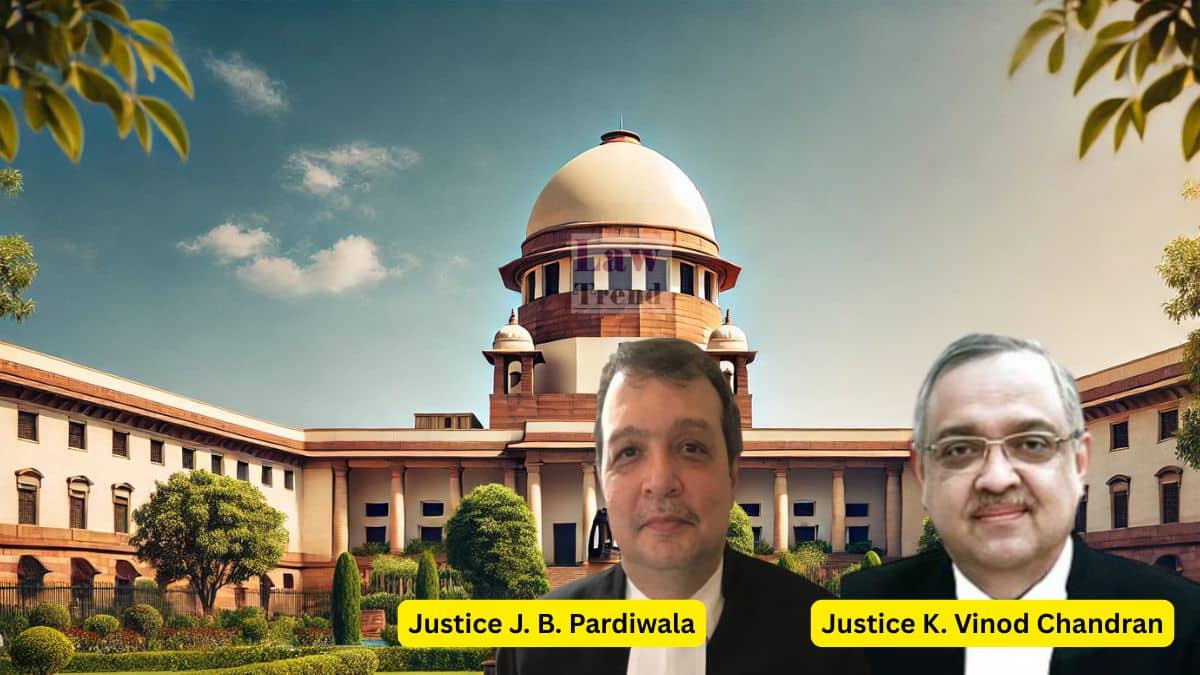
The Supreme Court of India, comprising Justice J. B. Pardiwala and Justice K. Vinod Chandran, has held that the Central Excise and Service Tax Department cannot invoke the extended period of limitation under the proviso to Section 11A of the Central Excise Act, 1944, when all material valuation facts were already within the knowledge of the revenue authorities. Ruling in favour of body-building job worker Audi Automobiles and others, the apex court set aside an excise duty demand raised beyond the prescribed one-year statutory period, holding that omission without wilful suppression does not justify extending limitation.
Background of the Case
The appellants operate as job workers engaged in building bodies on motor vehicle chassis supplied by manufacturers. At the time of clearing the chassis for body building, the manufacturer pays excise duty on its valuation calculated under Rule 8 of the Central Excise Valuation (Determination of Price of Excisable Goods) Rules, 2000, which equals 110% of the manufacturing cost.
Upon completing the body building, the job worker returns the completed vehicle to the manufacturer. When clearing the vehicle, the job worker computes excise duty—after availing CENVAT credit on the duty paid for the chassis—based on the sum total of the manufacturer’s cost, directly received raw materials, job work charges, and job worker’s profit. However, the appellants computed excise duty using the actual manufacturing cost of the chassis without including the additional 10% value, which represents the manufacturer’s profit margin under Rule 8.
The dispute arose when the Department issued a Show Cause Notice on April 30, 2008, seeking duty recovery for the period between November 1, 2004, and March 31, 2007, alleging suppression of facts to invoke the extended period of limitation under the proviso to Section 11A.
Preliminary Objection on Jurisdiction
Senior Counsel appearing for the Department raised a preliminary objection that the appeal did not fall within the scope of Section 35L of the Central Excise Act, 1944, arguing that the issue did not relate to the rate of duty or valuation of goods for assessment. The Department relied on SAIL v. Directorate General of Anti-Dumping & Allied Duties and Commissioner of Customs v. Motorola (India) Ltd.
The Supreme Court rejected this objection, holding that the issue had an inextricable link with the valuation of goods for assessment. The Court observed that since the matter had been pending before it for nearly a decade and valuation was the core issue in the Show Cause Notice, it was not inclined to relegate the appellants to the High Court.
Arguments and Precedents on Valuation
The counsel for the assessee contended that the legal position regarding assessable value was in a flux following M/s Ujagar Prints and Others (II) v. Union of India and M/s Ujagar Prints and Others (III) v. Union of India, and was settled only by the Larger Bench of the Central Excise Customs and Service Tax Appellate Tribunal (CESTAT) in Eicher Motors Ltd. v. Commissioner of Central Excise, Indore. The assessee also relied on Pawan Biscuits Co. Pvt. Ltd. v. CCE and General Engineering Works v. CCE.
The Supreme Court rejected the contention that the legal position was in flux, noting that Ujagar Prints (III)—which clarified Empire Industries v. Union of India and was discussed in CCE, Indore v. S. Kumars Ltd.—squarely applied. The Court distinguished Pawan Biscuits and General Engineering Works on facts, affirming that job workers are required to include the 10% statutory addition under Rule 8 in the assessable value of the completed vehicle.
Court’s Analysis on Extended Limitation
Addressing the crucial issue of limitation and penalty under Section 11A, the Supreme Court examined Larsen & Toubro Ltd. v. CCE, Continental Foundation Joint Venture Holding v. CCE, and CCE v. Kolety Gum Industries.
The Court emphasized that terms like “misstatement” or “suppression” under the proviso to Section 11A are qualified by the word “wilful,” requiring an intent to evade payment of duty. Reaffirming the principle laid down in Continental Foundation, the Court cited key observations:
“when the facts are known to both the parties, omission by one party to do what he might have done would not render its suppression”
Applying this standard, the Court noted that the chassis clearance at 110% of manufacturing cost was fully known to the Department. Therefore, any omission by the job worker to include the 10% component required immediate action under Section 11A(1) within the standard one-year period, rather than resorting to the extended limitation period under the proviso.
Decision of the Court
The Supreme Court allowed the appeals and set aside the orders of the Tribunal, original authority, and appellate authority. While ruling that the assessee’s underlying liability to include the full cost price was legally sound, the Court held that the demand could not be sustained due to limitation:
“the assessee’s liability to include the entire cost price on which excise duty is paid by the manufacturer on supply of chassis for body building, at the time of its supply of the built motor vehicle is unassailable, which for the subject year is not leviable for reason of limitation having run to the peril of the revenue.”
Because the Show Cause Notice issued on April 30, 2008, covered the period from November 1, 2004, to March 31, 2007, it was issued beyond the one-year limitation period prescribed under Section 11A(1), rendering the demand time-barred.
Case Details
Case Title: Audi Automobiles & Ors. v. Commissioner of Central Excise and Service Tax, Indore
Case No.: Civil Appeal Nos. 10504-10506 of 2017
Bench: Justice J. B. Pardiwala and Justice K. Vinod Chandran
Date: August 13, 2026