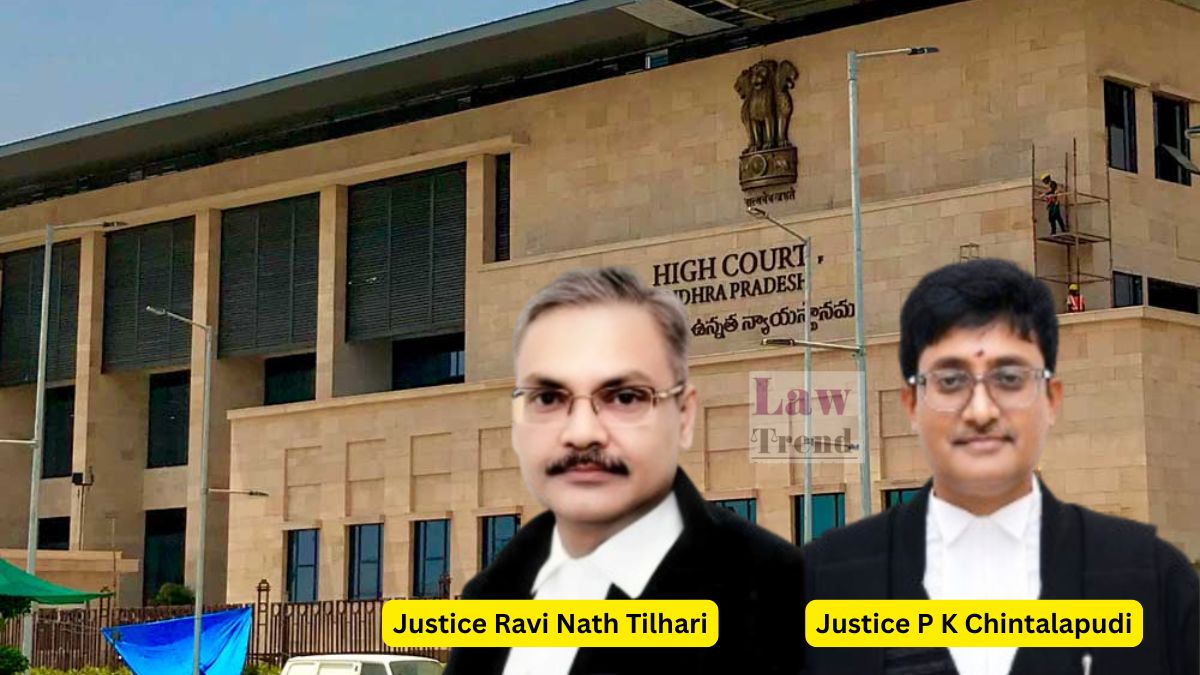
A Division Bench of the High Court of Andhra Pradesh at Amaravati, comprising Justice Ravi Nath Tilhari and Justice Purushottam Kumar Chintalapudi, has set aside a Single Judge order that interfered with an arbitral award under the National Highways Act, 1956. The Court held that a writ petition under Article 226 of the Constitution challenging an arbitral award directly—without exhausting the statutory remedy under Section 34 of the Arbitration and Conciliation Act, 1996—is not entertainable unless recognized exceptional circumstances are present. Furthermore, the Bench found that the Arbitrator had not ignored the material evidence as previously held by the Single Judge.
Background of the Case
The matter originated from land acquisition proceedings in Survey No. 1652/2A1 in Anakapalli Village and Mandal under the National Highways Act, 1956 (N.H. Act). The Competent Authority issued Award No. 46 of 2018 on November 5, 2018. Dissatisfied with the compensation, the landowners—Kandukuri Rama and Smt. Nirmala Ben Patel—approached the Arbitrator (District Collector, Visakhapatnam) under Section 3G(6) of the N.H. Act in Arbitration No. 195 of 2019.
On March 21, 2022, the Arbitrator upheld the Competent Authority’s award, rejecting the landowners’ demand for market value compensation at commercial rates of Rs. 17,500 per square yard. The landowners then filed Writ Petition No. 13038 of 2022 before the High Court of Andhra Pradesh under Article 226 of the Constitution. They contended that the Arbitrator failed to consider a Visakhapatnam Urban Development Authority (VUDA) letter dated September 29, 2018, which indicated that the land fell under an industrial zone.
On January 24, 2025, a Single Judge of the High Court set aside the Arbitrator’s award and remanded the matter for fresh adjudication to evaluate whether the VUDA letter demonstrated commercial or industrial land use. The Project Director, National Highways Authority of India (NHAI), challenged this order in Writ Appeal No. 799 of 2025.
Arguments of the Parties
Counsel appearing for NHAI submitted that Section 3G(6) of the N.H. Act explicitly applies the Arbitration and Conciliation Act, 1996 to every arbitration under the N.H. Act. Consequently, the landowners’ proper remedy against an arbitral award was a petition under Section 34 of the 1996 Act. NHAI argued that the writ petition directly challenging the award ought not to have been entertained. Furthermore, NHAI pointed out that the Arbitrator had in fact examined the VUDA letter dated September 29, 2018, and the Single Judge proceeded on a factually incorrect premise. In support, NHAI relied upon decisions including Kirpal Singh v. Government of India, Voluntary Consumer Assistance Network v. Union of India, and Ramashankar Yadav v. Union of India.
In response, counsel for the landowners submitted that alternative statutory remedies under Section 34 of the 1996 Act do not operate as an absolute bar to writ petitions under Article 226. They asserted that the market value had not been properly determined and that the VUDA letter was not correctly appreciated by the Arbitrator. Relegating the landowners to Section 34 after four years, they argued, would unduly delay the compensation process. They relied on judgments including Hareshbhai Punabhai Moradiya v. Competent Authority, K. Peda Venkataiah v. Government of Andhra Pradesh, Abdul Hameed v. Deputy Commissioner, and Vittal Reddy v. Principal Secretary.
Court’s Analysis and Observations
The High Court evaluated two primary points: the maintainability of a writ petition against an arbitral award when a statutory remedy exists, and whether the Arbitrator had indeed failed to consider the VUDA letter.
On the question of alternative remedy, Justice Ravi Nath Tilhari, writing for the Bench, reaffirmed that while a statutory alternative remedy is not an absolute bar, the High Court should ordinarily not entertain writ petitions unless specific exceptions apply—namely, violation of fundamental rights, violation of principles of natural justice, lack of jurisdiction, or a challenge to the constitutional validity of a statute.
The Bench cited established Supreme Court precedents:
- In Whirlpool Corporation v. Registrar of Trade Marks, the Supreme Court held that the High Court imposes self-restricted limitations when effective alternative remedies exist.
- In Commissioner of Income Tax v. Chhabil Dass Agarwal, the Apex Court ruled that when a complete statutory dispensation exists, a writ petition should not be entertained by ignoring statutory mechanisms.
- In Rikhab Chand Jain v. Union of India, the Supreme Court reiterated the classic principle from Thansingh Nathmal v. Superintendent of Taxes, where it was stated: “… The jurisdiction of the High Court under article 226 of the Constitution is couched in wide terms and the exercise thereof is not subject to any restrictions except the territorial restrictions which are expressly provided in the article. But the exercise of the jurisdiction is discretionary; it is not exercised merely because it is lawful to do so. The very amplitude of the jurisdiction demands that it will ordinarily be exercised subject to certain self-imposed limitations. Resort to that jurisdiction is not intended as an alternative remedy for relief which may be obtained in a suit or other mode prescribed by statute.”
- In Ramashankar Yadav v. Union of India, the Allahabad High Court summarized that arbitral awards must be challenged under Section 34 of the Arbitration Act, 1996, except in the rarest of rare cases.
Synthesizing these legal principles, the High Court observed: “The N.H. Act and the Act, 1996 are complete code. The statute provides the remedy under Section 34 of the Act, 1996 to challenge the award of the arbitrator on specified grounds and any party aggrieved from the decision under Section 34 has the statutory remedy of appeal under Section 37 of the Act. So, ordinarily a challenge to an award shall be made in proceedings under Section 34 of the Act, 1996 on the statutorily recognized grounds. Challenge to the award directly under Article 226 of the Constitution of India without taking recourse to Section 34 of the Act, 1996, in the absence of any well recognized exceptions being attracted, must ordinarily fail on the ground of statutory alternative remedy.”
Addressing the factual merits, the Bench analyzed the Arbitrator’s award and found that the VUDA letter dated September 29, 2018, had been explicitly discussed in the award. The Arbitrator had noted that while the letter showed the survey number partly earmarked for industrial use, it failed to specify Survey No. 1652/2A1 directly. The Arbitrator had further observed that under the APMRUDA Act, 2016, a landowner cannot claim commercial or industrial market value unless the land is formally notified and Change of Land Use (CLU) charges are paid.
Holding that the Single Judge was not presented with the complete text of the award, the Division Bench stated: “From the aforesaid, it is clear beyond any doubt that the letter of VUDA dated 29.09.2018 was taken into consideration while passing the award by the arbitrator but reliance was not placed for the reasons recorded in the award itself… So, in our view, it is not a case of ignoring or not taking into consideration the letter of VUDA dated 29.09.2018.”
The Court also distinguished the precedents relied upon by the landowners (Hareshbhai Punabhai Moradiya, K. Peda Venkataiah, Vittal Reddy, and Abdul Hameed), noting that those cases involved omissions of mandatory statutory considerations or instances where no arbitral award had been passed at all.
Decision of the Court
The High Court allowed Writ Appeal No. 799 of 2025 and set aside the judgment and order dated January 24, 2025, passed in W.P. No. 13038 of 2022. The Court granted liberty to the writ petitioners (landowners) to seek appropriate legal remedies available to them before the competent forum in accordance with law. No order was made as to costs.
Case Title: The Project Director, National Highways Authority of India Project Implementation Unit v. Kandukuri Rama & 9 others
Case No.: Writ Appeal No. 799 of 2025
Bench: Justice Ravi Nath Tilhari and Justice Purushottam Kumar Chintalapudi
Date: 21.07.2026