

Minor’s Custody Mutually Agreed With Father Is Not Illegal Custody: AP High Court Dismisses Mother’s Habeas Corpus Petition With Rs 50,000 Costs For Suppressing Facts
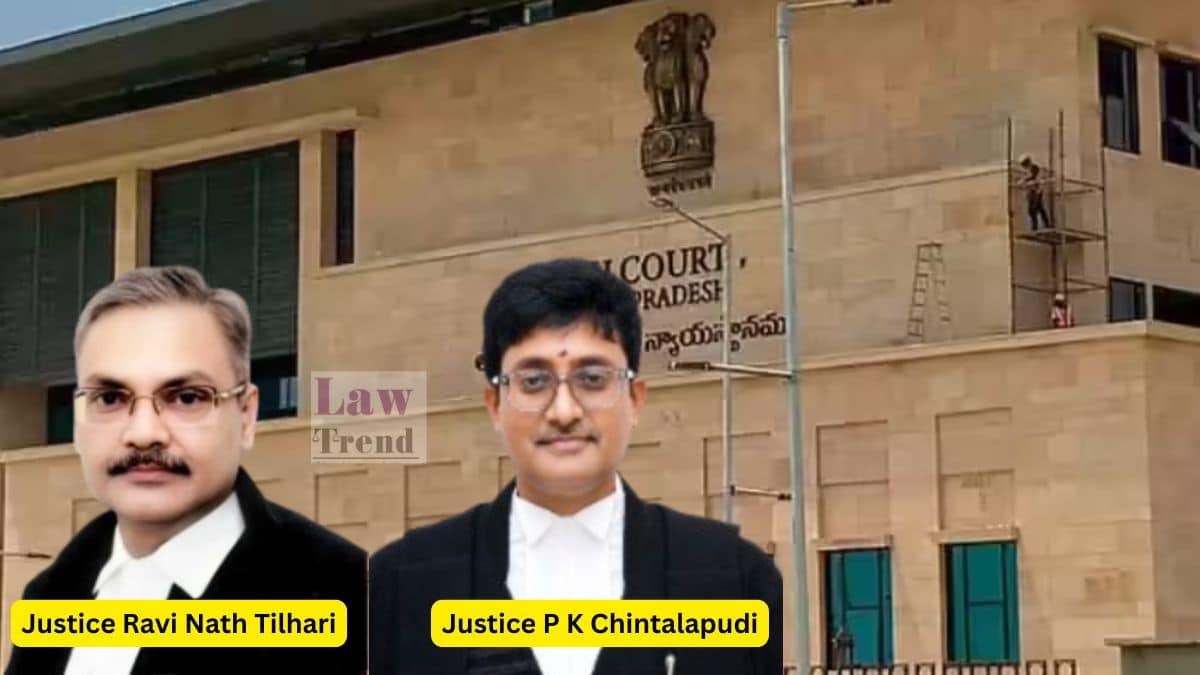

The High Court of Andhra Pradesh at Amaravati, comprising Justice Ravi Nath Tilhari and Justice Purushottam Kumar Chintalapudi, has held that a habeas corpus petition seeking custody of minor children from their father is not maintainable when custody was mutually agreed to remain solely with him under a Memorandum of Understanding (MoU). Finding that the petitioner-mother suppressed material facts regarding the MoU and prior judicial proceedings, the division bench dismissed the taken-up writ petition and imposed exemplary costs of Rs 50,000 on her.

Background of the Case

The matter originated as a taken-up writ petition (Writ Petition No. 18034 of 2026) registered on the basis of a letter petition dated June 28, 2026, addressed to the Chief Justice of the High Court of Andhra Pradesh by the petitioner, Vasabhaktula Swathi.

In her representation, Swathi stated that she was married to Tanuku Ravi Kumar and resided in Rajamahendravaram. She alleged that her husband became involved in a criminal case registered by the Rajamahendravaram CID Police under Crime No. 22/2024. She claimed that while attempting to abscond and evade police investigation, her husband unlawfully and forcibly removed their two minor sons—Tanuku Charan and Tanuku Dansuh Vahin—from her care and custody. Expressing mental agony and apprehension regarding the safety of the children in the custody of an absconding individual, she prayed for a writ of habeas corpus to trace the children and restore their custody to her.

Court Proceedings and Findings of Suppression

During the hearing on July 23, 2026, Assistant Government Pleader J. Krishna Praneeth, representing state officials, presented written instructions received from the Station House Officer of Prakash Nagar Police Station, Rajamahendravaram. The submission revealed that the husband, Tanuku Ravi Kumar, had previously filed Criminal Petition No. 9564 of 2025 before the High Court for the State of Telangana at Hyderabad under Section 528 of the Bharatiya Nagarik Suraksha Sanhita, 2023 (BNSS).

That criminal petition sought the quashing of proceedings in FIR No. 175 of 2025 registered at WPS-IT Corridor, Cyberabad, under Sections 85 and 115(2) of the Bharatiya Nyaya Sanhita, 2023 (BNS) and Sections 3 and 4 of the Dowry Prohibition Act, 1961. Swathi was impleaded as Respondent No. 3 in those proceedings. The Telangana High Court allowed the criminal petition on September 18, 2025, quashing the FIR against the husband.

READ ALSO  Gratuity in its Etymological Sense is a Gift, Especially for Services Rendered: Andhra Pradesh HC

The Telangana High Court’s judgment recorded that Swathi and Ravi Kumar had executed a Memorandum of Understanding (MoU) on March 26, 2025, to dissolve their marriage by mutual consent. Under Point 4 of the MoU, it was explicitly agreed that custody and care of their two children would remain solely with the husband. Furthermore, the MoU detailed a financial settlement of Rs 10,00,000, under which Swathi received payment in installments, along with monthly maintenance of Rs 30,000 for twelve months.

The record of the Telangana High Court also disclosed that Swathi had lodged FIR No. 745 of 2025 against another individual under Sections 64(2)(m) and 318(4) of the BNS, wherein she admitted to being in a relationship with that person. In quashing the dowry harassment proceedings, the Telangana High Court relied on the Supreme Court judgment in Dara Lakshmi Narayana v. State of Telangana (2025) 2 SCC 735, which held that continuing criminal proceedings in the absence of specific overt acts against the accused amounts to an abuse of the process of law.

READ ALSO  प्रासंगिक तर्कों पर विचार न करना 'रिकॉर्ड पर स्पष्ट त्रुटि' है: आंध्र प्रदेश हाईकोर्ट ने पुनर्विचार याचिका स्वीकार की, अपील बहाल

Upon noting these facts, the AP High Court on July 23, 2026, directed the impleadment of the husband (as Respondent No. 5) and the SHO of Prakash Nagar Police Station (as Respondent No. 6), and ordered the production of the children.

Conduct of the Petitioner in Court

On July 28, 2026, during the morning session, Swathi appeared in person and stated in her regional language that she could not understand or read English, including the court’s earlier order sent to her WhatsApp. Responding to her statement, the bench requested the Secretary of the Andhra Pradesh High Court Legal Services Committee to assign a lady Legal Aid Counsel to assist her. Counsel Smt. Santhi Sree Vallabhaneni was assigned to represent her.

However, when the hearing resumed in the afternoon session, Swathi appeared with her appointed counsel and fluently read the MoU in English before the judges. She also directly handed copies of the MoU dated March 26, 2025, and the Telangana High Court order dated September 18, 2025, to her counsel. When questioned by the court as to why she had concealed these crucial documents from her initial letter petition, she stated that she did not consider them relevant to disclose. She further admitted having already received Rs 5,00,000 from her husband under the financial settlement.

Court’s Analysis and Ruling

The division bench observed that since child custody was mutually transferred to the father under the signed MoU, the children were not under any unlawful restraint.

The court held: “Once it was agreed mutually between the petitioner and the R5 that the custody of the children shall remain solely with the husband, the children cannot be said to be in any illegal custody of the R5-father.”

Emphasizing that the entire judicial machinery was mobilized based on a misrepresentation of facts, the court held: “The Habeas Corpus petition is not maintainable. The petitioner has misused the process of this Court by suppression of the material facts.”

Although Swathi tendered an apology in court during the hearing, the bench declined to accept it, remarking: “We are not impressed. It is not a case, where apology be accepted.”

Decision and Directions

The High Court dismissed the writ petition and ordered Swathi to pay costs of Rs 50,000 to be deposited with the Registrar (Judicial) of the High Court within three weeks.

READ ALSO  Authorized Signatory Not Liable for Cheque Dishonour Under Section 138 NI Act Without Company as Principal Accused: Supreme Court

Upon deposit, the Registrar (Judicial) is directed to invest the amount in Fixed Deposit Receipts in any nationalized bank in equal amounts of Rs 25,000 each in the names of the two minor children, payable to them upon attaining majority.

Case Title: In Re… (Vasabhaktula Swathi v. The State of Andhra Pradesh and others)

Case No.: Writ Petition No. 18034/2026

Bench: Justice Ravi Nath Tilhari and Justice Purushottam Kumar Chintalapudi

Date: July 28, 2026

Law Trend
Law Trendhttps://lawtrend.in/
Legal News Website Providing Latest Judgments of Supreme Court and High Court

Related Articles

Latest Articles

