

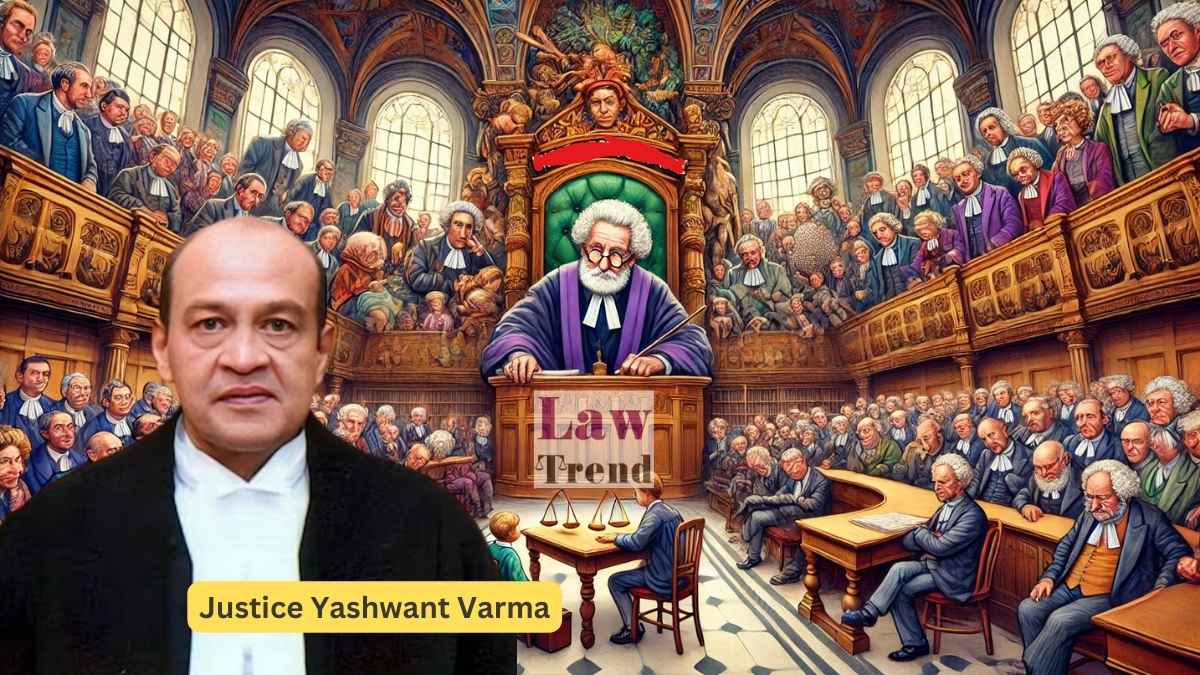
A three-member Inquiry Committee constituted by the Speaker of the Lok Sabha has concluded that all three charges framed against Justice Yashwant Varma, a judge of the Allahabad High Court, stand proved.
The finding, recorded in a 123-page report running to 299 paragraphs, arises from a fire at the judge’s then official residence in New Delhi on the night of 14–15 March 2025 — an incident that began as an ordinary emergency call and ended up triggering the first full statutory removal inquiry against a sitting judge in years.
The Committee comprised Justice Aravind Kumar, a judge of the Supreme Court of India, as Presiding Officer; Justice Shree Chandrashekhar, Chief Justice of the Bombay High Court; and Shri B.V. Acharya, a Senior Advocate of the Karnataka High Court, appointed as the “distinguished jurist” that the law requires on such a panel.
It is important to be clear at the outset about what this report is and is not. It is not a criminal verdict. It is not a conviction. It is a finding by an investigating committee that is one step — an important one — in a long constitutional process that only Parliament can complete.
How a fire became a constitutional question
On the night of 14–15 March 2025, a fire was reported through a Police Control Room call at 30, Tughlaq Crescent, New Delhi — the official residence then allotted to Justice Varma, who was at that time a judge of the Delhi High Court.
Fire tenders from Safdarjung Fire Station reached the premises. The fire was confined to a storeroom in a corner of the compound, near the portion where household staff and security personnel were housed. Police from Tughlaq Road police station also arrived.
While the fire was being doused and during the cooling operation that followed, fire service and police personnel say they saw something inside the room that had nothing to do with a household fire: large quantities of ₹500 currency notes — burnt, half-burnt, soaked by the fire hoses, and scattered across the floor and on a ledge.
Officials present photographed and filmed the scene on their mobile phones and forwarded the material to their superiors. Justice Varma and his wife were not in Delhi that night.
From there the matter travelled through institutional channels rather than through the police. The Chief Justice of the Delhi High Court, Justice Devendra Kumar Upadhyaya, reported the matter to the then Chief Justice of India, Justice Sanjiv Khanna. Justice Varma was asked to explain three specific things: how he accounted for the presence of cash in the room, what its source was, and who had removed the burnt cash on the morning of 15 March.
In his reply dated 22 March 2025, he denied all knowledge of any cash, said neither he nor his family had placed any there, said no cash was seen by his household or staff after the fire was doused, and said the question of explaining a source did not arise. He also said the material shown to him raised an apprehension of conspiracy.
The Supreme Court’s internal machinery took over. A three-judge in-house committee was constituted on 22 March 2025. On 28 March, it was announced that no judicial work would be assigned to Justice Varma. That committee submitted its report on 4 May 2025. The CJI then advised Justice Varma to resign or take voluntary retirement; he declined, saying that doing so would imply acquiescence in a process and outcome he considered unjust.
Justice Varma challenged the in-house report in the Supreme Court. That petition was dismissed on 7 August 2025. Meanwhile, on 21 July 2025, members of both Houses had submitted notices of motion for his removal. The Speaker of the Lok Sabha admitted the notice on 12 August 2025 and constituted the statutory Committee the same day.
The law behind the process
Under Article 124(4) of the Constitution — extended to High Court judges by Article 218 — a judge can be removed only for “proved misbehaviour or incapacity,” and only by an address of both Houses of Parliament passed by a special majority.
The word doing the heavy lifting is proved. Article 124(5) allowed Parliament to legislate the machinery for proving it, and that machinery is the Judges (Inquiry) Act, 1968. Once a removal motion is admitted, the Speaker or Chairman constitutes a committee, which frames definite charges, investigates them, and submits findings on each charge with reasons.
The Committee has the powers of a civil court — it can summon witnesses, take evidence on oath and compel production of documents. But it is not a criminal court. The report describes the proceedings as sui generis: statutory in source, judicial in method, and constitutional in consequence.
The three charges
Charges were framed on 23 November 2025 and served on Justice Varma on 27 November. They were:
- Discovery and possession of unexplained Indian currency within official premises under his occupation and control, and failure to disclose its lawful source or ownership.
- Failure to preserve, and interference with, material evidence — that the scene was altered or cleared before lawful inspection and sealing.
- Furnishing evasive and misleading explanations when called upon to account for the incident.
What the evidence was
Nine witnesses were examined — fire service personnel, police officers and a security guard. All were cross-examined at length by senior counsel for Justice Varma. Some 221 items were marked as exhibits, including videos, still photographs, forensic reports from CFSL, occurrence books, duty registers, call detail records and site photographs.
The fire personnel described bundles and heaps of ₹500 notes. One station officer’s voice, captured on a video recorded at the scene, was identified in evidence as saying “Mahatma Gandhi mein aag lag rahi hai bhai.” A head constable, asked in cross-examination whether the amount exceeded five lakh rupees, deposed: “I state that the money found at the place of fire was un-imaginable and an ordinary person like me could not have thought of it in dreams also. The amount of five lakhs is too small. When the fire was doused and being cleared, the bundles of five hundred currency notes were found all over.”
Then comes the part that shapes the whole report. Nobody seized the money. No panchnama was drawn. No inventory was made. Not even one or two notes were taken to test whether they were genuine. Officers explained that the scene was inside a sitting High Court judge’s residence, that they considered the matter sensitive, and that they acted on instructions from superiors. The judge’s Private Secretary asked the fire officials to leave once the fire was doused.
By the time anyone looked again, the cash was gone.
Liquor Cabinet
The Committee was careful to explain what it was and was not doing with this. It expressly recorded that the circumstance was “not noticed for the nature of the article stored” — the point had nothing to do with alcohol, or with any impropriety in keeping it. Nor, the report says in terms, does the cabinet prove that the currency belonged to Justice Varma, or amount to proof of possession of the cash. Its relevance, in the Committee’s words, is “narrower but significant.” The point was simply about what the room was. A locked cabinet holding personal articles, the Committee reasoned, is not ordinarily maintained in a space that is wholly unregulated, wholly outside the occupant’s knowledge, or wholly beyond his effective control.
That is the hinge on which the first charge turns. Justice Varma’s defence needed the storeroom to be a kind of no-man’s-land within his own compound — inside the gates, but effectively nobody’s responsibility. The cabinet suggested otherwise: that the room was connected enough to his household for him to keep something of his own there, under his own lock and key. A related detail pointed the same way. His claim that the storeroom was always locked was disputed, but it was accepted that when it was locked, the key hung near the water dispenser — an arrangement of the household, not of strangers. If the room was sufficiently part of his establishment for all that, the Committee held, the plea of no effective control could not be accepted in the sweeping form in which it was advanced.
How the Committee reasoned
The report is notably careful about the limits of what it finds.
On quantity, it refuses to name a figure. Without seizure, counting, weighing or sampling, it says, no exact rupee amount can be recorded. But it holds that the inability to quantify is not the same as absence of proof, and that the evidence describes bundles, heaps and stacks — “not stray notes.”
On control of the room, Justice Varma argued the storeroom was detached from his living quarters, unlocked, and accessible to staff, gardeners and CPWD personnel. The Committee accepted all of that as description, but held it did not answer the charge: the room was inside the allotted premises, not outside them, and shared access is not the same as absence of control. It noted his own statement of defence, which mentioned that a locked liquor cabinet was kept in that storeroom — using it not as proof that the cash was his, but to weaken the claim that the room was wholly outside his knowledge and use.
On non-seizure, it treated the failure as a serious lapse by the first responders — but a lapse that damages precise quantification, not the fact that the notes were seen by multiple independent officials from two different departments.
On the disappearance, the Committee relied on a CRPF witness who said he saw the judge’s Private Secretary and a household staff member near the storeroom after the fire, engaged in cleaning work in the early hours, and that when he offered help he was told to go and do his duty at the gate. Read with call records showing the judge was in telephonic contact with those very persons that night — the Committee used the records only for the fact and timing of the calls, not their content — it inferred that the clearing of the scene happened at his instance.
On the defences of conspiracy, planting, fake currency and removal by first responders, the Committee held each remained an unsupported hypothesis. Suggestions were put to witnesses in cross-examination and denied. No person was named. No complaint or FIR alleging planting or theft was ever lodged.
The withdrawal
On 9 April 2026 — after the prosecution evidence had closed and on the eve of the stage at which he was to lead his own defence — Justice Varma wrote to the Committee withdrawing from the proceedings, with parallel letters to the President of India and the Chief Justice of India. His letter alleged procedural unfairness, improper use of in-house committee material, and reversal of the burden of proof. On 21 April his counsel sought and were granted discharge.
The Committee held that a statutory inquiry “cannot be entered into in stages and judged in fragments,” and that unilateral withdrawal after substantial participation could not dissolve it. On 29 April 2026 the Speaker’s secretariat conveyed that the Committee should complete its investigation and report.
Significantly, the Committee expressly declined to treat the withdrawal as proof of any charge. Its relevance, it said, was narrower: it came precisely when the judge could have placed his positive factual case on record, and it left unanswered the questions only he and his household could answer. He never entered the witness box; his Private Secretary and household staff were never examined in his defence.
The findings
- Charge I: proved. Substantial unexplained ₹500 notes were found in a storeroom within the official premises, and no satisfactory explanation of their presence, source or ownership was furnished.
- Charge II: proved — but framed with precision. The finding rests on failure to preserve, disturbance of the scene, and the unexplained later non-availability of the cash, not on proof that Justice Varma personally removed anything.
- Charge III: proved. The explanations lacked the candour and transparency expected of a constitutional functionary, and shifted over time from broad denial to a series of alternative theories.
What happens next
The report goes to the Speaker of the Lok Sabha. From there it enters Parliament’s hands.
Both Houses must each pass the removal motion by a majority of the total membership of that House and by a two-thirds majority of members present and voting. Only then is an address presented to the President, and only then can a judge be removed. No judge in independent India has ever completed that full journey.
So the report is a finding of fact, not an outcome. It answers the question the Constitution asks first — whether the misbehaviour is proved — and hands the far harder political question to the two Houses.




