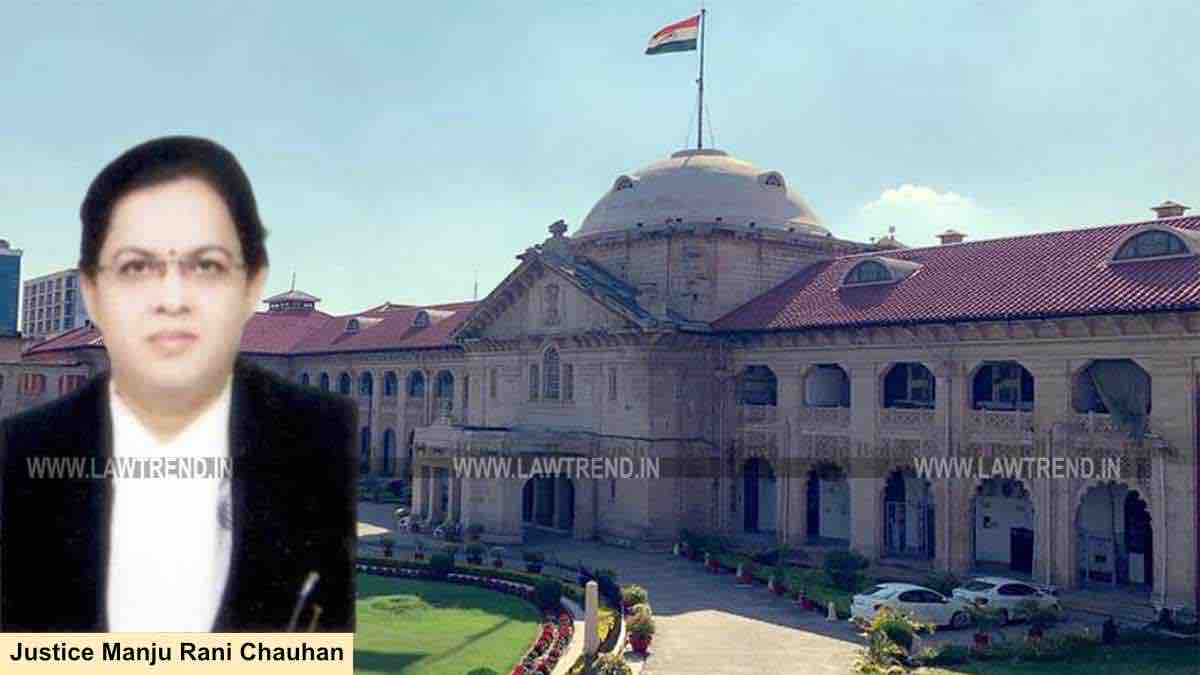
Setting aside orders that withheld the salary of a Class-IV employee appointed on compassionate grounds, the Allahabad High Court, presided over by Justice Manju Rani Chauhan, ruled that state authorities cannot deny financial benefits to an employee as long as the formal approval of their appointment remains legally valid and unrevoked. The Court emphasized that administrative authorities are bound by principles of fairness and natural justice and cannot penalize individuals for procedural lapses attributable to official inaction.
Background of the Case
The petitioner, Smt. Dharmwati Devi, sought the quashing of orders dated February 23, 2021, and March 8, 2021, passed by the Director of Basic Education, Uttar Pradesh, which rejected her claim for Class-IV salary.
Her husband, Shri Vijay Pal Singh, who served as an Assistant Teacher at Kisan Vaidik Junior High School in Latifpur, Gautam Buddh Nagar, passed away in harness in June 2001. At the time, the institution was an unaided recognized Junior High School. Following his death, the institution’s management issued an appointment letter on August 18, 2001, offering the petitioner a Class-IV post on compassionate grounds.
After a subsequent direction from the management on June 15, 2006, the petitioner joined the post on August 1, 2006. Her appointment was formally approved by the District Basic Education Officer (BSA), Gautam Buddh Nagar, on September 6, 2006.
When the institution was brought under the grant-in-aid list on December 2, 2006, under the U.P. Junior High School (Payment of Salaries of Teachers and Other Employees) Act, 1978, the Assistant Director of Education (Basic), Meerut/Saharanpur Division, raised an objection on March 16, 2007, claiming that the petitioner’s appointment had not followed statutory procedures. Consequently, her salary was withheld.
The petitioner previously approached the High Court in Writ Petition No. 58845 of 2008, which was initially dismissed by a Single Judge. However, in Special Appeal No. 898 of 2011, a Division Bench observed on January 18, 2020, that no record showed a lack of a vacant post or any revocation of the approval granted by the BSA. The Division Bench directed the competent authority to re-examine the matter. Despite this, the Director of Basic Education subsequently rejected her representation on February 23, 2021, and March 8, 2021.
Arguments of the Parties
Counsel for the petitioner contended that the rejection order violated natural justice, as it relied on reports submitted by subordinate authorities after the hearing concluded, without sharing them with the petitioner or granting an opportunity to respond. It was argued that the approval dated September 6, 2006, remained in force and had never been annulled. Furthermore, the petitioner argued that compassionate appointments are governed by the Government Order dated January 31, 1997, rather than the general selection procedures under the Uttar Pradesh Recognized Basic Schools (Junior High Schools) (Recruitment and Conditions of Service of Ministerial Staff and Group ‘D’ Employees) Rules, 1984, and that any administrative delay in processing the proposal could not be used to penalize the applicant.
On the other hand, the learned Standing Counsel appearing for the State submitted that the petitioner’s appointment was illegal because the selection process prescribed under the Rules of 1984 had not been followed. The State argued that on the date of appointment, the school was unaided, and government orders governing compassionate appointments became applicable to the institution only when it was brought on the grant-in-aid list on December 2, 2006. The State maintained that the BSA’s approval could not confer legality on an invalid appointment and that no sanctioned Class-IV post was available for pay release.
Court’s Analysis and Findings
Examining the record, Justice Manju Rani Chauhan held that the foundational premise of the State’s decision was legally unsustainable. The Court observed that the BSA’s approval order dated September 6, 2006, had never been withdrawn or cancelled by any competent authority in accordance with law.
Addressing the state’s refusal to release salary, the Court noted:
“An administrative order which continues to operate in the eyes of law cannot be rendered otiose by the simple expedient of refusing its consequential benefits. So long as the approval subsists, the respondents are estopped from questioning its efficacy indirectly while simultaneously declining the salary flowing therefrom.”
The Court criticized the authorities for ignoring the binding observations of the Division Bench in Special Appeal No. 898 of 2011 and re-agitating settled facts. Additionally, the Court found a clear breach of natural justice in relying on adverse reports obtained after the hearing without giving the petitioner a copy or a chance to rebut them, stating:
“Fairness in administrative action is not an empty formality but an indispensable facet of Article 14 of the Constitution.”
Relying on the Constitution Bench judgment in Mohinder Singh Gill v. Chief Election Commissioner (1978) 1 SCC 405 and Commissioner of Police Bombay v. Gordhandas Bhanji AIR 1952 SC 16, the Court reiterated that public orders must stand or fall on the reasons cited in them and cannot be supplemented later through fresh explanations.
The Court further held that a citizen cannot be made to suffer for administrative laches or procedural delays by state instrumentalities, citing the principle established in Asha Kaul (MRS) & Anr. v. State of Jammu & Kashmir & Ors. (1993) 2 SCC 573.
Reiterating the underlying objective of compassionate appointments, the Court emphasized:
“Such appointments are conceived not as a source of largesse but as a measure of immediate social welfare intended to rescue the bereaved family of a deceased employee from financial destitution.”
Citing Kranti Associates (P) Ltd. v. Masood Ahmed Khan (2010) 9 SCC 496, the High Court held that the rejection orders lacked cogent reasoning and violated Articles 14 and 21 of the Constitution of India.
Decision
The High Court quashed the impugned rejection orders dated February 23, 2021, and March 8, 2021, and allowed the writ petition in favor of the petitioner.
Case Title: Smt. Dharmwati Devi v. State of U.P. and 5 others
Case No.: Writ-A No. 6103 of 2021
Bench: Justice Manju Rani Chauhan
Date: July 07, 2026