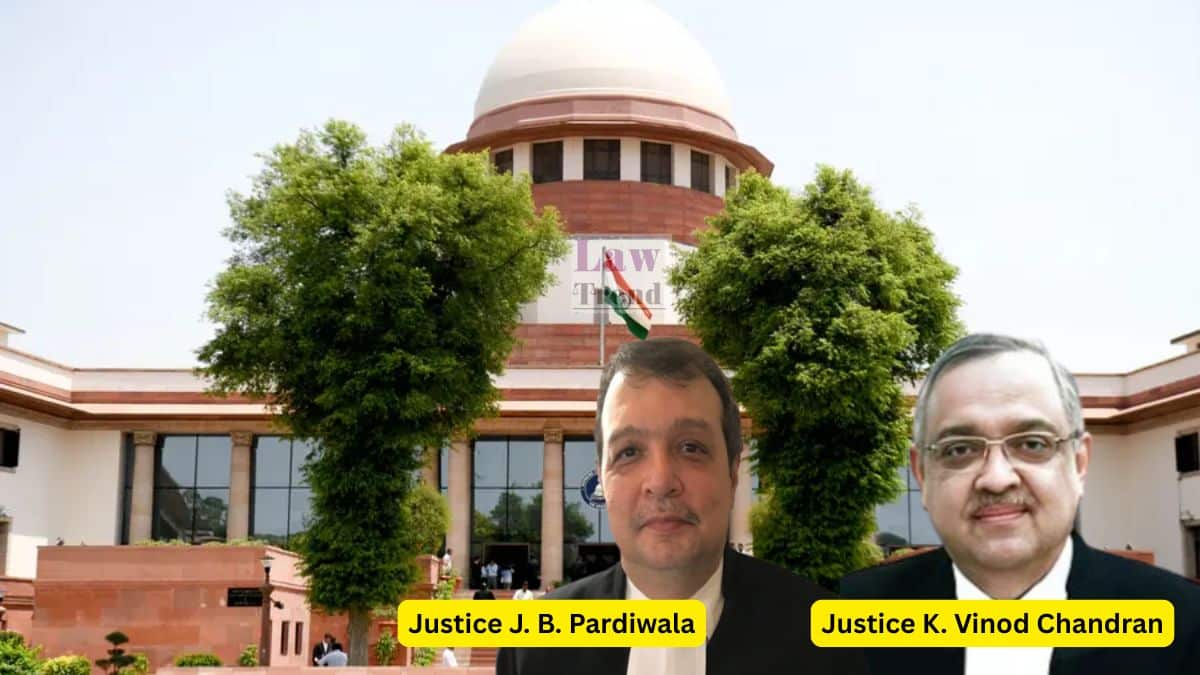
The Supreme Court has held that under Section 54 of the Transfer of Property Act, 1882, the non-payment or part-payment of the agreed sale consideration does not render a registered sale deed void or inoperative, nor does it entitle the seller to seek cancellation of the deed. A Supreme Court bench comprising Justice J. B. Pardiwala and Justice K. Vinod Chandran ruled that upon registration of a sale deed, title passes to the purchaser even if only part consideration is paid, and the seller’s remedy is to file a suit for the recovery of the balance consideration rather than seeking a declaration that the sale deed is null and void. On this basis, the apex court set aside a High Court judgment and restored the concurrent rulings of the Trial Court and First Appellate Court.
Background of the Case
The dispute arose out of two sale deeds executed on March 10, 1975, by a son and his mother (the original plaintiffs). The deeds were executed amidst mounting debts in the names of the plaintiffs with various financial institutions and government departments. The original defendant agreed to purchase the properties for a total consideration of Rs. 7,000 for each property.
Out of this amount, Rs. 2,500 per property was paid at the time of execution, as recorded in the sale deeds. As per the recitals, the defendant retained the balance of Rs. 4,500 for each property to directly satisfy the outstanding debts of the plaintiffs. However, the defendant failed to clear these dues. Subsequently, in 1975 and 1976, two agreements were executed wherein the defendant promised to pay the balance consideration and take responsibility for repaying the government loans.
In 1984, the plaintiffs filed a civil suit seeking to declare the two sale deeds void and inoperative, cancel the deeds, declare themselves absolute owners, and obtain a permanent injunction to prevent the defendant from interfering with their ownership and possession.
The Trial Court dismissed the suit, holding that the agreements pertained to a concluded sale and contained no clause stating that failure to pay the balance amount would cancel the sale deeds. The court observed that the defendant remained obligated to pay the balance amount of Rs. 4,500 for each property along with interest. Regarding possession, proceedings under Section 145 of the Code of Criminal Procedure, 1973 had led to the Sub Divisional Magistrate taking possession and later handing it back to the plaintiffs; the Trial Court chose not to disturb this possession. The First Appellate Court affirmed the Trial Court’s decision.
However, in a second appeal, the High Court reversed these concurrent findings. The High Court declared the sale deeds inoperative and declared the plaintiffs as absolute owners, reasoning that the defendant failed to produce evidence showing payment of the balance consideration or satisfaction of the plaintiffs’ debts.
Arguments of the Parties
Before the Supreme Court, counsel for the appellants (legal heirs of the original defendant) relied on Supreme Court precedents establishing that failure to pay full consideration does not invalidate a registered sale deed.
Counsel for the respondents (legal heirs of the original plaintiffs) argued that the High Court acted within its jurisdiction under Section 100 of the Code of Civil Procedure, 1908. It was submitted that the High Court did not reappreciate evidence but merely gave correct legal effect to the undisputed factual findings rendered by the lower courts regarding non-payment of full consideration.
Court’s Analysis and Cited Precedents
The Supreme Court examined the legal requirements of a sale under Section 54 of the Transfer of Property Act, 1882, and noted that Section 54 squarely applied to the case. The bench evaluated the principle laid down in Vidhyadhar v. Manikrao & Anr. (1999), which observed:
“The definition indicates that in order to constitute a sale, there must be a transfer of ownership from one person to another, i.e., transfer of all rights and interests in the properties which are possessed by that person are transferred by him to another person. The transferor cannot retain any part of his interest or right in that property or else it would not be a sale. The definition further says that the transfer of ownership has to be for a “price paid or promised or part-paid and part-promised”. Price thus constitutes an essential ingredient of the transaction of sale. The words “price paid or promised or part-paid and part-promised” indicate that actual payment of the whole of the price at the time of the execution of sale deed is not a sine qua non to the completion of the sale. Even if the whole of the price is not paid but the document is executed and thereafter registered, if the property is of the value of more than Rs 100, the sale would be complete.”
The Court further referenced the decision in Vidhyadhar, which cited Gayatri Prasad v. Board of Revenue (1973) and Sukaloo v. Punau (1961), highlighting that:
“The real test is the intention of the parties. In order to constitute a “sale”, the parties must intend to transfer the ownership of the property and they must also intend that the price would be paid either in praesenti or in future. The intention is to be gathered from the recital in the sale deed, the conduct of the parties and the evidence on record.”
The bench also discussed Dahiben v. Arvindbhai Kalyanji Bhanusali (Gajra) Dead through Legal Representatives & Ors. (2020), which reiterated that actual payment of the entire sale price at execution is not a condition precedent for completion of a sale. Once registered, title passes to the transferee, and non-payment of the remaining amount only gives rise to a remedy to recover the balance amount, not cancellation of the deed.
Applying these legal principles to the case, Justice K. Vinod Chandran noted for the bench:
“The sale deed executed with full knowledge of the part consideration alone having been passed, cannot be rendered void or inoperative merely because the balance consideration promised to be paid, which promise was incorporated in the sale deed, had not been complied with. The right of the plaintiffs was to file for recovery of balance sale consideration and not to seek declaration that the sale deeds were null and void; which they are not.”
The Supreme Court observed that the sale had become final upon execution and registration. Instead of suing for recovery of the balance consideration, the plaintiffs impermissibly sought cancellation of the deeds years after their execution.
Final Decision
The Supreme Court allowed the appeal, reversed the judgment of the High Court, and restored the judgment of the Trial Court as affirmed by the First Appellate Court.
The apex court confirmed that the appellants must pay the balance sale consideration with interest from March 10, 1975, at the rate charged on the plaintiffs by their creditors if they choose to seek possession of the property. The Supreme Court declined to interfere with the current possession of the plaintiffs.
Case Title: Raziya Begum & Ors. v. Nafisa Begum Abdul Hamid & Ors.
Case No.: Civil Appeal No. 7225 of 2011
Bench: Justice J. B. Pardiwala, Justice K. Vinod Chandran
Date: August 07, 2026