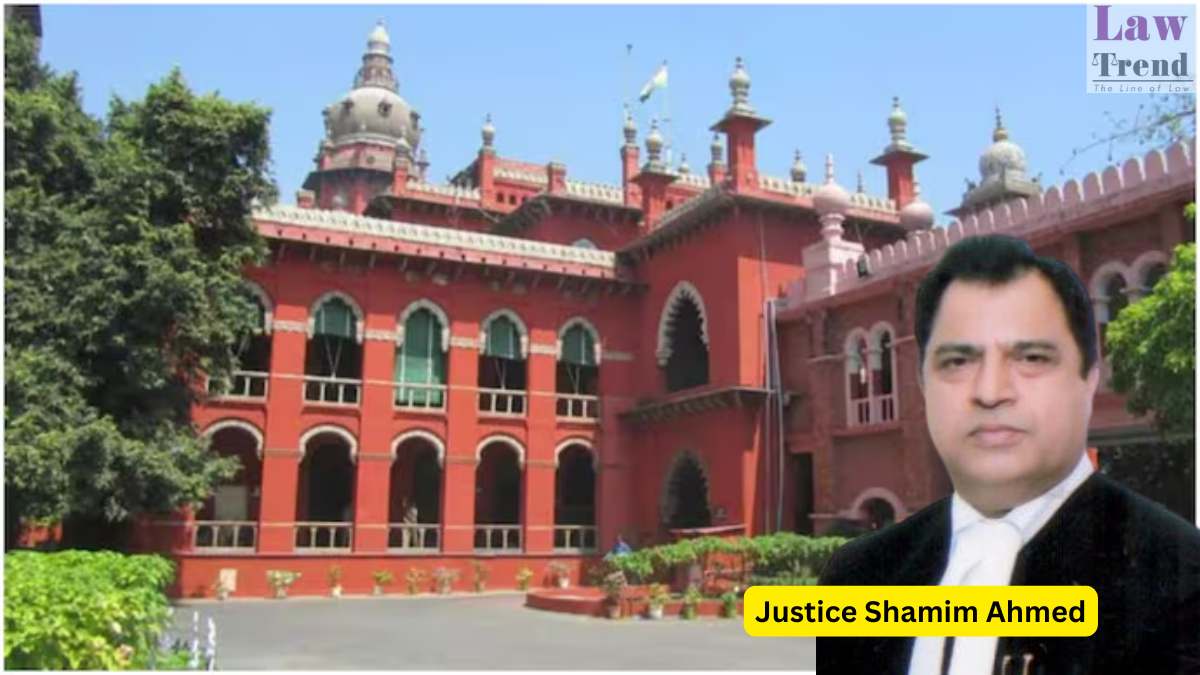
The Madras High Court, presided over by Justice Shamim Ahmed, has held that offences under Sections 3(1)(r) and 3(1)(s) of the Scheduled Castes and Scheduled Tribes (Prevention of Atrocities) Act, 1989, cannot be invoked when both the complainant and the accused belong to the Scheduled Caste community. Dismissing a criminal revision petition, the High Court upheld a trial court order refusing to take cognizance under the SC/ST Act while preserving the complainant’s liberty to pursue remedies under the Bharatiya Nyaya Sanhita, 2023.
Background of the Case
The petitioner, S. Krishnaraj, and the respondent, R. Raghupathi, were both employed at the Signal and Telecommunication Workshop of Southern Railway in Podanur, Coimbatore. According to the petitioner, who belongs to the Scheduled Caste community, the respondent intercepted him on July 12, 2025, at around 06:45 a.m. near the workshop entrance, insulted him using caste-based slurs, and physically assaulted him on his head and face. The petitioner sustained injuries to his head and elbow before being rescued by a passerby on a two-wheeler.
The petitioner lodged a complaint with the Inspector of Police, Podanur, on July 13, 2025. However, on July 16, 2025, the police allegedly instructed him to remove allegations regarding caste slurs, and the complaint was closed as an amicable settlement. Subsequently, on July 17, 2025, the petitioner suffered an epileptic fit, and a scan conducted on July 18, 2025, revealed hemorrhages in three locations on his head. Despite submitting representations and requesting an inspection of CCTV footage, no police action was taken.
The petitioner then filed a private complaint before the Special Court for trial of cases under the SC/ST (POA) Act, Coimbatore, under Sections 3(1)(r) and 3(1)(s) of the SC/ST (POA) Act, 1989, and Section 115(2) of the Bharatiya Nyaya Sanhita (BNS), 2023.
On November 21, 2025, the Special Court dismissed the complaint under the SC/ST Act on the ground that both the petitioner and the respondent belong to the Scheduled Caste community. It granted the petitioner liberty to file a fresh complaint before the appropriate court for the alleged offence under Section 115(2) of the BNS. Aggrieved by this decision, the petitioner approached the Madras High Court in revision.
Arguments of the Parties
Counsel for the petitioner, Mr. J. Nagarajan, argued before the High Court that once the trial court noted that the respondent caused injuries to the petitioner’s head and elbow and insulted him within public view, it ought to have directed an investigation by competent police officials and taken cognizance of the offences.
The respondent had maintained before the trial court that no offence was committed and that the police complaint had been amicably closed. The respondent asserted that the private complaint was instituted to harass him due to prior workplace friction, and produced a community certificate demonstrating that he belongs to the Hindu Adi Dravidar community, which falls under the Scheduled Caste category.
Court’s Analysis and Precedents
Justice Shamim Ahmed examined the essential statutory ingredients required to constitute offences under Sections 3(1)(r) and 3(1)(s) of the SC/ST Act, 1989:
- The accused person must not be a member of the Scheduled Caste or Scheduled Tribe.
- The accused must intentionally insult, intimidate, or abuse a member of a Scheduled Caste or Scheduled Tribe by caste name.
- The accused must act with the intent to humiliate such a person.
- The act must take place in any place within public view.
The High Court observed that the primary requirement of Section 3 of the Act is that the accused must be a non-member of the Scheduled Caste or Scheduled Tribe. The court noted that the petitioner himself admitted in his pleadings that the respondent claimed SC status upon joining service, and the respondent produced documentary proof of belonging to the Hindu Adi Dravidar community. The petitioner failed to adduce any evidence showing that the respondent was not a member of the SC community.
The court further noted that the petitioner failed to examine independent witnesses or submit materials demonstrating that the alleged caste-based abuse took place in a location within public view.
In analyzing the legal principles, the High Court referred to judgments of the Supreme Court and High Courts explicitly discussed in the case:
In Hitesh Verma v. State of Uttarakhand, the Supreme Court held: “All insults or intimidations to a person will not be an offence under the Act unless such insult or intimidation is on account of victim belonging to Scheduled Caste or Scheduled Tribe.” “Therefore, offence under the Act is not established merely on the fact that the informant is a member of Scheduled Caste unless there is an intention to humiliate a member of Scheduled Caste or Scheduled Tribe for the reason that the victim belongs to such caste.”
In Ramesh Chandra Vaishya v. State of U.P., the Supreme Court observed: “The legislative intent seems to be clear that every insult or intimidation for humiliation to a person would not amount to an offence under Section 3(1)(x) of the SC/ST Act unless, of course, such insult or intimidation is targeted at the victim because of he being a member of a particular Scheduled Caste or Tribe.”
In Bhaiya Lal Singh v. State UP, the High Court of Allahabad observed: “It is further observed that an offence under the Act, 1989 would be made out when a member of the vulnerable section of the society is subjected to indignities, humiliations and harassment in any place within the public view.”
Summarizing these principles, the High Court held: “To sum and substance, all insults or intimidations to a member of the SC or ST Community will not amount to an offence under the Act, 1989, unless such insult or intimidation is on the ground that the victim belongs to SC or ST Community.”
Decision of the Court
The High Court concluded that since both the petitioner and the respondent belong to the Scheduled Caste community, the provisions of Sections 3(1)(r) and 3(1)(s) of the SC/ST (POA) Act, 1989, cannot be attracted.
Finding no infirmity or irregularity in the trial court’s order, the High Court affirmed the dismissal of the revision petition while upholding the liberty granted to the petitioner to file a fresh complaint under the provisions of the Bharatiya Nyaya Sanhita, 2023. The Criminal Revision Case was dismissed with no order as to costs.
Case Title: S. Krishnaraj v. R. Raghupathi
Case No.: Crl. RC. No. 1618 of 2026
Bench: Justice Shamim Ahmed
Date: 05.08.2026