

No Mini-Trial Permitted At Discharge Stage: Madras High Court Rejects Discharge Plea In BSP Leader K. Amstrang Murder Case
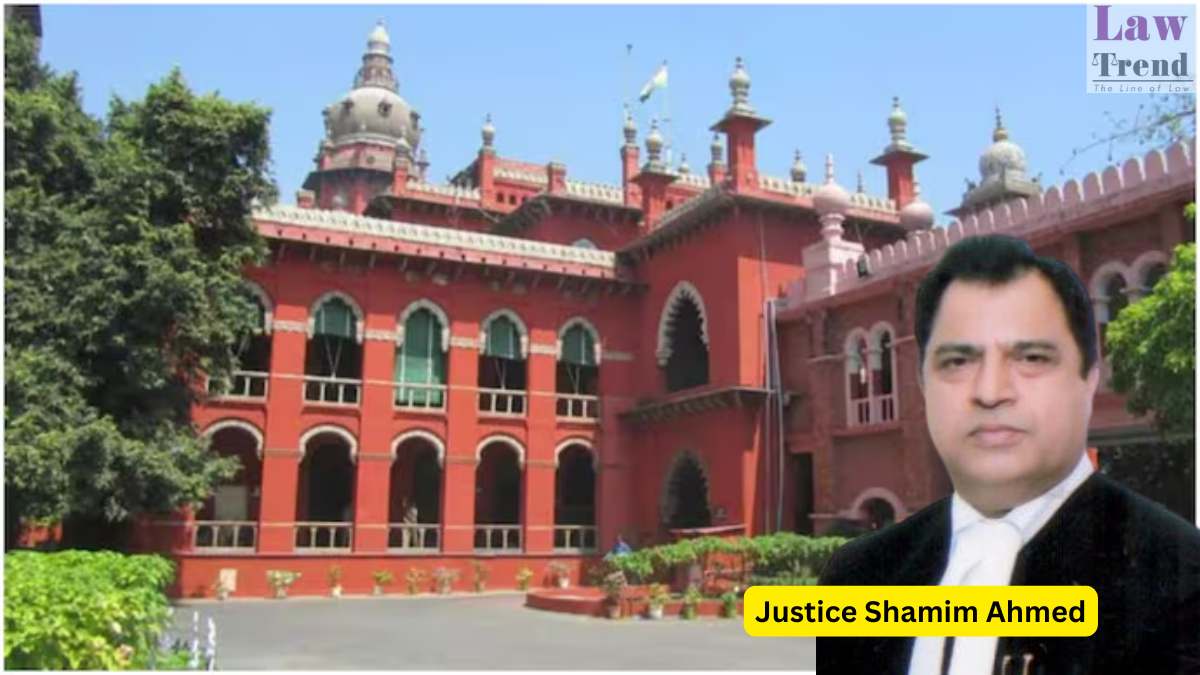

The Madras High Court, in a single-judge bench presided over by Justice Shamim Ahmed, has dismissed a criminal revision case seeking the discharge of an accused charged in connection with the murder of former Bahujan Samaj Party (BSP) Tamil Nadu State President K. Amstrang. The High Court affirmed that courts cannot conduct a mini-trial or evaluate evidence in-depth at the stage of framing charges under Section 250 of the Bharatiya Nagarik Suraksha Sanhita (BNSS), and must instead determine whether sufficient prima facie material exists to proceed with the trial.

Background of the Case

On July 5, 2024, K. Amstrang, who was serving as the Tamil Nadu State President of the Bahujan Samaj Party, was brutally murdered by a group of persons. During the investigation into Crime No. 293 of 2024 by the K-1 Sembium Police Station, law enforcement officials secured two country-made bombs near the scene of occurrence.

The petitioner, Kumara alias Senthilkumar (designated as Accused No. 28 / A28), was alleged to have supplied these country-made bombs to the co-accused on June 14, 2024. He was arrested and remanded to judicial custody on August 22, 2024. A charge sheet was filed under Sections 61(2)(a) read with 103(1), 191(3), 351(3), 109, 238 read with 190, and 49 of the Bharatiya Nyaya Sanhita (BNS), 2023, alongside Sections 4(b) read with 5 and 6 of the Explosive Substances Act, Section 25(1B)(a) of the Arms Act, and Section 201 of the Indian Penal Code (IPC). The case was taken on file as S.C. No. 425 of 2024 before the Principal Sessions Court, Chennai.

The petitioner subsequently filed a discharge petition under Section 250 of the BNSS (Crl.M.P. No. 12 of 2025). During its pendency, the High Court’s coordinate bench quashed the charge sheet and transferred the investigation to the Central Bureau of Investigation (CBI) on September 24, 2025. However, the Supreme Court of India stayed the quashing of the charge sheet on October 10, 2025, and subsequently stayed the transfer to the CBI on November 19, 2025, leaving the cognizance taken by the trial court in force.

On April 28, 2026, the learned Principal Sessions Judge, Chennai, dismissed the discharge petition, prompting the petitioner to approach the High Court in revision.

Arguments of the Parties

Appearing for the petitioner, learned counsel Mr. Vikram Veerasamy contended that the trial court failed to independently analyze the specific role attributed to A28. It was submitted that:

  • No CCTV footage demonstrated the petitioner’s presence at the scene of the occurrence or his involvement in the crime.
  • No explosive substance, weapon, or incriminating material was recovered from the petitioner.
  • No specific overt act was attributed to him, and no confessional statement of the co-accused disclosed that the petitioner had knowledge of the nature of the articles transported or their intended use.
  • In the absence of connecting material, continuation of criminal proceedings against the petitioner was legally unsustainable.
READ ALSO  Owner of the truck is jointly liable for the cost of transport, treatment and care of animals transported illegally for sale: Bombay HC

Representing the State, learned Government Advocate (Criminal Side) Mr. M.M.I. Khaleel submitted that:

  • In light of the Supreme Court’s stay on the quashing of the charge sheet, the cognizance taken in S.C. No. 425 of 2024 remains in full force.
  • Prima facie materials exist to frame charges against the petitioner under Section 201 of the IPC for supplying country-made bombs.
  • The grounds raised by the petitioner are factual in nature and can only be tested during trial.
  • At the stage of discharge, the court must only see if prima facie materials exist, and allowing the discharge petition would risk evidence tampering and trial obstruction.

Court’s Analysis and Legal Precedents

The High Court reviewed the scope of discharge under Section 173 of the Code of Criminal Procedure (CrPC) / BNSS, reiterating that a court is required to consider only the final report, documents filed alongside it, statements recorded under Section 161 CrPC, and confession statements.

Justice Shamim Ahmed underscored that courts cannot conduct a roving inquiry or mini-trial at the discharge stage. To support this legal position, the High Court relied on key Supreme Court decisions:

  1. State of Tamil Nadu v. N. Suresh Rajan and others (2014 11 SCC 709): “True it is that at the time of consideration of the applications for discharge, the Court cannot act as a mouthpiece of the prosecution or act as a post office and may sift evidence in order to find out whether or not the allegations made are groundless so as to pass an order of discharge. It is trite that at the stage of consideration of an application for discharge, the Court has to proceed with an assumption that the materials brought on record by the prosecution are true and evaluate the said materials and documents with a view to find out whether the facts emerging therefrom taken at their face value disclose the existence of all the ingredients constituting the alleged offence. At this stage, probative value of the materials has to be gone into and the Court is not expected to go deep into the matter and hold that the materials would not warrant a conviction. In our opinion, what needs to be considered is whether there is a ground for presuming that the offence has been committed and not whether a ground for convicting the accused has been made out. To put it differently, if the Court thinks that the accused might have committed the offence on the basis of the materials on record on its probative value, it can frame the charge; though for conviction, the Court has to come to the conclusion that the accused has committed the offence. The law does not permit a mini trial at this stage.”
    “While passing the impugned orders, the Court has not sifted the materials for the purpose of finding out whether or not there is sufficient ground for proceeding against the accused but whether that would warrant a conviction. We are of the opinion that this was not the stage where the Court should have appraised the evidence and discharged the accused as if it was passing an order of acquittal. Further, defect in investigation itself cannot be a ground for discharge. In our opinion, the order impugned suffers from grave error and calls for rectification.”
  2. State v. A. Arun Kumar (2015 2 SCC 417) citing Sajjan Kumar v. CBI (2010 9 SCC 368): “It is clear that at the initial stage, if there is a strong suspicion which leads the court to think that there is ground for presuming that the accused has committed an offence, then it is not open to the court to say that there is no sufficient ground for proceeding against the accused. The presumption of the guilt of the accused which is to be drawn at the initial stage is only for the purpose of deciding prima facie whether the court should proceed with the trial or not. If the evidence which the prosecution proposes to adduce proves the guilt of the accused even if fully accepted before it is challenged in cross-examination or rebutted by the defence evidence, if any, cannot show that the accused committed the offence, then there will be no sufficient ground for proceeding with the trial.”
  3. State by the Inspector of Police, Chennai v. S. Selvi and another (2018 13 SCC 455): “The Judge while considering the question of framing charge under Section 227 of the Code in sessions cases (which is akin to Section 239 CrPC pertaining to warrant cases) has the undoubted power to sift and weigh the evidence for the limited purpose of finding out whether or not a prima facie case against the accused has been made out; where the material placed before the court discloses grave suspicion against the accused which has not been properly explained, the court will be fully justified in framing the charge; by and large if two views are equally possible and the Judge is satisfied that the evidence produced before him while giving rise to some suspicion but not grave suspicion against the accused, he will be fully within his rights to discharge the accused. The Judge cannot act merely as a post office or a mouthpiece of the prosecution, but has to consider the broad probabilities of the case, the total effect of the statements and the documents produced before the court, any basic infirmities appearing in the case and so on. This however does not mean that the Judge should make a roving enquiry into the pros and cons of the matter and weigh the materials as if he was conducting a trial.”
    “If on the basis of the material on record, the Court would form prima facie opinion that the accused might have committed the offence, it can frame charge, though for conviction it is required to be proved beyond reasonable doubt that the accused has committed the offence. At the time of framing of charges, the probative value of the material on record has to be gone into and the Court is not expected to go deep into the matter and hold that the materials would not warrant conviction. The Court is required to evaluate the material on record at the stage of Sections 227 or 239 of the Code, as the case may be, only with a view to find out if the facts emerging therefrom taken at the face value discloses the existence of all the ingredients constituting the alleged offence. It is trite that at the stage of consideration of an application for discharge, the Court has to proceed with the presumption that materials brought on record by the prosecution are true and evaluate such material with a view to find out whether the facts emerging therefrom taken at their face value disclose existence of the ingredients of the offence.”
  4. Amit Kapoor v. Ramesh Chander and another (2012 9 SCC 460): The court reiterated that framing of charge is a tentative view, subject to final trial culmination, and the High Court cannot re-evaluate evidence at this stage when facts can only be tested during a full trial.
READ ALSO  Supreme Court Orders Inquiry into Juvenility Claim Raised 46 Years After Offence in 1983 Murder Case

Court Decision

Applying these established principles, the High Court held that the present stage is not appropriate for evaluating or appreciating documents and records in detail. It concluded that the petitioner’s claims can only be decided after a full-fledged trial upon adducing evidence.

Consequently, the Criminal Revision Case was dismissed, and the connected Criminal Miscellaneous Petition was closed. The High Court clarified that any observations made in the order were solely for disposing of the revision case and would have no bearing on the defence raised during the trial.

READ ALSO  सनातन धर्म पर टिप्पणी को लेकर अमित मालवीय के खिलाफ दर्ज FIR मद्रास हाईकोर्ट से खारिज

Case Title: Kumara @ Senthilkumar v. The State Rep. by the Inspector of Police, K-I Sembium Police Station, Chennai

Case No.: CRL RC No. 1428 of 2026 (Crl.MP.No.12309 of 2026)

Bench: Justice Shamim Ahmed

Date: 16-07-2026

Law Trend
Law Trendhttps://lawtrend.in/
Legal News Website Providing Latest Judgments of Supreme Court and High Court

Related Articles

Latest Articles

