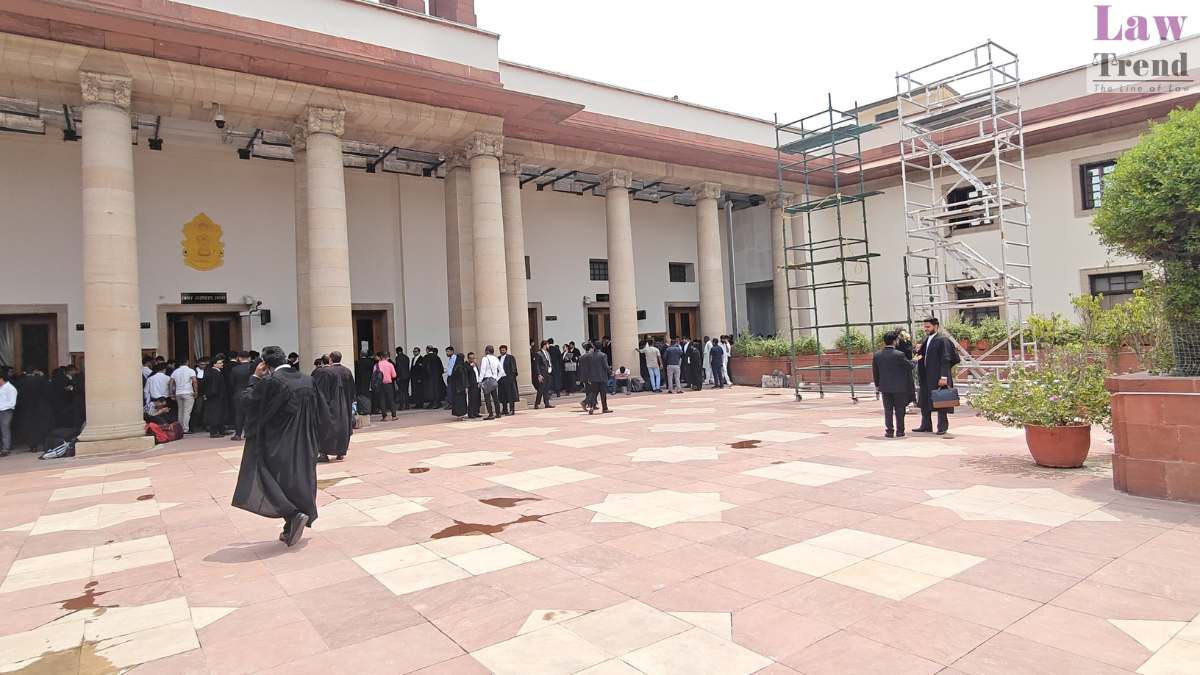
The Supreme Court of India, in a bench comprising Justice Sanjay Karol and Justice Augustine George Masih, has modified the sentence of a gang rape convict from rigorous imprisonment for the remainder of his natural life to 20 years of rigorous imprisonment with the benefit of remission. While the Court refused to interfere with the lower courts’ concurrent findings of conviction under Section 376-D of the Indian Penal Code, 1860, it examined whether the sentence of life imprisonment for the remainder of natural life satisfied the doctrine of proportionality. The bench ultimately balanced the heinous nature of the offense against the appellant’s youth, clean record, and demonstrated potential for reformation, holding that sentencing must remain balanced and proportionate.
Background of the Case
The case arose from an incident in New Delhi where the victim took a rickshaw at night from the Delhi Railway Station, on the driver’s assurance that he would drop her off at her home. Instead of doing so, the driver took her to a deserted place where another person was already present, and they proceeded to commit rape. This led to the registration of FIR No. 0411 on 7th September 2016 at the Police Station, I.P. Estate, New Delhi.
On 7th June 2017 and 9th June 2017, the Additional Sessions Judge, Tis Hazari Courts, Delhi, convicted the appellant, Ehsaan, and co-accused Umesh Giri under Section 376-D of the Indian Penal Code (IPC). They were sentenced to rigorous imprisonment for the remainder of their natural life, along with a fine of Rs. 25,000 each (and simple imprisonment for two years in default of payment). The Trial Court’s decision relied on the evidence of the victim (PW-2) and witness (PW-8), citing precedents such as State of Punjab v. Saurabh Bakshi, Gopal Singh v. State of Uttarakhand, and State of Punjab v. Bawa Singh. The High Court of Delhi, on 1st November 2017, independently evaluated the evidence and affirmed the conviction and sentence in total. While issuing notice on 5th January 2026, the Supreme Court refused to interfere with the conviction, limiting its review strictly to the quantum of sentence.
Arguments of the Parties
The appellant argued that he had no prior criminal antecedents and was only 25 years old at the time of the offense. Given his young age, it was submitted that there is a strong possibility of reformation. The appellant further stated that during his nearly ten years of incarceration (including remission), he had maintained good conduct in prison.
The respondent, the State of National Capital Territory of Delhi, did not bring any material on record to show that reformation was impossible, nor did it dispute the appellant’s statement regarding his good prison conduct.
The Court’s Analysis
The Supreme Court evaluated the sentence through the lens of the doctrine of proportionality. Justice Sanjay Karol, writing the judgment, highlighted the foundational principle of sentencing by quoting Justice K. Ramaswamy from Sevaka Perumal v. State of T.N.:
“By deft modulation of sentencing process be stern where it should be, and tempered with mercy where it warrants to be.”
The Court referred to the dissenting opinion of Justice P.N. Bhagwati in Bachan Singh v. State of Punjab, which established proportionality as a constitutional criterion under Articles 14, 19, and 21:
“Now it is an essential element of the rule of law that the sentence imposed must be proportionate to the offence. If a law provides for imposition of a sentence which is disproportionate to the offence, it would be arbitrary and irrational, for it would not pass the test of reason and would be contrary to the rule of law…”
The bench also cited the observations of Justice Surya Kant in Surinder Singh v. State (UT of Chandigarh), which noted that while gravity is the primary consideration, the elements of rehabilitative justice and mitigating grounds must be considered within judicial discretion. Additionally, the Court cited State of Karnataka v. Krishnappa (later referred to in Shimbhu v. State of Haryana), which emphasized that crimes of violence against women must be severely dealt with, and public abhorrence must find reflection in appropriate sentencing.
The bench reviewed several precedents where sentences were modified, including Shankar Kisanrao Khade v. State of Maharashtra (death sentence reduced to life imprisonment), Rajkumar v. State of M.P. (death sentence altered to 35 years of rigorous imprisonment without remission), Selvam v. State (modified to a minimum of 30 years without remission), Parsuram v. State of M.P. (death sentence modified to 30 years of actual imprisonment due to failure to consider reformation and lack of antecedents), Sundar v. State (sentence modified to a minimum of 20 years of rigorous imprisonment without remission for a young offender with good prison conduct), and Ravinder Singh v. State (NCT of Delhi) (sentence modified to a fixed 20-year term).
The Court noted that Section 376-D of the IPC was substituted by the Criminal Law Amendment Act of 2013 following the Nirbhaya incident. This amendment set a statutory minimum sentence of 20 years and a maximum of life imprisonment for the remainder of natural life. By removing the judicial discretion to reduce the sentence below the statutory minimum for “adequate and special reasons,” the legislature recognized the extreme seriousness of the offense.
While acknowledging the severity of the crime, the Court reflected on the persistence of sexual violence against women, referring to National Crime Records Bureau (NCRB) statistics on rape cases reported between 2021 and 2024. The bench observed:
“…the offence, as already observed is heinous and is not only against the victim PW-2 but against the society at large. Despite much evolution, sociologically and psychologically, to break away from the chains of patriarchal thought, incidents such as these are only continuing unabashedly.”
The Decision
Applying these principles, the Supreme Court balanced the heinous nature of the gang rape against the mitigating factors in favor of the appellant. Since the appellant had no criminal antecedents, was 25 years old at the time of the incident, had maintained good conduct over nearly ten years of incarceration, and the State had failed to establish that reformation was impossible, the Court deemed it appropriate to modify the sentence.
The Supreme Court partly allowed the appeal, reducing the appellant’s sentence from life imprisonment for the remainder of his natural life to 20 years of rigorous imprisonment, with the benefit of remission, if any.
Case Title: Ehsaan v. State of National Capital Territory of Delhi
Case No.: Criminal Appeal No. of 2026 (Arising out of SLP(Crl.) No. 3407 of 2026)
Bench: Justice Sanjay Karol, Justice Augustine George Masih
Date: July 20, 2026