

Section 68 of Evidence Act Applies Only to Documents Requiring Mandatory Attestation, Not Registered Sale Deeds: Supreme Court
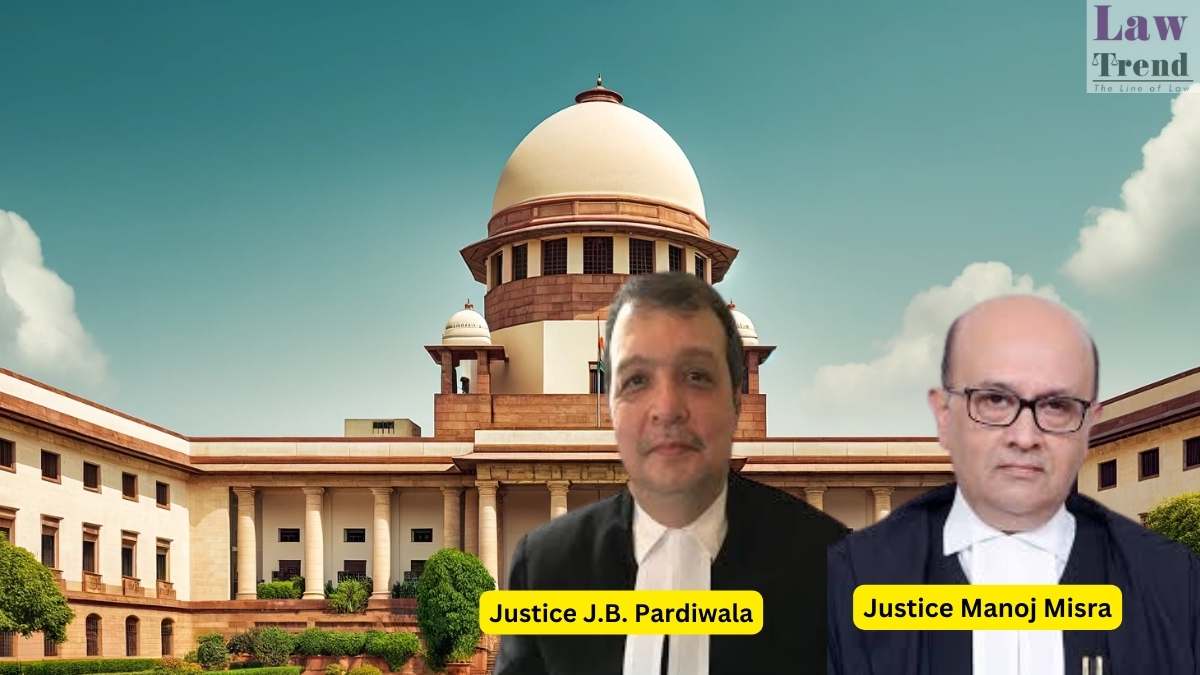

In a significant legal development, the Supreme Court of India, comprising Justice J.B. Pardiwala and Justice Manoj Misra, has ruled that Section 68 of the Indian Evidence Act, 1872, applies exclusively to documents requiring mandatory attestation by law and has no application to registered sale deeds. Setting aside a Kerala High Court judgment, the apex court remitted the matter back for a fresh hearing after holding that the High Court erred procedurally by not formulating any substantial questions of law and substantively by misinterpreting the rules of attestation in relation to a registered sale deed.

Background of the Dispute

The case originated from a dispute over a 13-cent property designated as Plaint “A” Schedule property. Originally, a 6.5-cent portion of this property (described as “B” Schedule property) belonged to Rajeswari (Defendant No. 3) through a 1978 partition deed. The other half was owned by Ashok Kumar and Lalitha.

On December 19, 1978, Rajeswari sold her 6.5-cent share to a buyer named Vanajakshi via a registered sale deed (Ext. A-3). Subsequently, on December 31, 1979, Ashok Kumar, Lalitha, and Vanajakshi jointly executed a registered sale deed transferring the entire 13 cents to the original plaintiff, Rudrayani Devaki (now represented by her legal representatives).

The conflict arose when Rajeswari executed a second sale deed on January 24, 1996 (Ext. A-4), for the exact same 6.5-cent property in favor of R. Veronica and another (the appellants/Defendant Nos. 1 and 2). Based on this 1996 deed, the appellants allegedly took forceful possession of the property and began construction. This led the plaintiff to file a suit in the Court of the Munsif, Nedumangad, seeking a declaration of title over Plaint “A” Schedule, recovery of possession of Plaint “B” Schedule, and the cancellation of the 1996 sale deed.

The defendants resisted the suit, claiming that Rajeswari had never executed the 1978 sale deed to Vanajakshi and that the plaintiff’s title documents were fabricated.

READ ALSO  Criminal Proceedings Launched by Drawer of Cheque After Filing Sec 138 NI Act Case are Counterblast and Abuse of Process of Law: Allahabad HC

Journey Through the Lower Courts

The Trial Court allowed the plaintiff’s suit, declaring the 1996 sale deed null and void. It accepted the oral testimony of the attesting witness (PW-3, the husband of the deceased Vanajakshi) as reliable.

However, on appeal, the First Appellate Court reversed the Trial Court’s decision and dismissed the suit. It held that the Advocate Commissioner failed to properly identify the properties and that the testimony of PW-3 did not inspire confidence to prove the execution of the 1978 sale deed, especially since the execution had been denied by Rajeswari.

The plaintiff then filed a Second Appeal before the Kerala High Court. The High Court allowed the appeal and restored the Trial Court’s decree. The High Court reasoned that under the proviso to Section 68 of the Evidence Act, any denial of execution must be raised specifically by the executant herself in a suit or counterclaim initiated by her. Since Rajeswari had not filed any such independent proceeding, the High Court held that the proviso to Section 68 applied, and therefore, the plaintiff was not required to call any attesting witnesses to prove the deed.

Arguments of the Parties before the Supreme Court

Before the Supreme Court, the appellants argued that the High Court committed a grave legal error by deciding the Second Appeal under Section 100 of the Code of Civil Procedure (CPC) without formulating any substantial questions of law. They also argued that the High Court’s interpretation of Section 68 of the Evidence Act was entirely erroneous because the statutory provision does not require a party to file an independent suit or counterclaim just to deny the execution of a document.

READ ALSO  बिक्री समझौते के विशिष्ट निष्पादन की मांग करने के लिए वादी को धन की उपलब्धता दिखानी होगी: सुप्रीम कोर्ट

The respondents countered that the High Court’s legal interpretation was correct. They maintained that the 1978 sale deed was validly proved and that the First Appellate Court had no justifiable grounds to disbelieve the testimony of the attesting witness.

The Court’s Analysis and Observations

The Supreme Court examined two critical legal issues: the procedural requirement of formulating questions of law in a Second Appeal, and the substantive interpretation of Section 68 of the Evidence Act.

On the procedural front, the Court emphasized that under Section 100 of the CPC, the formulation of a substantial question of law is a mandatory condition precedent for a High Court to entertain and decide a second appeal. By deciding the appeal on its merits without formulating such questions, the High Court’s judgment was rendered legally invalid.

On the substantive issue of evidence, the Supreme Court pointed out that Section 54 of the Transfer of Property Act, 1882, defines a sale deed and does not mandate that a sale deed must be attested by witnesses. Because attestation is not a legal requirement for a sale deed, Section 68 of the Evidence Act—which details how to prove documents that are required by law to be attested—has no application.

The Court explicitly observed: “A sale deed being not required by law to be attested, the provisions of Section 68 of the Indian Evidence Act on the face of it is not applicable.”

The Court explained that the High Court misconstrued the proviso to Section 68. The proviso relaxes the requirement of calling attesting witnesses for registered documents (excluding Wills) “unless its execution… is specifically denied.” The Supreme Court clarified that this proviso only applies to documents that compulsorily require attestation by law, such as gift deeds or mortgages, and has no bearing on sale deeds.

READ ALSO  Confession of Co-accused Could Be Used Solely in a Corroborative Capacity and Not itself a Basis of Conviction: Allahabad HC

Discussing the rules of statutory interpretation, the Bench noted: “It is a cardinal rule of interpretation that a proviso to a particular provision of a statute only embraces the field which is covered by the main provision. It carves out an exception to the main provision to which it has been enacted as a proviso and to no other (…)”

Therefore, since the main body of Section 68 applies only to documents requiring attestation, the proviso cannot be used to create an independent rule regarding “specific denial” for registered sale deeds.

The Decision

Finding that the High Court had committed egregious errors of both procedure and substantive law, the Supreme Court allowed the appeal and set aside the High Court’s judgment. The case has been remitted to the Kerala High Court for a fresh hearing. The High Court is directed to formulate the substantial questions of law and dispose of the Second Appeal within three months from the receipt of the order.

Case Details:

Case Title: R. Veronica & Anr. Versus Rudrayani Devaki(D) Through LRs. S. Satha Kumar & Ors.
Case No.: Civil Appeal No. 6526 of 2024 (@Petition for Special Leave to Appeal (C) No. 27109/2018)
Bench: Justice J.B. Pardiwala, Justice Manoj Misra
Date: 14th July, 2026

Law Trend
Law Trendhttps://lawtrend.in/
Legal News Website Providing Latest Judgments of Supreme Court and High Court

Related Articles

Latest Articles

