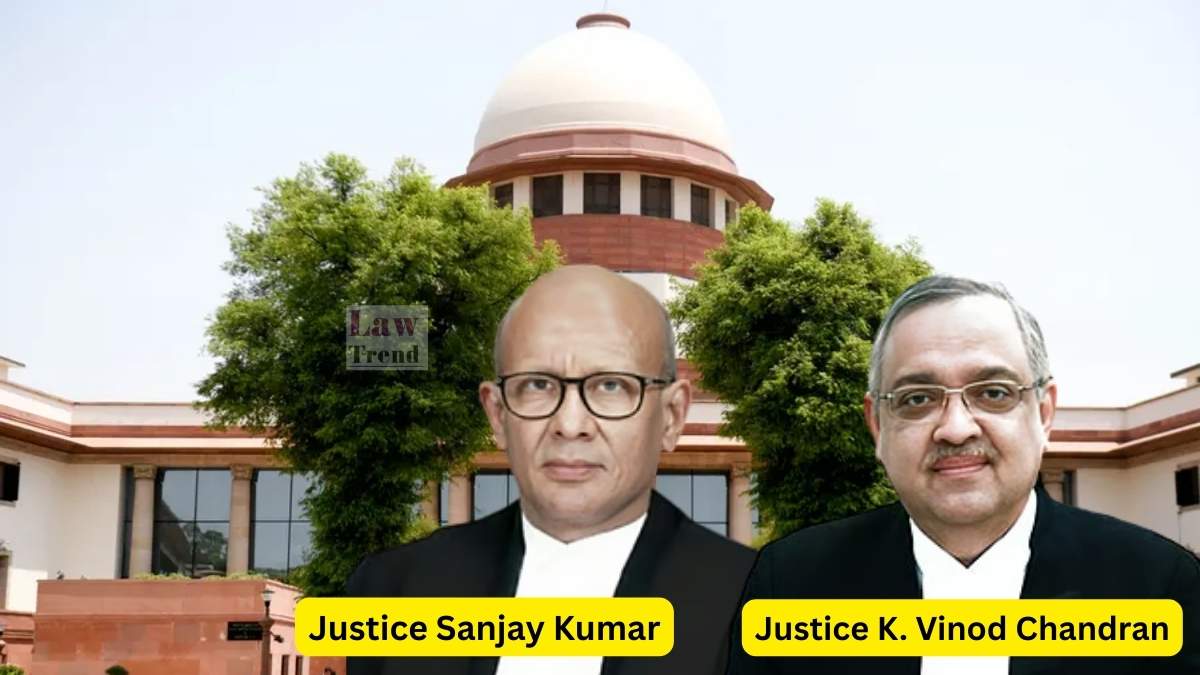
The Supreme Court of India has ruled that the strict 120-day outer limit for filing a written statement in commercial disputes applies to a plaintiff replying to a counter-claim. Resolving a split among various High Courts, a bench comprising Justice Sanjay Kumar and Justice K. Vinod Chandran dismissed the appeals filed by A.K. Ghosh & Company against a Calcutta High Court order, holding that the time-bound framework of the Commercial Courts Act, 2015, cannot be bypassed. The court ruled that plaintiffs must file their written statements to counter-claims within this statutory timeframe, and any delay beyond the maximum 120-day outer limit will result in the forfeiture of their right to do so.
Background of the Case
The dispute originated from the supply of printing paper by the plaintiffs (A.K. Ghosh & Company and others) to the defendants (Biman Bose and others). Following disputes regarding outstanding payments, the plaintiffs issued a legal notice on June 16, 2021, claiming a sum of Rs. 74,65,527 plus interest. The defendants denied the claim via a reply letter on June 28, 2021.
Subsequently, the plaintiffs filed a recovery suit, CS No. 274 of 2022, which was later renumbered as CS (COM) No. 440 of 2024 on the file of the Calcutta High Court. The contesting defendants (Defendant Nos. 1, 2, 3, 5, and 6) filed their written statement, raising a counter-claim. The written statement and counter-claim copies were served on the plaintiffs’ Advocate-on-Record on July 18, 2023.
However, the plaintiffs only filed an application seeking leave to file their written statement to the counter-claim on March 15, 2024—after a delay of 238 days. On August 19, 2024, a Single Judge of the Calcutta High Court dismissed the application, noting that while no specific time had been fixed under Order VIII Rule 6A(3) of the Code of Civil Procedure, 1908 (CPC), Order VIII Rule 6G CPC extended all rules of written statements to counter-claims, preventing the plaintiffs from escaping the commercial suit timelines.
The plaintiffs appealed to a Division Bench of the Calcutta High Court. On February 26, 2025, the Division Bench dismissed the appeal on both merits and maintainability. The plaintiffs then moved the Supreme Court, which stayed the High Court proceedings on May 23, 2025.
Arguments of the Parties
The senior counsel for the plaintiffs contended that the 120-day timeline under Order VIII Rule 1 CPC cannot apply mutatis mutandis to a plaintiff’s reply to a counter-claim. He highlighted that because the trial court did not fix a specific timeframe under Order VIII Rule 6A(3) CPC, the plaintiffs should not be penalized. He argued that penal provisions must be strictly construed against the party seeking to exploit them, and if alternative interpretations exist, they must benefit the affected party. On the question of maintainability under Section 13(1A) of the Commercial Courts Act, he argued that Section 13(2) merely regulates procedural aspects of appeals and does not eliminate substantive appellate rights. He relied on Nasima Naqi vs. Todi Tea Company Limited and others to argue that what is excluded by omission in a statute must be deemed excluded by implication.
Conversely, the senior counsel for the contesting defendants argued that plaintiffs cannot bypass statutory mandates for completing pleadings in commercial suits. He pointed out that Order VIII Rule 6G CPC plainly states that rules governing a written statement by a defendant apply to written statements filed in response to a counter-claim. Therefore, the mandatory time limits of Order VIII Rule 1 CPC must apply to commercial counter-claims.
The Court’s Analysis
The Supreme Court examined the history and scheme of Order VIII CPC. It observed that counter-claims, introduced via the 1976 CPC Amendment, are treated as cross-suits on par with plaints, and a plaintiff’s reply to them is functionally a written statement. Under Order VIII Rule 6G CPC, the rules relating to written statements by defendants are applied to written statements filed in response to counter-claims.
Tracing legislative developments up to the enactment of the Commercial Courts Act, 2015, the Court noted that timelines have been made progressively tighter to prevent commercial delays. In commercial suits, the proviso to Order VIII Rule 1 CPC mandates that a defendant must file a written statement within 30 days, extendable up to 120 days upon showing sufficient cause, recording written reasons, and paying costs. On the expiry of 120 days, the right to file is forfeited, as affirmed in SCG Contracts (India) Private Limited vs. K.S. Chamankar Infrastructure Private Limited and others.
The Supreme Court addressed conflicting High Court decisions on this issue:
- In Nirottam Sharma vs. Ramkishore and another (Rajasthan High Court) and CSCO LLC and another vs. Lakshmi Saraswathi Spintex Limited and others (Madras High Court), a liberal approach was taken, holding that the clock only ticks once the court explicitly fixes a time under Order VIII Rule 6A(3) CPC. The Supreme Court rejected this, stating that it would allow plaintiffs to “devise their own time schedule” if a court fails to set a deadline.
- In Dattaram Krishnanath Pednekar and others vs. Pandurang K. Pednekar and others (relying on Mrs. Shalini Nunes Mascarenhas vs. Mr. Trevor Nunes), the Bombay High Court had ruled that Order VIII Rule 6G only governs the contents of a written statement, not the filing timeline.
The Supreme Court explicitly rejected the Bombay High Court’s view, stating:
“We, therefore, do not agree with the view taken by the Bombay High Court that the ‘rules’ referred to in Order VIII Rule 6G CPC only relate to the contents of a written statement to a counter-claim and have nothing to do with the time limit for filing of such written statement. The phrasing of Order VIII Rule 6G does not allow for any such restriction being read into the provision.”
The Court also rejected the Madras High Court’s view in CSCO LLC that the omission of Order VIII Rule 9 CPC from the proviso of Order VIII Rule 10 CPC allowed courts to extend timelines for counter-claim replies, explaining that a reply to a counter-claim is not a “subsequent pleading” requiring the court’s leave.
Highlighting the legislative intent of the Commercial Courts Act to ensure speedy disposal of commercial disputes, the Court held that the strict timeframes must apply equally to plaintiffs. It concluded:
“A plaintiff in a commercial suit, governed by the CC Act, is bound by the mandate of the proviso to Order VIII Rule 1 CPC, as applicable to a commercial suit, and must file a written statement to a counter-claim by a defendant therein, ordinarily within 30 days from the date of service of summons or receipt of the counter-claim, and in the event a plaintiff fails to file such a written statement within that time but offers sufficient cause for the delay, the Court may extend the time to do so, for reasons to be recorded in writing and upon payment of appropriate costs, but not beyond 120 days from the date of service of summons upon the plaintiff/receipt of the counter-claim by the plaintiff.”
Maintainability of Appeal
On the question of maintainability, the Supreme Court analyzed Section 13 of the Commercial Courts Act. Relying on BGS SGS SOMA JV vs. NHPC Limited, it reiterated that appeals are creatures of statute and must be located within its terms. Pointing to Kandla Export Corporation and another vs. OCI Corporation and another, the Court noted that Section 13(1A) permits appeals only against orders specifically listed under Order XLIII CPC or Section 37 of the Arbitration and Conciliation Act, 1996. Since an order under Order VIII CPC denying leave to file a delayed written statement is not listed under Order XLIII CPC, the Division Bench correctly held that the plaintiffs’ appeal was unmaintainable.
The Decision
The Supreme Court dismissed the appeals and vacated the interim stay order dated May 23, 2025. The Court ruled that both the Single Judge and the Division Bench of the High Court were fully justified in rejecting the plaintiffs’ plea to file their written statement to the counter-claim after the expiry of the maximum 120-day timeframe. The parties were directed to bear their own costs.
Case Details
Case Title: A.K. Ghosh & Company and others v. Biman Bose and others
Case No.: Civil Appeal Nos. of 2026 (@ SLP (C) Nos. 15817 & 15818 of 2025)
Bench: Justice Sanjay Kumar, Justice K. Vinod Chandran
Date: July 13, 2026