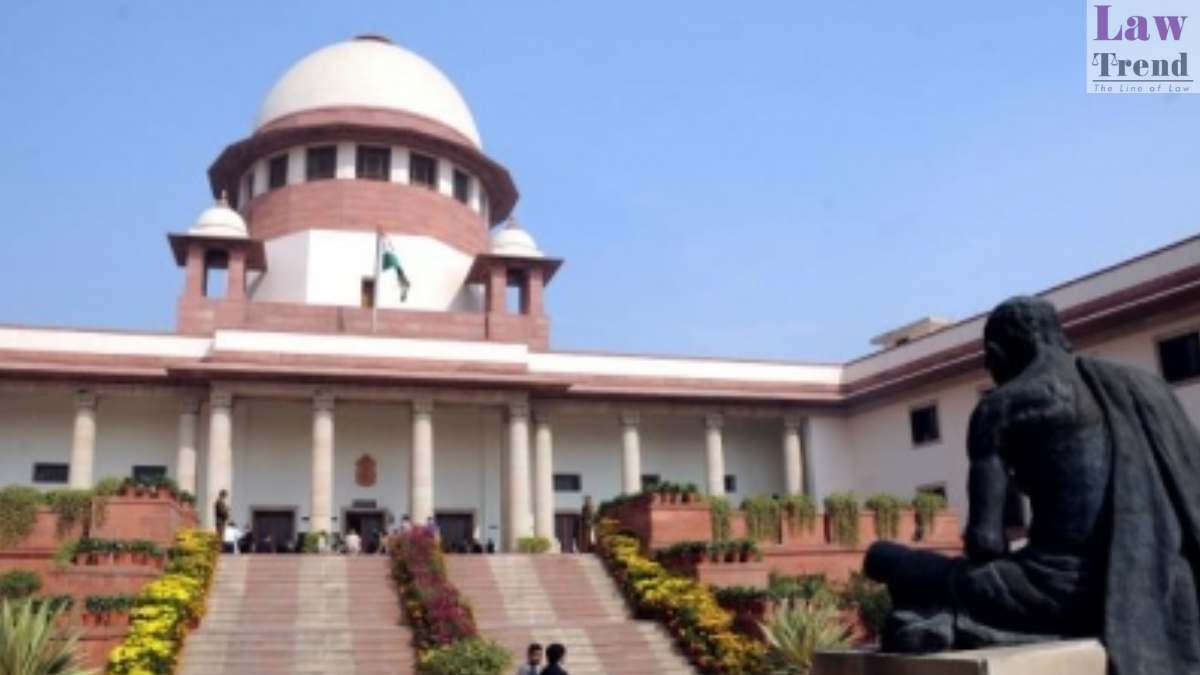
In a significant ruling on eminent domain and procedural compliance, the Supreme Court of India has dismissed appeals filed by landholders challenging the acquisition of 27 hectares of land for Phase II of the Jaipur Metro Rail Project. A Bench comprising Justice Dipankar Datta and Justice Satish Chandra Sharma ruled that there was no violation of the statutory right of hearing under Section 5A of the Land Acquisition Act, 1894, as the landowners had abandoned their opportunity to participate by failing to appear before the Land Acquisition Officer (LAO). The decision clears the way for the Jaipur Metro Rail Corporation Limited (JMRCL) to complete a vital metro car depot, reversing a prior High Court Single Judge order that had stalled the project.
Background of the Case
The dispute traces back to May 26, 2011, when the Urban Development Department of the Government of Rajasthan issued a preliminary notification under Section 4(1) of the Land Acquisition Act, proposing to acquire 27 hectares of land in Village Sheopura, Tehsil Sanganer, District Jaipur. The land, owned by the appellants, was earmarked for a proposed metro car depot.
In response, the landowners filed identical written objections under Section 5A(1) of the Act on June 27 and 28, 2011. Following multiple dates of appearance before the LAO, JMRCL filed detailed replies to these objections in August 2011 and March 2012. The LAO scheduled the matter for April 9, 2012, specifically to allow the landowners to file their rejoinder to JMRCL’s replies.
However, on April 9, the landowners neither appeared nor filed a rejoinder. The LAO recorded that the file would be put up when recommendations under Section 5A were sent to the State Government. Subsequently, on May 18, 2012, the LAO noted that the land was urgently required for a public purpose and forwarded a report to the State Government recommending the acquisition, adding that the objections were not being considered. This was followed by a formal declaration under Section 6(1) on July 5, 2012.
The landowners challenged the acquisition in the Rajasthan High Court, alleging a denial of their mandatory right to a personal hearing. While a Single Judge quashed the acquisition in May 2023 due to procedural lapses by the LAO, a Division Bench of the High Court reversed that decision in April 2026, directing JMRCL to take possession. The landowners then approached the Supreme Court.
Arguments of the Parties
The appellants argued that the land acquisition process was fundamentally flawed because the LAO did not provide a mandatory personal hearing. They contended that after the non-appearance on April 9, 2012, the LAO should have fixed a subsequent date for a hearing instead of abruptly concluding the proceedings on May 18, 2012. They further alleged that the LAO merely “copy-pasted” JMRCL’s responses and recorded that the “objections received are not being considered,” demonstrating a complete lack of independent application of mind.
Additionally, the landowners raised substantive objections, arguing that:
- No prior physical survey had been conducted on the land before the Section 4 notification.
- More suitable alternative government-owned lands (such as those belonging to RIICO and IOCL) were available.
- The metro line’s terminal point had shifted 12 kilometers away, neutralizing the immediate need for this specific land.
- The project sought excess land to be used for commercial renting, which does not constitute a “public purpose.”
- The acquisition would lead to ecological damage due to the felling of numerous trees on the property.
Conversely, the respondents, represented by the Solicitor General, argued that the LAO is an administrative body and not a quasi-judicial court, meaning it is not bound to issue separate, repeated notices to defaulting parties. They maintained that the landowners were afforded multiple opportunities to present their case but willfully absented themselves.
On the merits of the objections, the respondents clarified that the alternate RIICO land was already dedicated to a public-private partnership Exhibition-cum-Convention Centre, and the IOCL land housed a crucial crude oil pipeline pumping station. They also referenced a drone survey demonstrating that the subject land was largely vacant, and highlighted that the High Court had already directed JMRCL to transplant uprooted trees and plant double the quantity at alternative sites.
The Court’s Analysis
The Supreme Court framed its analysis around two primary questions: whether there was substantial compliance with the hearing mandate under Section 5A, and whether the substantive objections raised by the landowners had legal merit.
Addressing the procedural issue, the Court recognized Section 5A as an essential safeguard for property rights under the principles of natural justice, citing precedents like Kolkata Municipal Corpn. v. Bimal Kumar Shah (2024). However, the Court emphasized that a landowner’s right to object is coupled with the responsibility of diligence.
The Bench noted that the landowners had regularly appeared on prior dates and had received JMRCL’s replies, but failed to show up or request an extension on April 9, 2012.
The Court observed: “The settled legal position is that once objections under Section 5A(1) are filed, it is for the Collector to fix a date of hearing and intimate the landowner.”
However, once a date is set and missed, the administrative authority is not bound to indefinitely postpone proceedings.
The judgment noted: “A party might choose not to prosecute its own objection; but the LAO cannot be expected to compel such party to prosecute its objection.”
The Bench further held: “In the absence of any request from the appellants, we find no breach of duty by the LAO and, consequently, no violation of the right of hearing.”
Addressing the LAO’s remark that the objections were “not being considered,” the Court rejected the landowners’ literal interpretation. It clarified that, read in context, the phrase simply meant the objections did not merit acceptance when weighed against the overwhelming public purpose of the metro project.
The Court declared: “A mere error of discretion or indiscretion is not malice in law. Such non-exercise of discretion cannot, without anything more, be elevated to a breach of Section 5A resulting in violation of the statutory right of hearing and vitiating the acquisition.”
On the landowners’ substantive challenges, the Supreme Court ruled as follows:
- Prior Survey: The Court rejected the argument that a physical survey must precede a Section 4(1) notification. Pointing to the plain text of Section 4(2), the Court explained that the word “Thereupon” establishes that the power to enter and survey lands legally commences after the preliminary notification is published. “The statute does not posit the conduct of a comprehensive survey as a condition precedent to the issuance of the notification under Section 4.”
- Alternative Lands & Expert Discretion: Citing State of Punjab v. Gurdial Singh (1980), the Court reiterated that the power to select specific parcels of land for public projects lies within the exclusive domain of the executive. The Court quoted: “Wisdom in administrative action is the property of the executive and judicial circumspection keeps the court lock-jawed save where power has been polluted by oblique ends or is otherwise void on well established grounds.”
- Ecological Impact: Drawing from Naveen Solanki v. Rail Land Development Authority (2026), the Bench held that the subsequent growth of vegetation on private land does not automatically grant it the status of a “deemed forest” to stall public infrastructure projects, particularly when the Master Plan and revenue records do not classify it as such. Environmental concerns were deemed adequately met by the High Court’s directives on tree transplantation.
The Decision
Finding no merit in both the procedural and substantive objections, the Supreme Court dismissed the appeals and vacated all interim stay orders. The Bench held that the High Court’s Division Bench was fully justified in reversing the Single Judge’s ruling, which had erroneously stalled an essential public transit project over unmeritorious claims. The Court granted the appellants the liberty to pursue statutory remedies for any enhancement of land compensation.
Case Details:
- Case Title: Alok Kotahwala & Ors. VS. Jaipur Metro Rail Corporation Limited & Ors.
- Case No.: Civil Appeal No. 8269 of 2026 (Arising out of SLP (C) No. 16742 of 2026) with Civil Appeal No. 8270 of 2026 (Arising out of SLP (C) No. 16743 of 2026)
- Bench: Justice Dipankar Datta, Justice Satish Chandra Sharma
- Date: July 13, 2026