

Hostility of Informant and Lack of Public Witnesses Do Not Invalidate FIR or Police Testimony: Allahabad High Court
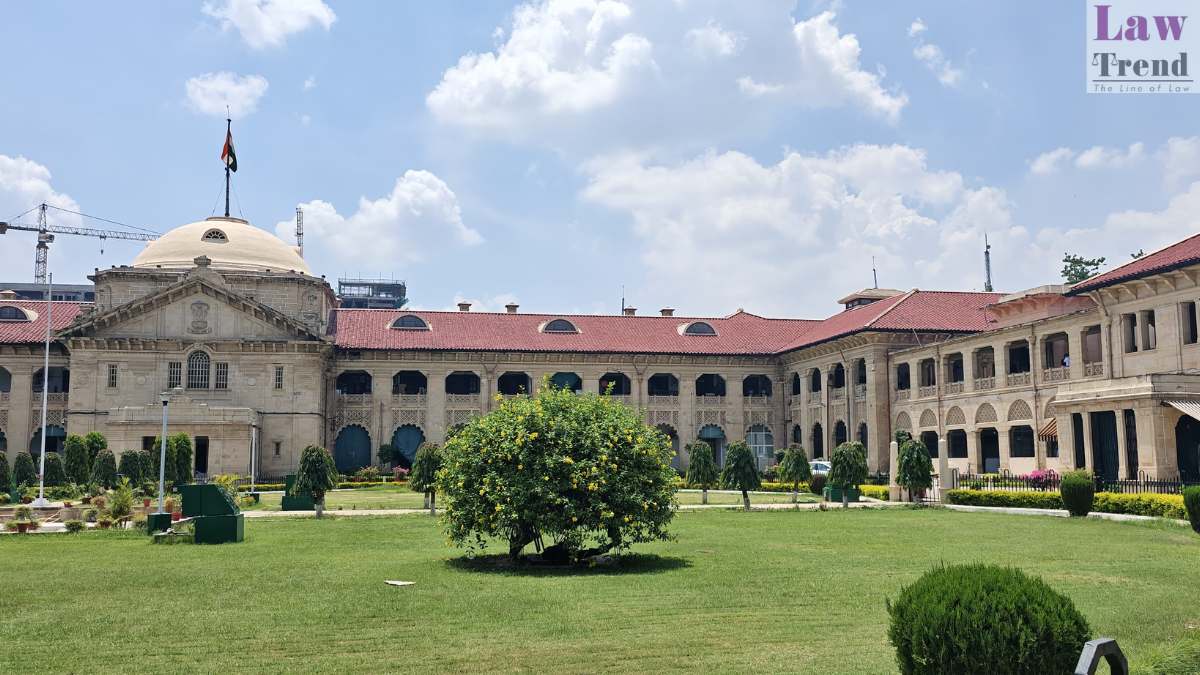

The High Court of Judicature at Allahabad, presided over by Justice Siddharth and Justice Vinai Kumar Dwivedi, has delivered a crucial verdict in a 1995 murder and robbery case, holding that the hostility of an informant or the absence of independent public witnesses does not dilute the relevance of a First Information Report (FIR) or the credibility of police testimonies. Deciding on two connected criminal appeals, the division bench upheld the conviction of appellant Dharmendra Singh for murder, robbery, and possession of stolen property, while setting aside his conviction under the Arms Act. Concurrently, the court extended the benefit of doubt to co-appellant Charan Singh, acquitting him of all charges due to a lack of incriminating evidence establishing his presence at the crime scene.

Background of the Case

The case stems from an incident on December 22, 1995, at approximately 3:45 P.M. near the eastern gate of the Moradabad Railway Station. The deceased, Pappu alias Raj Kishore Prasad, a resident of Muzaffarpur, Bihar, was a businessman dealing in raw materials for utensils. He frequently visited Moradabad to collect payments from local traders. Having collected approximately Rs. 1,25,000 in cash from traders Sachin, Mohammad Nasir, Rajesh Metal, Ishwar, and Ibrahim, Pappu was heading to the railway station on a rickshaw. He was accompanied by Suresh Kumar Khanna (PW-2) and Surendra Kumar.

Upon reaching the eastern gate and walking towards the station, three individuals—Dharmendra Singh, Charan Singh, and Sher Singh—attempted to snatch the suitcase containing the collected money from Pappu. When Pappu resisted, Sher Singh shot him in the chest, while Dharmendra Singh snatched the suitcase and attempted to flee. Although Sher Singh and Charan Singh escaped along the railway tracks, Dharmendra was caught red-handed on the railway overbridge by a police team led by SHO Hemant Kumar Mishra (PW-1). The police recovered the looted suitcase containing Rs. 1,25,000 along with Pappu’s personal belongings and a 12-bore country-made pistol (tamancha) with three live cartridges from Dharmendra’s possession. Pappu died on the spot.

A trial court on March 27, 2008, convicted both Dharmendra Singh and Charan Singh under Sections 302/34 and 394 of the Indian Penal Code (IPC), sentencing them to rigorous life imprisonment. Dharmendra was further convicted under Section 411 IPC and Section 25 of the Arms Act. The third accused, Sher Singh, died during the trial, and the case against him was abated. Both convicts appealed their conviction before the Allahabad High Court.

Arguments of the Parties

The learned counsel representing the appellants argued that there was no reliable and trustworthy evidence linking them to the crime. They highlighted that key prosecution eyewitnesses, including the informant Suresh Kumar Khanna (PW-2), had turned hostile and failed to support the prosecution’s narrative. The defense contended that because the informant did not support the written report, the entire prosecution case fell through. They also asserted that the recovery of the suitcase could not be trusted because independent recovery witnesses had turned hostile. It was argued that the prosecution’s reliance solely on police personnel, who were interested witnesses with motives to prove their recovery memos, made the case unsustainable.

READ ALSO  Sister of slain gangster Atiq Ahmad moves Supreme Court seeking inquiry into 'extra-judicial killings'

On the other hand, the learned Additional Government Advocate (A.G.A.) representing the State opposed the appeals. The State argued that even though the witnesses of fact had turned hostile, the core of the incident and the participation of the appellants stood proved through their hostile statements, which cannot be discarded in their entirety. The State maintained that police witnesses had no personal enmity or motive to falsely implicate the appellants and that their testimonies, coupled with the immediate red-handed recovery of the cash and articles, fully established Dharmendra’s guilt beyond a reasonable doubt.

The Court’s Analysis and Observations

The High Court conducted a thorough examination of the hostile testimonies and settled legal precedents.

Relevance of FIR Despite Hostility of Informant

The court addressed the fact that the informant Suresh Kumar Khanna (PW-2) resiled from his initial statement, claiming the report was written under the dictation of police personnel. Citing the Supreme Court of India’s ruling in Goverdhan and Another v. State of Chhattisgarh (2025), which relied on Bable @ Gurdeep Singh v. State of Chhattisgarh (2012), the bench observed:

“Merely because PW 1 has turned hostile, it cannot be said that the FIR would lose all its relevancy and cannot be looked into for any purpose.”

The court noted that the registration of the FIR was legally proved by Head Moharrir Yashpal Singh (PW-14) and other police officials, preserving its relevancy and support for the prosecution story.

Reliability of Police Testimonies

Addressing the defense’s challenge to the recovery memo due to the absence of public witnesses, the court firmly rejected the idea that police testimonies are inherently untrustworthy. Pointing to the Supreme Court’s ruling in Girja Prasad (Dead) by LRS. v. State of M.P. (2007), the bench emphasized:

READ ALSO  Delhi High Court Likely to Transfer Engineer Rashid’s Plea on Parliament Attendance Costs to Previous Bench

“The presumption that every person acts honestly applies as much in favour of a police official as any other person. No infirmity attaches to the testimony of police officials merely because they belong to police force.”

The court further cited Madhu @ Madhuranatha v. State of Karnataka (2014), reiterating:

“there can be no prohibition to the effect that a policeman cannot be a witness or that his deposition cannot be relied upon if it inspires confidence.”

The bench found that the testimonies of SHO Hemant Kumar Mishra (PW-1), SI T.R. Kothari (PW-6), and SI Mahendra Singh Tyagi (PW-10) were reliable, creditworthy, and inspired absolute confidence.

Establishment of Motive

The court ruled that the recovery of Rs. 1,25,000, which contained currency bundles marked with the seals and signatures of the specific Moradabad traders, established a clear and powerful motive. The accused were aware of Pappu’s business activities, and the substantial sum of money induced them to plan and execute the robbery and murder.

Arms Act and Charan Singh’s Involvement

The court pointed out two critical lapses in the prosecution’s case. First, S.I. Kailash Chandra Verma (PW-9), who investigated the Arms Act case, admitted that he did not send the recovered tamancha and cartridges to the Forensic Science Laboratory (FSL) for expert examination, nor did he personally test if the weapon was functional. Due to this failure, the weapon could not be linked to the crime, making Dharmendra’s conviction under Section 25 of the Arms Act legally unsustainable.

READ ALSO  Allahabad High Court Orders Probe Into ‘Fake’ Arya Samaj Marriage Registrations in Uttar Pradesh

Second, the court found no evidence establishing the presence or active involvement of appellant Charan Singh at the crime scene. He was not arrested on the spot, and no incriminating materials were recovered from him, making his involvement highly doubtful.

The Decision

The Allahabad High Court modified the trial court’s judgment with the following directions:

  1. Charan Singh: The appeal filed by Charan Singh was allowed. Extending the benefit of doubt, the court acquitted him of all charges under Sections 302/34 and 394 IPC, canceling his bail bonds and discharging his sureties.
  2. Dharmendra Singh: The appeal filed by Dharmendra Singh was partly allowed. The court set aside his conviction under Section 25 of the Arms Act. However, his conviction and sentences under Sections 302/34 (rigorous life imprisonment), 394 (10 years rigorous imprisonment), and 411 IPC (3 years rigorous imprisonment) were affirmed.
  3. Dharmendra Singh, who is currently on bail, was directed to surrender before the Chief Judicial Magistrate (CJM), Moradabad, within one month to serve out the remainder of his sentence. If he fails to do so, the CJM Moradabad is directed to issue non-bailable warrants to secure his arrest.

Case Details:

Case Title: Dharmendra Singh v. State of U.P
Case No.: Criminal Appeal No. 2718 of 2008
Bench: Justice Siddharth and Justice Vinai Kumar Dwivedi
Date: July 10, 2026

Law Trend
Law Trendhttps://lawtrend.in/
Legal News Website Providing Latest Judgments of Supreme Court and High Court

Related Articles

Latest Articles

