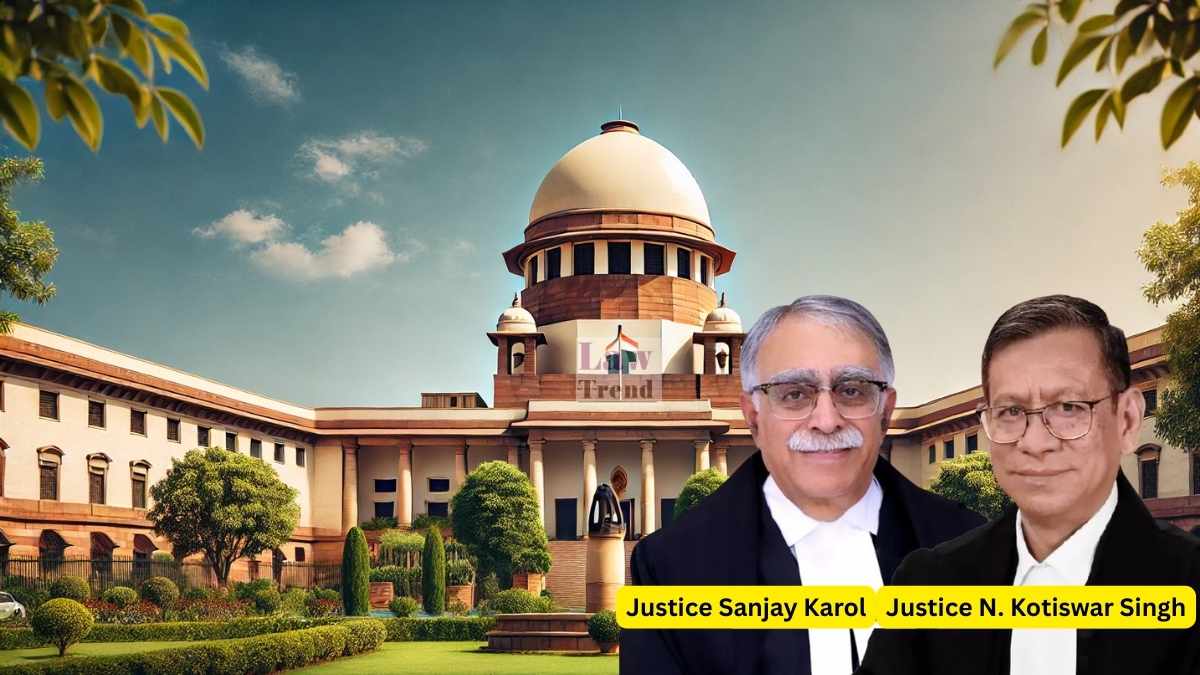
In a significant ruling clarifying the strict application of the law of limitation, the Supreme Court of India has quashed a civil suit seeking specific performance of a 38-year-old unregistered agreement to sell. The division bench comprising Justice Sanjay Karol and Justice Nongmeikapam Kotiswar Singh allowed the appeal, holding that the suit was barred by limitation under Order VII Rule 11(d) of the Civil Procedure Code (CPC), 1908, and subsequently termed the litigation an abuse of the judicial process.
Background of the Case
The dispute originated over a property located at Plot No. 1480 in Ulhasnagar, Maharashtra, originally owned by Tukaram Daji Bhoir. In 1974, a Development Plan for the Ulhasnagar township reserved the land for public amenities, and physical possession of the plot was handed over in 1988 to construct the Hill Line Police Station.
The respondents claimed they had entered into an unregistered agreement to sell the subject property with Bhoir on August 21, 1984. Meanwhile, Bhoir and his legal representatives (the appellants) engaged in prolonged administrative proceedings to secure alternate land in lieu of the reserved plot. The authorities finally allotted alternate properties to the appellants and executed a Deed of Conveyance in March 2019.
The respondents challenged this allotment by filing a Writ Petition before the High Court of Judicature at Bombay, which was dismissed in November 2021. In its dismissal, the High Court noted that the respondents had not initiated any civil proceedings to establish their substantive rights over the property. Following this observation, the respondents filed a civil suit in March 2022—thirty-eight years after the alleged agreement—seeking specific performance of the 1984 agreement to sell.
Arguments of the Parties
Upon the filing of the suit, the appellants moved two applications under Order VII Rule 11(d) of the CPC, requesting the Trial Court to reject the plaint. They argued that under Article 54 of the Limitation Act, 1963, the limitation period for a specific performance suit is three years, rendering the 2022 suit hopelessly barred by time.
The Trial Court rejected these applications in September 2023, observing that the suit did not appear to be entirely barred by limitation based on the plaint’s statements. The Bombay High Court affirmed this decision in June 2025, finding no illegality in the Trial Court’s reasoning. Dissatisfied, the appellants approached the Supreme Court.
The Supreme Court’s Analysis
The Supreme Court analyzed the foundational premise of the respondents’ suit and found no justifiable explanation for a delay of more than three decades in seeking the execution of a Conveyance Deed.
The bench examined the statutory powers under Order VII Rule 11, referring to landmark precedents including Dahiben v. Arvindbhai Kalyanji Bhanusali, Correspondence, RBANMS Educational Institution v. B. Gunashekar and Anr., and Madansuri Sri Rama Chandra Murthy v. Syed Jalal. The Court reiterated that the provision serves as a crucial filter to terminate proceedings at the threshold when a suit is barred by law, even if clever drafting attempts to veil the implied bar.
The Court further rejected the respondents’ argument that the Bombay High Court’s 2021 observation regarding the lack of a civil suit triggered a fresh period of limitation. Placing reliance on the precedent set in Mukund Bhavan Trust & Ors. v. Shrimant Chhatrapati Udayan Praje Pratapsinh Maharaj Bhonsle & Anr., the bench emphasized that the period of limitation begins to run from the date when the right to sue first accrues. By no stretch of the imagination could the High Court’s passing observation serve as a basis for a fresh limitation period.
The Decision
Setting aside the orders of both the Trial Court and the Bombay High Court, the Supreme Court allowed the appeal and rejected the plaint.
Highlighting the necessity of intervening at the preliminary stage, the Court observed, “The purpose behind the remedy under Order 7 Rule 11(d) is to prevent protracted proceedings in a civil suit, which on a plain reading itself is barred by law.“
Issuing a firm stance on the timely assertion of legal rights, the bench concluded, “A litigant who has remained silent for decades cannot be permitted to file a suit as an afterthought, in ignorance of the laws of limitation.“
Ultimately, the Court ruled, “Consequently, the present suit filed by the respondents is an abuse of process of the Court and barred by law.“
Case Title: Shobha Vasant Bhoir & Ors. v. Soni @ Vandana Gurumukhdas Jagiasi & Ors.
Case No.: Civil Appeal No. of 2026 (Arising out of SLP(C) No. 27748 of 2025)
Bench: Justice Sanjay Karol, Justice Nongmeikapam Kotiswar Singh
Date: July 1, 2026