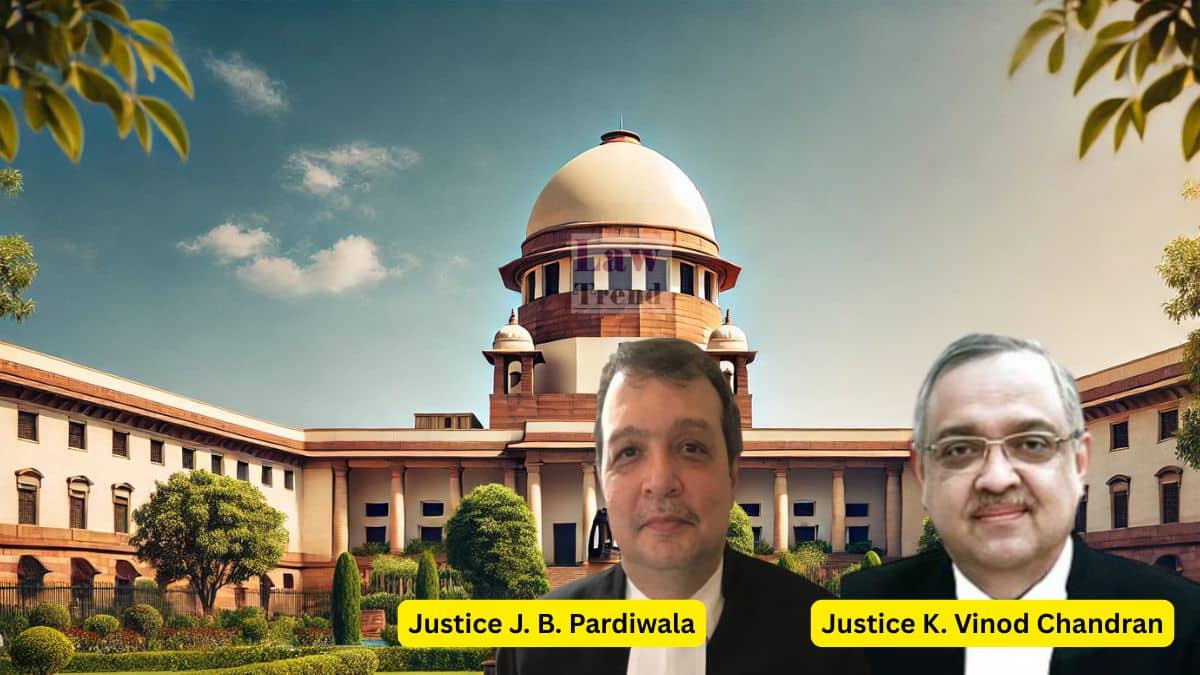
A Supreme Court bench comprising Justice J. B. Pardiwala and Justice K. Vinod Chandran has held that when a suit and a counterclaim are adjudicated and disposed of by a single common judgment, they can be challenged through a composite appeal. The apex court clarified that such a composite appeal must set out separate grounds of challenge against the decision in the suit and the counterclaim, and must be valued as two separate appeals with the requisite court fees paid for both. With this ruling, the court resolved a cleavage of opinion among various High Courts on whether two distinct appeals are mandatory when a suit and a counterclaim are decided together.
Background of the Case
In the underlying dispute, the plaintiffs filed a suit claiming a half share in the suit property along with an injunction against interference. The defendants filed a counterclaim seeking ownership over the entire property. The Trial Court allowed the suit claim and dismissed the counterclaim.
Aggrieved, the defendants filed a single appeal against the Trial Court’s decision. The Appellate Court subsequently dismissed the suit and allowed the counterclaim. However, in second appeal, the High Court held that the single appeal filed by the defendants was incompetent. Relying on a Division Bench decision in Ramesh Chand v. Om Raj, the High Court concluded that since the suit was decreed and the counterclaim was rejected, two separate appeals ought to have been filed, and that the single appeal was liable to be rejected on principles of waiver and estoppel. The appellants then approached the Supreme Court.
Arguments Before the Court
Senior Counsel Jayant Bhushan, appearing for the appellants, pointed out that only a single decree had been drawn up by the trial court. He contended that when the court itself drew up only one decree, the appeal could not have been rejected as maintainable. He placed reliance on earlier rulings in Narhari v. Shanker and Charan Singh v. Ram Saroop.
On the other hand, Senior Counsel Sanjay R. Hegde, representing the respondents, relied on Ramesh Chand v. Om Raj and Premier Tyres Ltd. v. Kerala State Road Transport Corporation. He argued that even if only one decree is drawn up, two separate appeals are required to be filed under the law.
Court’s Analysis and Review of Precedents
The Supreme Court examined various conflicting decisions rendered by different High Courts and the apex court on this issue.
Referring to Narhari v. Shanker, the Court noted that where two decrees in substance stem from one judgment deciding the entire suit, holding an appeal barred by res judicata was improper. Similarly, in Charan Singh v. Ram Saroop, while noting the requirement to challenge both outcomes, the court had permitted filing a separate memorandum of appeal without requiring duplicate copies of the judgment to subserve the ends of justice.
The bench examined Order VIII Rule 6A to Rule 6D of the Code of Civil Procedure (CPC), inserted by the 1976 amendment. The Court observed that Rule 6A(2) enables a counterclaim to be treated as a cross-suit, facilitating a common judgment on both claims. Rule 6C indicates that a counterclaim must be interlinked with the suit claim to enable adjudication on evidence led at a single trial.
Addressing the decision in Rajni Rani v. Khairati Lall, the Court clarified that it had been misinterpreted by certain High Courts (such as in Ghanshyam Singh v. Narendra Singh and Gumai Singh v. Baburam) to hold that two appeals are mandatory in every case. The Supreme Court explained that Rajni Rani concerned whether an order rejecting a counterclaim under Order VII Rule 11 was subject to revision or appeal while the main suit remained pending, and did not lay down that two separate appeals are required when both claims are disposed of together by a final judgment.
The bench also discussed decisions from the Kerala High Court (Girija v. Rajan and its subsequent reversal by a Division Bench in Abdul Nazer v. Lakshmana Das), the Bombay High Court (Shankar Masu Dokare v. Shobha Subhash Dokare), the Madras High Court (T.K.V.S. Vidyapoornachary Sons v. M.R. Krishnamahary and K. Kandasamy v. P. Natarajan), and the Madhya Pradesh High Court.
Regarding Order XX Rule 19(2) of the CPC, the Court held that while it makes provisions regarding appeals applicable to suits where a set-off or counterclaim is raised, it does not mandate two separate appeals nor prohibit a single composite appeal.
The Court referred to Laxmidas Dayabhai Kabrawala v. Nanabhai Chunilal Kabrawala, where even before the 1976 amendment, a counterclaim was allowed to be treated as a cross-suit to do justice between the parties.
Emphasizing the purpose of procedural rules, the Supreme Court quoted from Owners and Parties Interest in M.V. ‘Vali Pero’ v. Fernandeo Lopez:
“Rules of procedure are not by themselves an end but the means to achieve the ends of justice. Rules of procedure are tools forged to achieve justice and are not hurdles to obstruct the pathway to justice. Construction of a rule of procedure which promotes justice and prevents its miscarriage by enabling the court to do justice in myriad situations, all of which cannot be envisaged, acting within the limits of the permissible construction, must be preferred to that which is rigid and negatives the cause of justice.”
The Court further cited the observation in that judgment that:
“Otherwise, rules of procedure will become the mistress instead of remaining the handmaid of justice, contrary to the role attributed to it in our legal system.”
Addressing statutory amendments to Order XLI Rule 1 of the CPC effective from July 1, 2002, the Court noted that a memorandum of appeal is now required to be accompanied by the ‘judgment’ rather than the ‘decree’. The legislature’s intention was clear that delay in drawing up decrees should not frustrate appellate remedies. The bench also adverted to Lakshmi Ram Bhuyan v. Hari Prasad Bhuyan, observing that:
“A self-contained decree drawn up in conformity with the judgment would exclude objections and complexities arising at the stage of execution”
The Court noted that whether one decree or two decrees are drawn up by trial courts in different States pales into insignificance, as the requirement for preferring an appeal centers on the judgment.
Final Decision and Guidelines
The Supreme Court laid down the following law for future guidance:
- When a suit and a counterclaim are adjudicated by a single common judgment, both claims can be challenged in a composite appeal.
- The composite appeal must set out separate grounds of challenge against the decree in the suit and the decree in the counterclaim.
- The composite appeal must be valued as two separate appeals, and court fees must be paid accordingly for both valuations.
- This mechanism avoids procedural rigmarole, prevents multiplicity of litigation, and ensures appeals are heard on merits without being defeated by technical pleas of res judicata or estoppel.
In the specific facts of the present case, considering the prevailing uncertainty in law, the Supreme Court set aside the orders of the High Court and the First Appellate Court, and restored the first appeal. The Court permitted the appellants to file a fresh memorandum with separate grounds and pay court fees for the additional appeal, directing the First Appellate Court to decide the matter on merits as expeditiously as possible.
The Registry was directed to forward a copy of the judgment to all High Courts.
Case Title: Basudev & Ors. v. Sanjay Kumar & Ors.
Case No.: Civil Appeal No. of 2026 (Arising out of SLP (C) No. 4338 of 2025)
Bench: Justice J. B. Pardiwala and Justice K. Vinod Chandran
Date: August 11, 2026