

Deferred Promotion Cannot Permanently Deprive Judicial Officer of Seniority When No Disciplinary Proceedings Follow: Chhattisgarh High Court
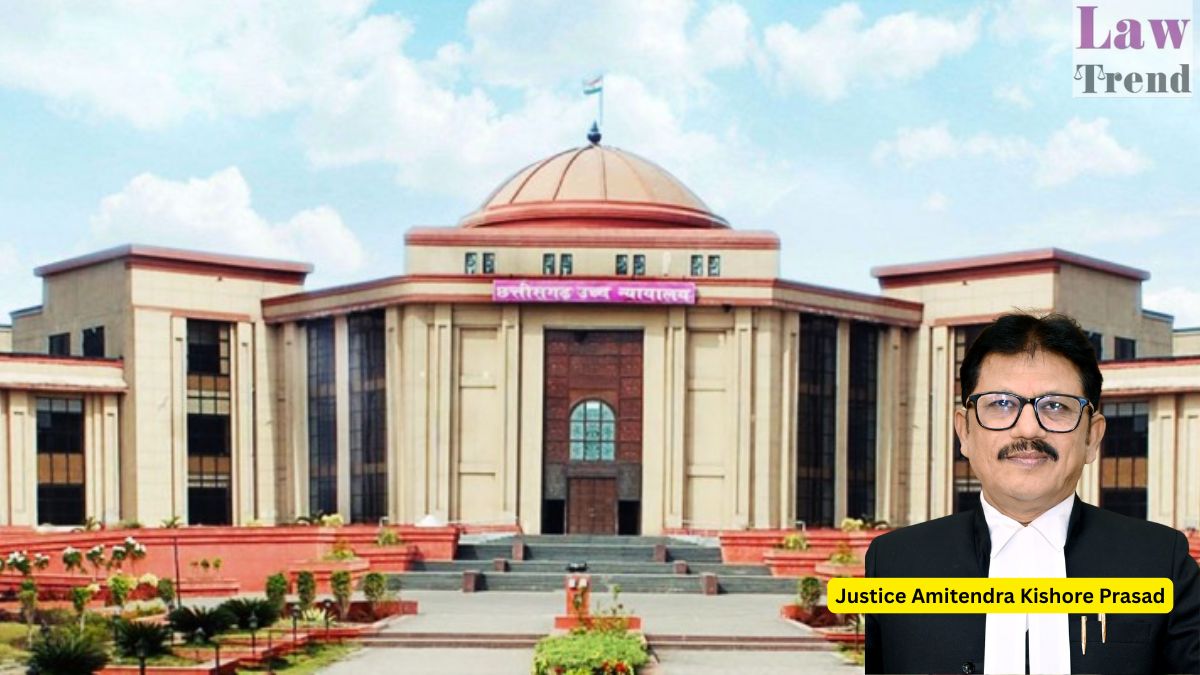

The High Court of Chhattisgarh has ruled that deferring a judicial officer’s promotion due to a pending complaint, which eventually leads to no disciplinary action or finding of misconduct, cannot be allowed to permanently damage their seniority and career prospects. Justice Amitendra Kishore Prasad allowed the writ petition, directing the High Court administration and state authorities to reconsider the petitioner’s claim for promotion to Civil Judge Class-I (Senior Division) with effect from August 14, 2014—the date her batchmates were promoted—and to restore her original seniority with all consequential benefits.

Background of the Case

The petitioner, Smt. Chhaya Singh, was appointed as a Civil Judge Class-II (Junior Division) on December 26, 2008, securing the 14th merit position out of 60 selected candidates. Her service was confirmed on September 1, 2012, maintaining her original merit ranking. Under the Chhattisgarh Lower Judicial Service (Recruitment and Conditions of Service) Rules, 2006, she became eligible for promotion to Civil Judge Class-I (Senior Division) upon completing five years of qualifying service. At the time, her record was clean, with consistent “C” and “B” gradings in her Annual Confidential Reports (ACRs) and no adverse remarks.

However, during her posting at Durg, the then Superintendent of Police submitted a complaint against her in connection with judicial orders she had passed directing the registration of an FIR against certain police officials. The petitioner submitted a detailed explanation to this complaint on March 4, 2013, and no further action, departmental inquiry, or disciplinary proceedings were ever initiated against her.

Despite this, when the promotion order was issued on August 14, 2014, elevating 45 officers from her batch, the petitioner’s promotion was “deferred.” She submitted a representation on April 15, 2015, which remained undecided. Nearly two years later, on August 12, 2016, she was promoted to Civil Judge Class-I (Senior Division) but was denied her original seniority. Her subsequent representation for restoration of seniority was rejected on February 21, 2018, via a cryptic, unreasoned memorandum. She was later promoted to Chief Judicial Magistrate on July 2, 2019. Due to the denial of her original seniority, her name was placed significantly lower in the eligibility lists for promotion to District Judge (Entry Level) in 2021 and 2022, severely affecting her promotional avenues.

Arguments of the Parties

Counsel for the petitioner submitted that she had an unblemished service record up to 2014, with no disciplinary inquiries or adverse ACR entries. They argued that deferring her promotion solely on the basis of a complaint arising out of the discharge of her judicial duties was arbitrary and contrary to Sub Rule 12(D) of the Chhattisgarh Civil Services (General Conditions of Service) Rules, 1961. The petitioner’s counsel relied on H.S. Vankani v. State of Gujarat to argue that seniority is a vital civil right that directly affects future career progression. They also cited Krishna Prasad v. State of Bihar, contending that disciplinary action cannot be initiated against a judicial officer merely for passing erroneous judicial orders unless extraneous considerations are established. Furthermore, they invoked Ishwar Chand Jain v. High Court of Punjab and Haryana to emphasize that the independence of the judiciary and the protection of honest officers are constitutional mandates under Article 235 of the Constitution.

READ ALSO  Adopted Son is to be Treated At Par With Natural Son For Compassionate Appointment: Karnataka HC

Conversely, counsel representing the High Court and state authorities vehemently opposed the petition, asserting that her promotion was deferred by a conscious decision of the Departmental Promotion Committee (DPC) based on the pending complaint. They argued that the petition was barred by gross delay and laches, as the petitioner had accepted her subsequent promotion in 2016 and subsequent postings without challenging the 2014 deferment or the 2018 rejection of her representation. They contended that reopening her seniority after nine years would unsettle settled positions and prejudice third-party rights of other officers. The respondents maintained that Rule 12(D) of the 1961 Rules does not confer an automatic right to retrospective seniority and that seniority must flow only from the date of actual promotion.

The Court’s Analysis

Upon analyzing the records, the High Court observed that the DPC had not declared the petitioner “unfit” but had merely deferred her case due to the complaint. The court pointed out that no departmental inquiry or disciplinary proceedings were ever initiated, meaning the complaint did not culminate in any adverse finding or misconduct.

READ ALSO  "Mockery of Justice": Supreme Court Orders Inquiry into 23-Year Delay in Dowry Death Trial Stayed by Rajasthan High Court

Furthermore, the court noted that the petitioner was promoted in 2016 on the basis of the exact same service profile and ACRs that were available to the DPC in 2014. This demonstrated that she was fit for promotion when her batchmates were elevated, and the temporary deferment ceased to have any legal significance once the complaint proved inconsequential.

Addressing the respondents’ objection regarding the 2018 rejection of the petitioner’s representation, the court noted that the rejection order was completely devoid of reasons. Citing the Constitution Bench decision in S.N. Mukherjee v. Union of India, the court declared that recording clear and explicit reasons is an essential requirement of fair decision-making and that unreasoned administrative orders affecting valuable service rights cannot be sustained.

On the issue of delay and laches, the court rejected the technical objections raised by the respondents, stating that issues relating to promotion and seniority carry recurring civil consequences that affect an employee throughout their career. The court referred to the Supreme Court’s ruling in Major General H.M. Singh v. Union of India, observing:

“…if the appellant was the senior most serving Major General eligible for consideration, he most definitely had the fundamental right of being considered against the vacancy, and also the fundamental right of being promoted if he was adjudged suitable. Failing which, he would be deprived of his fundamental right of equality before the law and equal protection of the laws extended by Article 14 of the Constitution of India.”

Additionally, the court cited Union of India v. K.V. Jankiraman, which established that the sealed cover or deferment procedure cannot be resorted to unless a formal charge-sheet has been issued. In the petitioner’s case, no charge-sheet was pending in 2014, and the mere pendency of a complaint was insufficient to deny her timely promotion. The court also highlighted P.N. Premachandran v. State of Kerala, reiterating that an employee cannot be made to suffer due to administrative or procedural lapses attributable to the department.

The Decision

Allowing the writ petition, the High Court ruled that the respondents were unjustified in allowing a temporary deferment, founded on an inconsequential complaint, to permanently damage the petitioner’s career.

READ ALSO  Following Supreme Court Circular, Chhattisgarh HC Adopts Virtual Hearings, WFH & Car-Pooling for Summer Vacations

The court directed the High Court of Chhattisgarh and state authorities to reconsider the petitioner’s case for promotion to Civil Judge Class-I (Senior Division) with effect from August 14, 2014. The competent authority was instructed to examine her claim for the restoration of her original seniority and all consequential benefits in accordance with the law, provided no other legal impediments exist. The court ordered that this entire exercise be completed and a reasoned, speaking order be passed within three months. No order was made as to costs.

Case Details

  • Case Title: Smt. Chhaya Singh v. High Court of Chhattisgarh & Others
  • Case No.: WPS No. 7379 of 2023
  • Bench: Justice Amitendra Kishore Prasad
  • Date: 29.06.2026

Law Trend
Law Trendhttps://lawtrend.in/
Legal News Website Providing Latest Judgments of Supreme Court and High Court

Related Articles

Latest Articles

