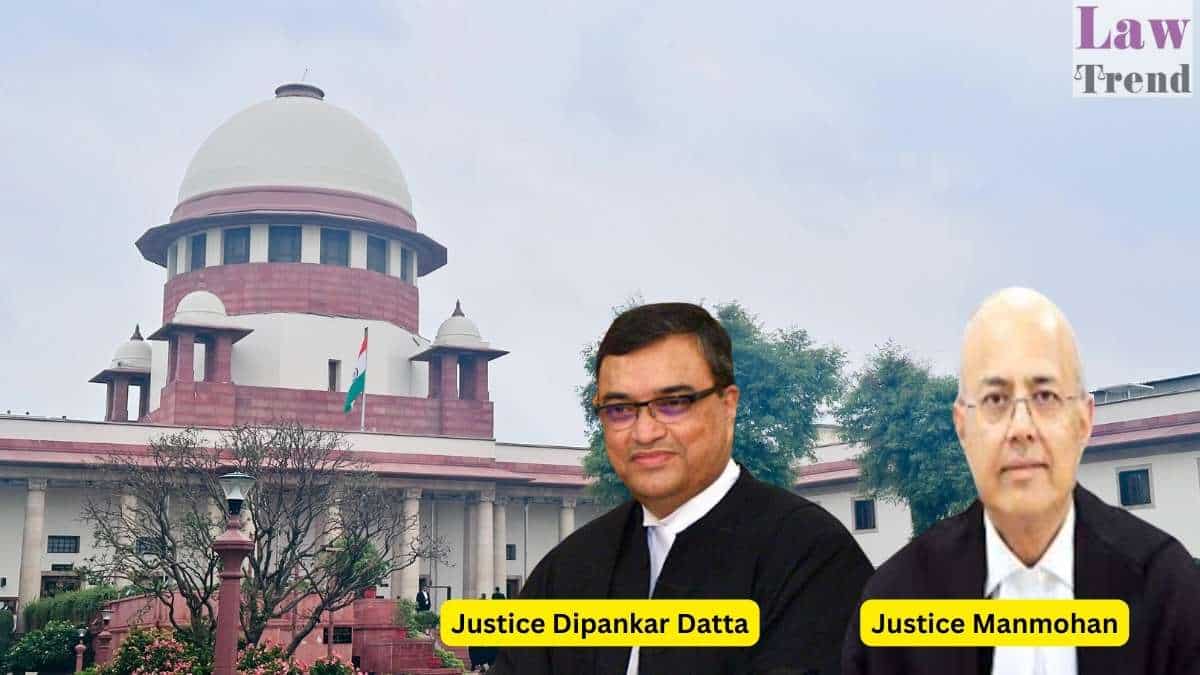
The Supreme Court of India has ruled that physical relationships between consenting unmarried adults cannot be used as a ground to draw an adverse inference about a person’s character or to deny public employment. A division bench comprising Justice Manoj Misra and Justice Manmohan set aside a decision of the Division Bench of the Telangana High Court, which had upheld the cancellation of a candidate’s selection as a police constable. The candidate, Gajula Thirupathi, had his selection cancelled due to his past involvement in a criminal case of cheating and criminal intimidation that arose from a consensual pre-marital relationship that later broke down and was settled amicably through a Lok Adalat.
Background of the Case
The appellant, Gajula Thirupathi, was provisionally selected as a Stipendiary Cadet Trainee Police Constable (SCTPC) under a 2018 notification issued by the Telangana State Level Police Recruitment Board. In his attestation form, Thirupathi fully disclosed that a criminal complaint (Crime No. 190/2014) had been registered against him under Sections 417 (cheating), 420 (cheating and dishonestly inducing delivery of property), and 506 (criminal intimidation) read with Section 34 of the Indian Penal Code (IPC) at the Dharmaram Police Station.
The case stemmed from a relationship with a neighbor that spanned approximately four years. After the relationship did not culminate in marriage and Thirupathi married another woman, the complainant filed a police report alleging cheating and stating that Thirupathi’s parents had threatened her. Following an investigation, the police filed a charge sheet against Thirupathi and his parents under Sections 417, 420, and 506/34 of the IPC. Notably, there was no indictment under Section 376 of the IPC (rape). The criminal case did not proceed to trial; instead, it was compounded and resolved based on a compromise before the Lok Adalat at the JFCM Court, Peddapalli, on May 31, 2015.
Based on this past case, the Recruitment Board issued a show-cause notice and subsequently cancelled Thirupathi’s provisional selection on August 17, 2020, asserting that he was involved in an offense of moral turpitude. Thirupathi challenged this decision before the High Court of Telangana. A Single Judge allowed his writ petition on November 20, 2020, setting aside the cancellation and directing the respondents to reconsider his case in light of the Supreme Court’s ruling in Avtar Singh vs. Union of India and Others.
Upon reconsideration, the Board issued a fresh order on January 29, 2021, again cancelling his selection. The Board claimed that compounding a case in a Lok Adalat does not wash off the criminal antecedents and that entering a disciplined police service requires candidates to have impeccable character. Thirupathi challenged this second order before the High Court. The Single Judge allowed his writ petition on June 3, 2024, noting that pre-marital consensual relationships among youth are common and that the relationship in question appeared consensual, directing his appointment if his record was otherwise clean.
However, the Division Bench of the High Court reversed the Single Judge’s decision on November 22, 2024, ruling that the compromise did not constitute a clean acquittal and that the employer is the best judge of suitability for a disciplined force. Thirupathi then appealed the decision to the Supreme Court of India.
Arguments of the Parties
Appearing for the appellant, counsel argued that Thirupathi had made a complete and honest disclosure of his antecedents, leaving no room for accusations of suppression. It was submitted that the complaint arose from a consensual pre-marital relationship between two adults that lasted for several years. The allegations of cheating were never evaluated through a full trial, meaning they could not be used to conclude that the appellant possessed a flawed moral character. Furthermore, the allegations regarding threats were directed against his parents and not against him. Counsel emphasized that there was no evidence that the compromise before the Lok Adalat was forced upon the victim, and the Board erred in treating the compromise as an admission of guilt.
On the other hand, the respondents argued that the rules governing police recruitment disqualified candidates involved in offenses of moral turpitude. Counsel for the state argued that the police investigation had found sufficient grounds to charge Thirupathi and his parents, indicating that the allegations were serious. Relying on the decision of the Orissa High Court in Krushna Jena and seven others vs. State of Orissa, the respondents argued that compounding an offense does not imply the offense was never committed, but merely that the victim chose to accept a resolution. Citing paragraphs 38.4.3 and 38.5 of Avtar Singh, the respondents asserted that employers retain the ultimate right to evaluate a candidate’s suitability.
They further relied on decisions in Commissioner of Police vs. Mehar Singh, State (UT of Chandigarh) vs. Pradeep Kumar & Anr., and State of Madhya Pradesh & Ors. vs. Abhijit Singh Pawar to contend that the police force is a disciplined body where even a minor doubt regarding character justifies rejection. They also cited Satish Chandra Yadav vs. Union of India and others to argue against adopting a lenient or sympathetic approach.
The Court’s Analysis & Findings
In analyzing the case, the Supreme Court acknowledged that while employers have the authority to decide on a candidate’s suitability even after an acquittal, such power must not be exercised arbitrarily by state authorities. The bench observed that for a decision to withstand judicial review and not be deemed arbitrary:
“the State and its officers cannot act arbitrarily. Therefore, when such a decision is subjected to judicial review, to ensure that the same is not held arbitrary, in our view, it must be demonstrated that, (a) there exists material on record to indicate that an offence involving moral turpitude was indeed committed; and (b) there exists material against the candidate even though he may have succeeded in earning an acquittal or a discharge for reasons such as the benefit of: (i) a technical latch, (ii) a reasonable doubt, (iii) the witnesses turning hostile, either because they are won over or because they are threatened or lured into a compromise.”
Referencing its previous decision in Ravindra Kumar v. State of Uttar Pradesh & Others, the Court noted that evaluating suitability requires a holistic analysis of various aspects, including the nature of the office, the timing and nature of the case, and the overall context of the acquittal.
The Supreme Court strongly rejected the Recruitment Board’s assertion that settling a case through a compromise constitutes an admission of guilt. The bench noted:
“the statement that the compromise amounts to admission of guilt is without any basis. Further, the statement that the appellant compromised because he was guilty is completely perverse and defies logic.”
The Court then highlighted the social context of modern pre-marital relationships, stressing that they should not be criminalized or used to attack an individual’s character:
“Besides authorities would have to be sensitive to the changing times in the context of pre-marital relationships. Such pre-marital relationships are common today. Moreover, physical relationship between two consenting unmarried adults cannot and should not by itself be a ground to draw an adverse impression about the character of the person in that relationship. There is no law which prohibits two consenting unmarried adults to have a relationship of their choice.”
The bench pointed out that where a pre-marital relationship spans a long period, such as four years in this case, there is a presumption of valid consent, as established in various precedents including Sonu @ Subash Kumar v. State of Uttar Pradesh, Deepak Gulati v. State of Haryana, and Ravish Singh Rana v. State of Uttarakhand & Another.
The bench emphasized:
“In the instant case, the appellant and the victim were neighbors and in a relationship for about four years. Not every relationship culminates in marriage. Therefore, merely because the relationship did not culminate in marriage is no ground to believe that one party has cheated the other.”
The Supreme Court also distinguished the facts of the present case from Commissioner of Police vs. Mehar Singh, which was heavily relied upon by the respondents. In Mehar Singh, the candidate was accused of being part of a group armed with chains and sticks that assaulted a bus conductor and damaged public property. In contrast, the allegation against Thirupathi was purely related to an alleged false promise of marriage. Because the offense of cheating depends heavily on the subjective testimony of the victim regarding deception, and the victim chose to voluntarily compound the case without any evidence of force or threat, the Court held there was no basis for the Board to suspect Thirupathi’s character.
Supreme Court’s Decision
Concluding that the Screening Committee’s decision to deny appointment to Thirupathi was arbitrary, the Supreme Court set aside the Division Bench’s judgment and restored the order passed by the Single Judge. The Recruitment Board was directed to reconsider his case and, if his record is otherwise clean, to send him for training with the next batch of constables. No order was made as to costs.
Case Details
Case Title: Gajula Thirupathi v. The Telangana State Level Police Recruitment Board and Others
Case No.: Civil Appeal No. 8059 of 2026 (Arising out of SLP (C) No. 018626/2026)
Bench: Justice Manoj Misra, Justice Manmohan
Date: May 21, 2026