

Appellate Court Cannot Enhance Sentence in Absence of State Appeal: Allahabad High Court Upholds Acid Attack Conviction
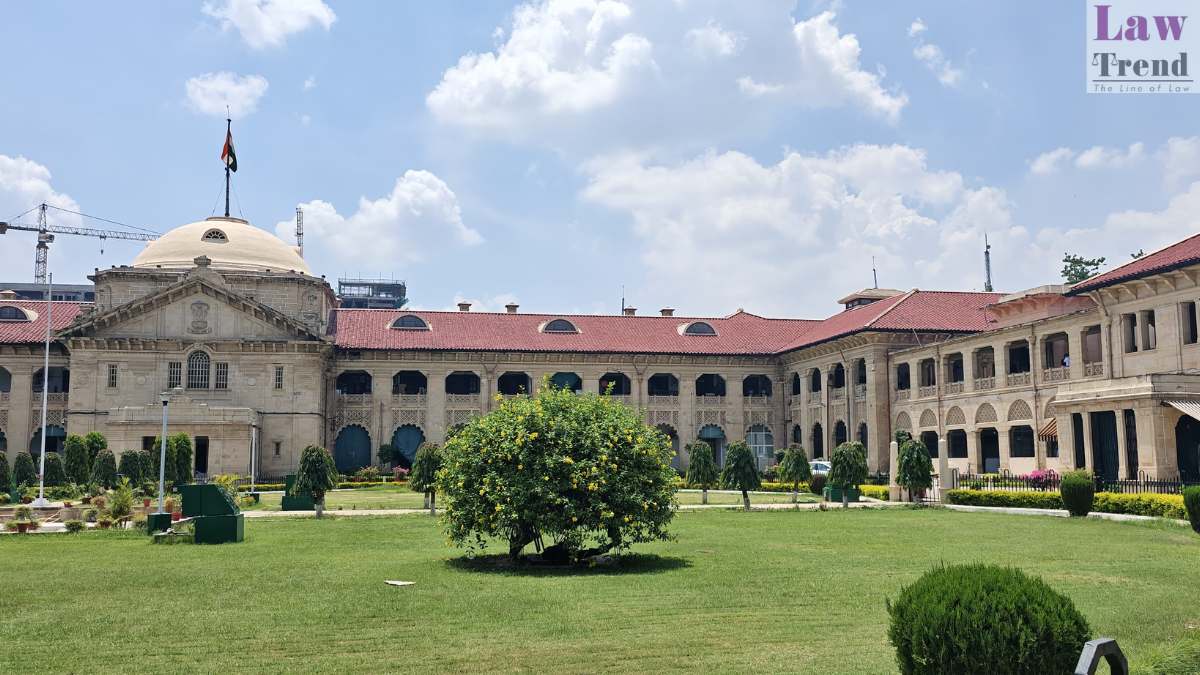
The Allahabad High Court has dismissed an appeal filed by a man convicted of throwing acid on his father in 1981, upholding his conviction and three-year rigorous imprisonment sentence under Section 326 of the Indian Penal Code (IPC). Delivering the judgment, Justice Santosh Rai expressed deep concern over the trial court’s decision to convict the appellant under a lesser offense and its failure to impose the mandatory statutory fine, but ruled that an appellate court cannot enhance a sentence or alter findings to the prejudice of the accused in an appeal preferred solely by the convict.

Background of the Case

The prosecution’s case dates back to September 5, 1981, at approximately 7:00 a.m. in village Bichhia, Gorakhpur. The appellant, Razzak, lived with his father, Gulam Husain, on the upper floor of a double-storeyed house, while tenants occupied the ground floor.

A quarrel broke out between Razzak and his father inside their residence. During this altercation, Razzak poured acid onto his father, causing extensive burns. Following the incident, Razzak attempted to flee toward the south but was chased and apprehended nearby by a local resident, Mahatam Singh (P.W.-1), with the assistance of another villager, Ram Sakal. Razzak was subsequently handed over to the police, and an First Information Report (FIR) was registered.

Gulam Husain was transported to the medical college by a rickshaw puller, Abdul Nisar. He sustained approximately 60 percent acid burn injuries across his face, neck, chest, and upper body. After surviving for nearly three weeks, Gulam Husain succumbed to his injuries in the hospital due to septicaemia and exhaustion. Razzak had also sustained simple acid splash injuries on his hand during the scuffle.

The Sessions Judge, Gorakhpur, framed charges against the appellant under Section 302 of the IPC (murder). However, the trial court ultimately convicted Razzak under Section 326 of the IPC (voluntarily causing grievous hurt by dangerous weapons or means) and sentenced him to three years of rigorous imprisonment, without imposing any fine.

READ ALSO  Supreme Court Frames Guidelines For Deciding Criminal Cases by Plea Bargaining, Compounding and Probation of Offenders Act

Arguments of the Parties

The learned Amicus Curiae appearing for the appellant argued that Razzak had not committed the offense and was falsely implicated. It was contended that the death of his father was entirely accidental and that Razzak had sustained burn injuries on his hands while trying to rescue him. Furthermore, the defense highlighted that the criminal appeal had been pending since 1983 and that the appellant is now over 60 years of age, making him eligible for the benefit of probation.

The learned Additional Government Advocate (AGA) representing the State strongly opposed these submissions. The AGA argued that Razzak intentionally poured acid on vital parts of his father’s body during an altercation. The prosecution pointed out that although the offense committed amounted to murder or culpable homicide, the trial court had already adopted an extraordinarily lenient approach by convicting and sentencing the appellant only under Section 326 of the IPC.

The Court’s Analysis

In reviewing the evidence, the High Court noted a significant disparity between the superficial injuries sustained by the appellant and the extensive, deep 60 percent burns suffered by the deceased. The court observed that this disparity strongly indicated that the appellant was the aggressor.

The court also pointed out that the appellant failed to hospitalize his father despite being present on the spot, and instead tried to escape before being apprehended by independent witnesses.

READ ALSO  Arbitration Clause Cannot Be Invoked for Disputes Arising After Tenancy Agreement Ends: Allahabad High Court

Furthermore, the court analyzed the statement made by Gulam Husain to the investigating officer, S.I. Umesh Chand Upadhyay (P.W.-6), at the hospital on September 8, 1981. Although the word “liquor” was mistakenly recorded instead of “acid” in the Case Diary, this was later clarified in court. Since the statement related to the cause of Gulam Husain’s death and was followed by his demise, the court held that it satisfied the requirements of Section 32(1) of the Indian Evidence Act and was admissible as a dying declaration. Justice Santosh Rai observed that, “So far involvement of the accused is concerned, is not doubtful on the basis of evidence available on the record.”

The High Court disagreed with the trial court’s finding that the appellant lacked the requisite knowledge for murder or culpable homicide, stating that the dangerous nature of acid is common knowledge and its deliberate use implies such awareness. The court remarked that the trial court committed a material legal error by failing to impose a fine, which is a mandatory statutory requirement alongside imprisonment under Section 326 of the IPC.

Justice Santosh Rai expressed deep anguish regarding the trial judge’s handling of the sessions trial, noting:

“Judicial discretion is never synonymous with judicial arbitrariness. Sympathy or misplaced leniency has no place where the statute and the evidence demand a reasoned and lawful adjudication.”

The Court added that the judgment should serve as a warning to judicial officers:

“This judgment shall serve as a reminder that failure to discharge these fundamental judicial obligations may invite serious judicial criticism and, where the officer is in service, appropriate administrative consequences in accordance with law.”

Despite these observations, the Court noted that the State had not filed an appeal or revision for the enhancement of the sentence. Relying on settled legal principles, the High Court ruled that an appellate court cannot enhance a sentence or alter a finding to the prejudice of the accused in an appeal preferred solely by the convict.

The Decision

The High Court rejected the appellant’s plea to be released on probation of good conduct, citing the gravity and domestic nature of the offense.

READ ALSO  Allahabad HC Refuses to Quash 23-Yr-Old Criminal Case Against Congress MP Surjewala

The Court upheld the conviction of the appellant under Section 326 of the IPC. While noting the legal infirmity in the trial court’s failure to impose a fine, the Court left the three-year rigorous imprisonment sentence undisturbed in the absence of a State appeal.

The appeal was dismissed. The appellant was ordered to surrender within two weeks to serve out the remaining sentence, failing which the trial court was directed to take coercive measures, including the issuance of non-bailable warrants, to take him into custody.

Case Details:

Case Title: Razzak Versus State of U.P.
Case No.: CRIMINAL APPEAL No. 2810 of 1983
Bench: Justice Santosh Rai
Date: July 15, 2026

Law Trend
Law Trendhttps://lawtrend.in/
Legal News Website Providing Latest Judgments of Supreme Court and High Court

Related Articles

Latest Articles
