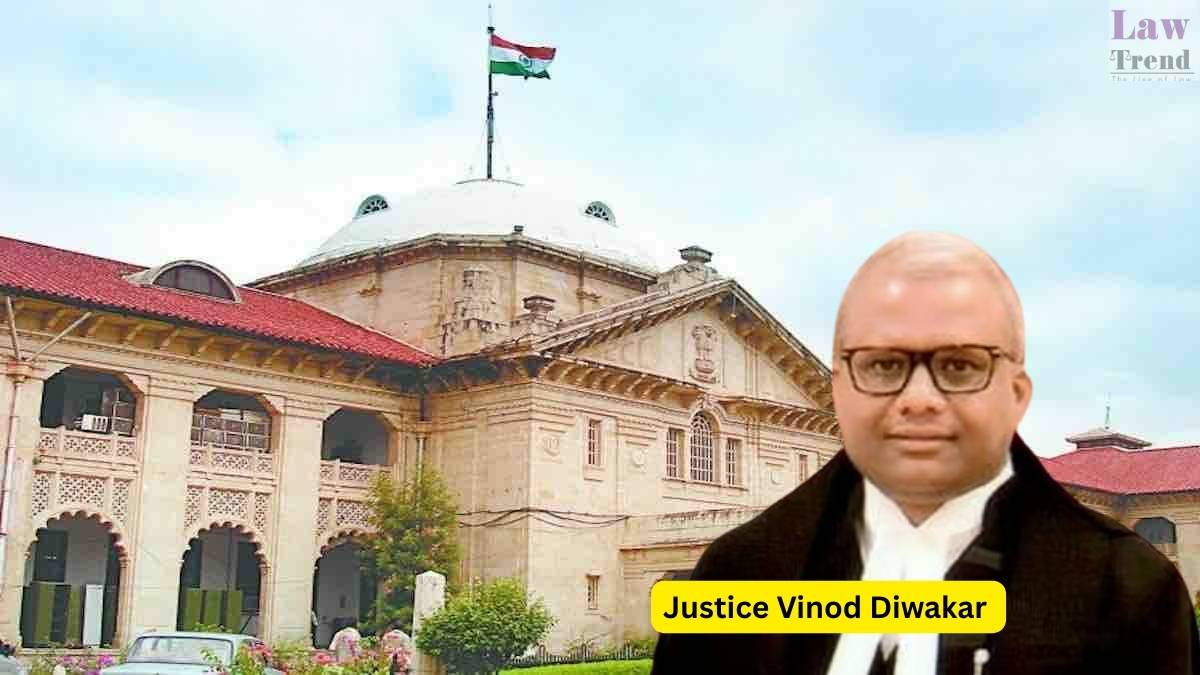
The Allahabad High Court has quashed criminal proceedings initiated under the Uttar Pradesh Gangsters and Anti-Social Activities (Prevention) Act, 1986, against three members of a family. Justice Vinod Diwakar ruled that financial transactions and disputes concerning land purchases do not meet the legal threshold of running an organized gang or acting as gangsters under Section 2 of the Act. The Court found that the local police had misused their authority, and specifically criticized the “patently illegal” arrest of a 35-year-old homemaker who was kept in judicial custody for approximately 80 days without any substantial allegations against her in the underlying base cases.
Background of the Case
The prosecution’s case originated from allegations that Rajendra Tyagi and his son, Deepak Tyagi, acted together as an organized gang for financial, material, and personal gains. They were accused of committing fraud worth crores of rupees, forgery, and criminal intimidation under the guise of providing plots or land in the Ghaziabad and Jalaun districts.
Based on these allegations, FIR No. 101 of 2023 was registered on February 12, 2023, under Sections 2 and 3 of the U.P. Gangsters and Anti-Social Activities (Prevention) Act, 1986, at Police Station Nandgram, District Ghaziabad. The FIR named three individuals:
- Rajendra Tyagi (designated as the gang leader)
- Deepak Tyagi (son of Rajendra Tyagi, designated as a gang member)
- Lalita Tyagi (daughter-in-law of Rajendra Tyagi, a homemaker, designated as a gang member)
The invocation of the Gangsters Act was based on two underlying “base cases”:
- Case Crime No. 912 of 2022 (P.S. Nandgram, Ghaziabad): Registered under Sections 406 and 506 of the Indian Penal Code (IPC), with Section 420 later added. The informant, Pankaj Tyagi, alleged that the accused took money on the assurance of returning it and induced him into executing a registered agreement of sale for a property, but subsequently failed to execute the sale deed.
- Case Crime No. 703 of 2021 (P.S. Chandpur, District Bijnor): Registered under Sections 406, 504, and 506 of the IPC. The informant, Sapna Agarwal, alleged that the accused induced her to hand over money and failed to return Rs. 32 lakhs as agreed.
Following the registration of the Gangsters Act FIR, Rajendra Tyagi and Deepak Tyagi were arrested on February 13, 2023. Lalita Tyagi was arrested the following day, on February 14, 2023. She was eventually granted bail on May 3, 2023, and released on May 6, 2023, after spending nearly 80 days in judicial custody. Rajendra and Deepak Tyagi were released on June 3, 2023, after being granted bail on May 31, 2023. The applicants subsequently moved the High Court under Section 482 of the Code of Criminal Procedure (Cr.P.C.), challenging the proceedings.
Systemic Issues and the Commissionerate Controversy
During the course of the hearings, the High Court examined a critical procedural issue. Under Rule 5(3)(a) of the U.P. Gangsters and Anti-Social Activities (Prevention) Rules, 2021, a gang chart must be approved in a “joint meeting” of the competent authorities. In standard districts, this joint meeting is held between the District Magistrate (DM) and the Senior Superintendent of Police (SSP)/Superintendent of Police (SP).
However, in districts operating under the Police Commissionerate system—such as Ghaziabad—the gang charts were being approved solely by the Commissioner of Police, completely excluding the District Magistrate. The applicants argued this practice violated the mandatory procedures established under Rule 5(3)(a) and relied on the ruling in Vinay Kumar Gupta v. State of U.P. and Others.
This procedural anomaly prompted the High Court to issue a series of orders starting in March 2025, demanding explanations from the Home Department. The Secretary (Home) and the Commissioner of Police, Ghaziabad, filed multiple personal affidavits. The State Government defended the exclusion of the DM by relying on a notification dated November 26, 2022, issued under Section 20 of the Cr.P.C. This notification appointed Commissionerate police officers (from Assistant Commissioners up to the Commissioner) as Executive Magistrates, and designated the Commissioner, Joint Commissioners, and Additional Commissioners as Additional District Magistrates, conferring upon them the powers of a District Magistrate for 14 specific enactments, including the Gangsters Act.
Arguments of the Parties
Arguments on Behalf of the Applicants:
- The disputes underlying the entire case were strictly civil and commercial in nature, arising out of financial transactions and agreements for land sales.
- There was no material to indicate that the applicants were habitual criminals, nor did they satisfy the definitions of “gangsters” or “gang” under Sections 2(b) and (c) of the Act.
- Lalita Tyagi, a young homemaker, had no specific allegations or role attributed to her in either of the base case charge sheets, making her arrest and subsequent 80-day detention entirely unjustified.
- The approval of the gang chart by the Commissioner of Police, Ghaziabad, without a joint meeting with the District Magistrate, violated Rule 5(3)(a) of the 2021 Rules.
Arguments on Behalf of the State:
- The District Magistrate is not a persona designata. Under Section 20 of the Cr.P.C. and the notification dated November 26, 2022, the Commissioner of Police holds the legally delegated powers of a District Magistrate for the purposes of the Gangsters Act and is fully competent to approve the gang chart in a joint meeting with the Deputy Commissioner of Police (DCP).
- The transition to the Commissionerate system in metropolitan areas represents a necessary, specialized model for urban policing. Modern crimes such as real estate syndicates, shell companies, and cyber-extortion require digital forensics and financial auditing expertise housed within the police department rather than revenue administration.
- Statistical data from March 2022 to November 2025 indicated that the Commissionerate system achieved 258% higher enforcement and 61% higher asset seizure values compared to non-Commissionerate districts. Additionally, court objections to gang charts were lower in Commissionerate districts (1.42 per 100 FIRs) than in traditional districts (2.04 per 100 FIRs).
- The State has implemented extensive training programs for police officers acting as Executive Magistrates and established a “Post-Acquittal Audit” mechanism to review cases of procedural negligence.
- The constitutional validity of the Gangsters Act and the Rules is currently pending before a three-judge Bench of the Supreme Court in Rameez Nemat and Another v. State of Uttar Pradesh and Others and Irfan Solanki v. State of Uttar Pradesh. Thus, the Court should defer final determination on the larger legislative issues.
The Court’s Observations on Executive Abuse and Bureaucratic Culture
While Justice Vinod Diwakar acknowledged that the Supreme Court is currently examining the overall constitutional validity of the Gangsters Act, the High Court made sweeping observations regarding the abuse of police powers and the systemic decay within the administrative machinery of Uttar Pradesh.
The Court noted with deep concern that the strict provisions of the Gangsters Act are routinely used against petty and street-level offenders, while organized syndicates remain largely unaffected due to a lack of structured enforcement. Reflecting on the state of administrative ethics, the Court observed:
“Uttar Pradesh, by virtue of its demographic magnitude and political significance, has historically been a crucible of political hegemony, driven by the feudal mindset of politicians and bureaucrats. It has long reduced constitutional governance to an instrument of personal dominion rather than public service.”
The Court criticized the lack of independence among field officers, stating that postings and promotions are frequently treated as political patronage rather than merit-based rewards. It remarked:
“A systemic and deeply entrenched culture has emerged wherein a considerable section of the officer cadre treats the rule of law not as a constitutional obligation but as an operational inconvenience.”
Highlighting the issue of institutional impunity, the Court recalled that the police officer supervising the operation during the infamous Bikru massacre—where eight police personnel, including a Deputy Superintendent of Police, were killed—was only punished with a “formal caution” upon the conclusion of departmental inquiries. The Court observed:
“This Court finds it difficult to reconcile such a disproportionately lenient outcome with the gravity of the supervisory failure involved, and it is precisely this culture of institutional impunity that emboldens those in authority to remain unaccountable, perpetuating the feudal and politically patronised administrative ecosystem that this Court has adverted to hereinabove.”
The judgment also called out the role of senior bureaucrats in the Home Department, pointing out that some officers who occupied the post of Home Secretary served as conduits for self-serving interests:
“Certain officers who rose to the post of Home Secretary have, in practice, served as conduits for self-serving interests. Recommendations on postings, approvals of departmental proceedings, and responses to court proceedings have, in such instances, reflected considerations driven by personal or extrinsic calculations rather than dispassionate and constitutionally informed administrative judgment.”
Analysis on Merits and the ‘Unwarranted’ Arrest of Lalita Tyagi
Turning to the merits of the case, the Court found that the prosecution completely failed to demonstrate that the applicants were operating an organized gang. The underlying disputes were purely commercial transactions regarding land purchase, where cheques had been issued and civil execution/settlement agreements were drawn.
Justice Vinod Diwakar observed that even if the accused committed offenses of cheating and forgery, those actions could not be construed as running an organized criminal gang. The Court noted:
“The activities and the material placed on record do not satisfy the ingredients of Section 2(b) of the Uttar Pradesh Gangsters and Anti-Social Activities (Prevention) Act, 1986. There is no material on record which could establish the use of violence, intimidation, coercion, or any other means with the object of disturbing public order or of gaining any undue temporal or pecuniary advantage.”
The Court severely reprimanded the police for the arrest of Lalita Tyagi, a 35-year-old homemaker against whom no allegations existed in the base case charge sheets. The Court remarked:
“The Investigating Officer exercised the power of arrest in a manifestly unjustified manner, betraying a complete non-application of mind to the settled legal principles governing the necessity of arrest.”
The Court also observed that the Commissioner of Police, Ghaziabad, failed to properly supervise the investigation and ignored the guidelines issued by the Supreme Court in Gorakhnath Mishra v. State of Uttar Pradesh and the High Court in Vinay Kumar Gupta when approving the gang chart.
The Final Ruling
The High Court allowed the application and quashed the entire proceedings of Special Sessions Trial No. 3072 of 2023 (State v. Rajendra Tyagi and Others), arising out of Case Crime No. 101 of 2023 under Sections 2/3 of the Gangsters Act, pending before the Additional Sessions Judge, Ghaziabad.
With respect to Shri Ajay Kumar Mishra, the then Commissioner of Police, Ghaziabad (now Inspector General of Police, Prayagraj Range), under whose watch the illegal arrest and improper approval took place, the Court took a lenient view but issued a strong directive:
“Taking a lenient view and having regard to the future career prospects of the officer, this Court considers it just and appropriate to direct Shri Ajay Kumar Mishra, Inspector General of Police, Prayagraj, to remain vigilant and circumspect in the discharge of his official functions, befitting the responsibilities of a position that demands balanced judgment, institutional restraint, and scrupulous adherence to law.”
The Court placed on record its appreciation for the assistance rendered by the Additional Government Advocates and concluded the proceedings.
Case Details:
Case Title: Rajendra Tyagi And 2 Others v. State of U.P. and Another
Case No.: Application U/S 482 No. 6547 of 2025
Bench: Justice Vinod Diwakar
Date: June 3, 2026