

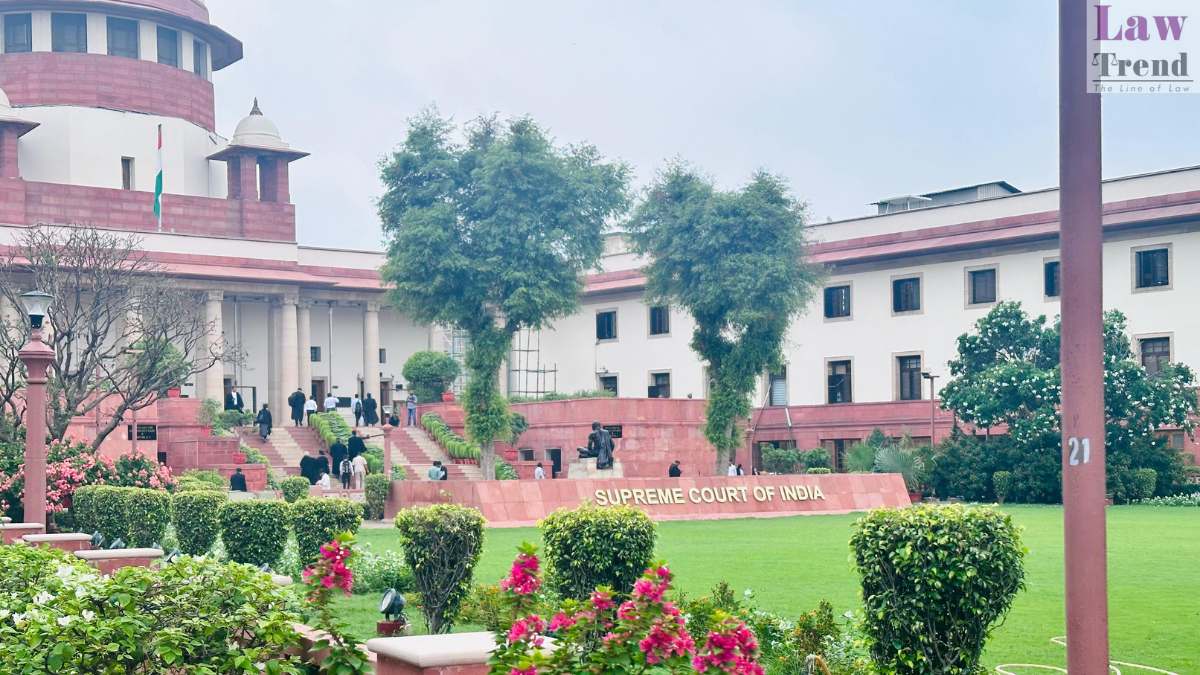
The Supreme Court of India has agreed to examine a legal challenge against a controversial new policy by the Central Board of Secondary Education (CBSE) that mandates the study of three languages—including at least two native Indian languages—for Class 9 students starting July 1, 2026.
A three-judge bench comprising Chief Justice Surya Kant and Justices Joymalya Bagchi and Vipul M Pancholi issued notices to the Central Government, the CBSE, and the National Council of Educational Research and Training (NCERT), seeking comprehensive replies within two weeks. While the top court refused to pass any interim order to halt the policy, it has scheduled a detailed hearing for the second week of July.
Additionally, the court directed Additional Solicitor General Aishwarya Bhati to submit a report detailing the CBSE’s logistical readiness to roll out the sweeping curriculum changes.
“A Matter of Choice”: The Legal Challenge
The legal challenge brings constitutional questions of student autonomy and federalism to the forefront.
Senior advocate Mukul Rohatgi, representing lead petitioner Yashica Bhandari Jain and others, argued that the nationwide circular forces a massive curricular shift on students starting this upcoming academic year.
Supporting other petitioners in the case, senior advocate Kapil Sibal raised broader constitutional concerns. “Language is a matter of choice, and cannot be imposed,” Sibal submitted to the bench, emphasizing that the policy infringes upon the principles of federalism and individual choice.
Inside the CBSE’s New Language Formula
The disputed policy, outlined in a CBSE circular issued on May 15, is part of a broader effort to align secondary school education with the National Education Policy (NEP) 2020 and the National Curriculum Framework for School Education (NCF-SE) 2023.
Under the new guidelines, Class 9 students must compulsorily study three languages, designated as R1, R2, and R3. Key aspects of the framework include:
- Native Language Mandate: At least two of the three compulsory languages must be native Indian languages.
- Restrictions on Foreign Languages: Students wishing to study a foreign language can only do so as their third language (R3)—after selecting two native Indian languages—or as an optional fourth language.
- No Board Exam for R3: In an effort to reduce academic pressure, the CBSE clarified that no formal Class 10 board examination will be conducted for the third language (R3). Assessments will be entirely school-based and internal, meaning no student will be barred from taking their Class 10 board exams due to R3 performance, though grades will be reflected on their final CBSE certificate.
Logistical Hurdles and Interim Solutions
The rapid implementation timeline has raised practical concerns regarding textbook availability and teaching staff. To address these hurdles, the CBSE has proposed several temporary workarounds:
- Textbook Shortages: Because dedicated R3 textbooks are not yet fully available, Class 9 students will temporarily use the Class 6 R3 textbooks (2026–27 edition) of their chosen language.
- Language Offerings: Class 6 R3 textbooks for 19 scheduled languages are expected to be available before July 1. For other native Indian languages, schools are directed to use resources from State Councils of Educational Research and Training (SCERT) and other state-level bodies. Schools must update their language offerings on the OASIS portal by June 30.
- Teacher Shortages: Schools lacking qualified native language teachers are permitted to temporarily assign existing teachers of other subjects who possess “functional proficiency” in the language. The CBSE also suggested resource-sharing through Sahodaya school clusters, hybrid or virtual classes, hiring retired teachers, and employing qualified postgraduates.
- Supplementary Material: To support local context, textbooks will be supplemented with local or state literary works (poems, short stories, or non-fiction) chosen by schools. Detailed guidelines on this will be released by June 15.
Exemptions to the policy will be granted to children with special needs, in line with the Rights of Persons with Disabilities Act, 2016. Foreign students returning to India may also receive case-by-case exemptions from the two-native-languages requirement.
A Broader Overhaul of Secondary Education
The mandatory language policy is just one part of a phased restructuring of the CBSE curriculum.
In April, the board announced a phased rollout of the three-language formula starting from Class 6, alongside a new two-level system for Mathematics and Science for Class 9, beginning in the 2026–27 academic session.
Under this parallel system, math and science will feature a mandatory “standard” course and an optional “advanced” course. While all students will sit for a standard 80-mark paper, those seeking higher proficiency can opt for an additional advanced-level paper to test conceptual depth. The first Class 10 board exams utilizing this two-level structure are scheduled for 2028.
As the July 1 implementation date fast approaches, all eyes remain on the Supreme Court’s upcoming July hearing to determine whether this sweeping educational overhaul will proceed as planned.




