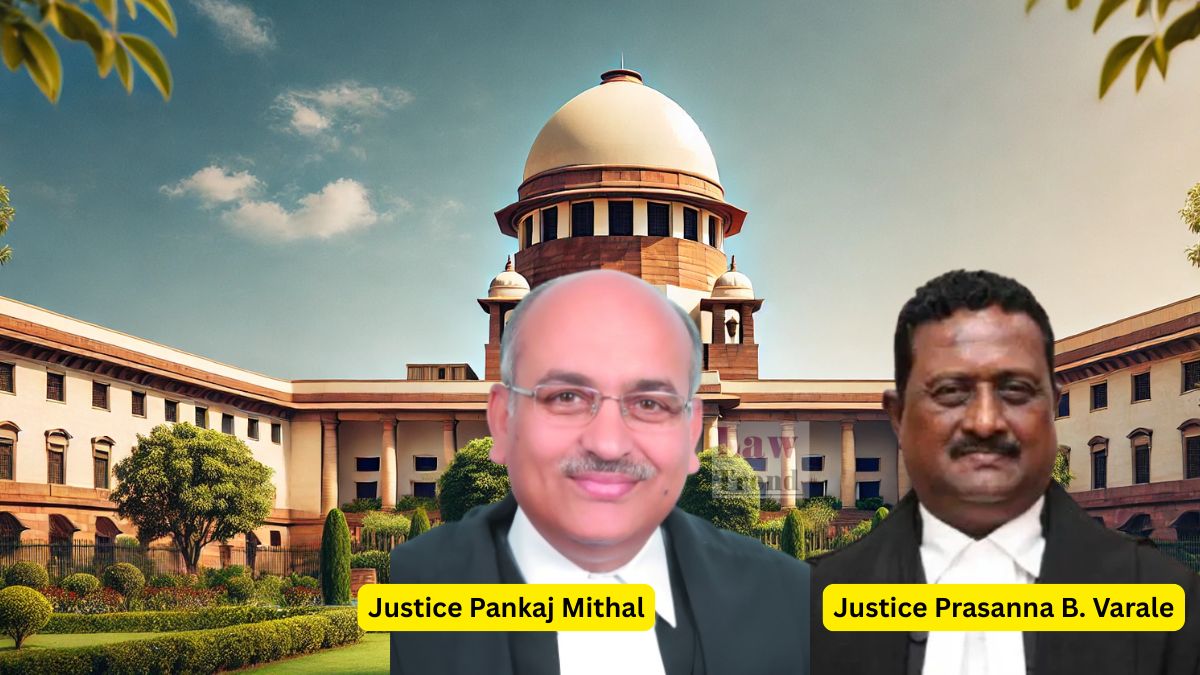
The Supreme Court of India has dismissed appeals challenging the acquittal of four individuals accused of kidnapping, murdering, and robbing a taxi driver in Rajasthan, ruling that the prosecution failed to establish a complete and reliable chain of circumstantial evidence. A Bench comprising Justices Pankaj Mithal and Prasanna B. Varale held that “suspicion however strong it may be, cannot take place of the legal evidence so as to convict an accused person.”
The judgment upheld a 2015 order of the Rajasthan High Court, Jaipur Bench, which set aside the trial court’s conviction and life sentences of Manoj Kumar, Manjeet Kumar @ Billu, Balraj @ Tiloo, and Vijay Singh @ Sunder under Sections 364 read with 120B, 302 read with 120B, 396, and 201 of the Indian Penal Code, 1860 (IPC).
Factual Background of the Case
The criminal machinery was set in motion on April 28, 2007, when the complainant, Pawan Kumar Sharma (P.W. 1), filed a written report at Khetri Police Station. The report stated that on April 26, 2007, at around 5:00 PM, two boys came to his shop and hired a Bolero Jeep operated as a taxi by his brother, Ashok Kumar Sharma (the deceased), to travel towards Lambi Road. While the deceased was scheduled to return that same night, both he and the vehicle went missing.
Based on the missing report, the police registered FIR Case No. 122/2007 and subsequently arrested five individuals: Manoj Kumar, Manjeet Kumar @ Billu, Balraj @ Tiloo, Vijay Singh @ Sunder, and Surendra Kumar (a juvenile tried separately before the Juvenile Justice Board). The prosecution claimed that Balraj @ Tiloo was arrested on April 28, 2007, and led the police to discover the deceased’s body in a dry well on the same day based on his disclosure statement.
Following a trial in which the prosecution presented 18 witnesses and 65 documents, the Trial Court, on July 26, 2008, found all four adult accused guilty, awarding them life imprisonment and fines under Sections 364/120B, 302/120B, 396, and 201 of the IPC.
On appeal, the Rajasthan High Court on January 30, 2015, reversed this decision, acquitting all four accused. The High Court found that the prosecution’s circumstantial evidence was disjointed and that the identification of Vijay Singh @ Sunder was weak. Aggrieved, both the complainant and the State of Rajasthan preferred separate appeals before the Supreme Court.
Arguments of the Parties
For the Appellants (State of Rajasthan & Complainant): Ms. Sansriti Pathak, Additional Advocate General (A.A.G.) for the State, and Mr. K.L. Janjani, counsel for the complainant, contended that the prosecution had proved its case beyond reasonable doubt. They argued that the recovery of multiple material objects completed the chain of circumstantial evidence:
- A tape recorder and a quartz watch worn by the deceased, recovered from Manjeet Kumar @ Billu.
- A towel, recovered from Vijay Singh @ Sunder.
- Registration papers of the Bolero Jeep, recovered from Manoj Kumar.
- The dead body, the Bolero Jeep, and a lathi, recovered from Balraj @ Tiloo.
The appellants argued that because the deceased was last seen in the company of the accused (Vijay Singh @ Sunder and the juvenile), the burden shifted to the respondents under Section 106 of the Indian Evidence Act, 1872, to explain his fate. They further urged that the addition of Section 302 IPC to the arrest memo prior to recovery was naturally done after the Investigating Officer spotted the body in the well, and that recovery in the presence of a relative (the deceased’s uncle) rather than independent witnesses was not a ground to discard the entire recovery. Lastly, they claimed that a Test Identification Parade (TIP) is not applicable to the recovery of immovable articles, as admissibility is governed by Section 27 of the Evidence Act.
For the Respondents (Accused Persons): Counsel for the accused supported the High Court’s acquittal, arguing that piecemeal recoveries failed to establish guilt and that suspicion cannot substitute proof. The respondents relied heavily on the Supreme Court’s decision in Tulesh Kumar Sahu v. State of Chhattisgarh, which discussed Sunder Lal alias Sundera v. State of Madhya Pradesh and Sanwant Khan v. State of Rajasthan, to emphasize:
“Where, however, the only evidence against an accused person is the recovery of stolen property and although the circumstances may indicate that the theft and the murder must have been committed at the same time, it is not safe to draw the inference that the person in possession of the stolen property was the murderer. Suspicion cannot take the place of proof.”
The Court’s Analysis and Findings
Justice Prasanna B. Varale, writing for the Bench, began by examining the scope of Article 136 of the Constitution of India in appeals against acquittal, reiterating the principles in State of M.P. v. Paltan Mallah and quoting State of Punjab v. Kewal Krishan:
“Normally, this Court is reluctant to interfere with an order of acquittal. But when it appears that the High Court has on an absolutely wrong process of reasoning and a legally erroneous and perverse approach to the facts of the case and ignoring some of the most vital facts, acquitted the respondent and the order of acquittal passed by the High Court has resulted in a grave and substantial miscarriage of justice, extraordinary jurisdiction under Article 136 of the Constitution of India may rightfully be exercised…”
On evaluating the evidence, the Supreme Court highlighted several fatal flaws in the prosecution’s case:
1. Doubtful Recovery of the Dead Body
The Bench found that the High Court rightly doubted the recovery of the body at the instance of Balraj @ Tiloo. At the time of Balraj’s arrest on April 28, 2007, the police only had a missing report, raising the unanswered question of how the arrest memo filed on that very day already charged him under Sections 302, 394, and 201 IPC.
Furthermore, the testimony of an independent witness, P.W. 5 (Basant Singh), revealed that the police had already visited and examined the dry well on April 28, 2007, prior to the recovery on April 29, and that none of the accused were present during the recovery.
Additionally, the Court noted a violation of Section 100(4) of the Code of Criminal Procedure (Cr.P.C.) because the prosecution failed to produce Ramawtar, an independent witness to the recovery, leaving only P.W. 2 (the deceased’s uncle) to testify:
“…the requirement of independent witnesses, more particularly, as per Section 100(4) of Cr.P.C. is to provide credibility to the investigation… Ramawtar who was an independent witness and failure to produce him before the Court is nothing but withholding the material witness and this creates a doubt about the recovery of the dead body alleged at the instance of accused Balraj @ Tiloo.”
2. Recovery of the Bolero Jeep
The vehicle was recovered from an open, accessible road and not from the direct possession of Balraj @ Tiloo. Applying the law in Jaikam Khan v. State of U.P., the Bench observed that recoveries from places accessible to the public cannot be relied upon.
3. Limitations of the “Last Seen Together” Theory and Section 106
Addressing the “last seen together” theory applied to Vijay Singh @ Sunder, the Supreme Court pointed out that Section 106 of the Evidence Act does not shift the primary burden of proof, which always remains on the prosecution. Citing Manoj @ Munna v. State of Chhattisgarh, the Court held:
“…any adverse inference under Section 106 of the Evidence Act is to be drawn against the accused person when the prosecution has been able to establish the case beyond a reasonable doubt.”
Citing Kanhaiya Lal vs. State of Rajasthan, the Bench affirmed that “evidence on last seen together is a weak evidence” and insufficient for conviction under Section 302 and 201 of the IPC without strong corroborative evidence.
4. Material Omission of Test Identification Parade (TIP)
Regarding the tape recorder and wrist watch recovered from Manjeet Kumar @ Billu, the Supreme Court noted that neither was subjected to a TIP. Under the Rajasthan Police Rules, 1965, recovered objects must be subjected to a TIP to assess objective identification. Citing Thammaraya & Anr. v. The State Of Karnataka, the Court observed:
“Therefore, this material omission on part of the Investigating Officer (PW-27) in not conducting a Test Identification Parade (TIP) of the recovered articles, more particularly when the case of prosecution is based solely upon recoveries of these articles, has created holes in the fabric of the prosecution story, which are impossible to mend.”
Similarly, the recovery of a towel from Vijay Singh @ Sunder’s house was dismissed as immaterial, given that a towel is a common household object and bore no bloodstains or connection to the deceased or the recovered lathi.
5. Principles of Circumstantial Evidence
The Supreme Court invoked the classic Sharad Birdhichand Sarda v. State of Maharashtra case, highlighting the Hanumant principle:
“…the circumstances from which the conclusion of guilt is to be drawn should in the first instance be fully established, and all the facts so established should be consistent only with the hypothesis of the guilt of the accused. Again, the circumstances should be of a conclusive nature and tendency and they should be such as to exclude every hypothesis but the one proposed to be proved. In other words, there must be a chain of evidence so far complete as not to leave any reasonable ground for a conclusion consistent with the innocence of the accused…”
Supreme Court’s Decision
The Supreme Court concluded that the High Court had carefully “separated grain from the chaff” and arrived at a plausible conclusion that the chain of circumstances was incomplete. Finding that the prosecution had left the court “groping in the dark” on weak suspicion, the Bench held that there was no good reason to interfere with the High Court’s order of acquittal. Consequently, the Supreme Court dismissed the appeals and upheld the acquittal of the four accused persons.
Case Details
- Case Title: Pawan Kumar Sharma v. Manoj Kumar & Ors.
- Case No.: Criminal Appeal Nos. 1353-1355 of 2017
- Bench: Justice Pankaj Mithal and Justice Prasanna B. Varale
- Date: May 25, 2026