

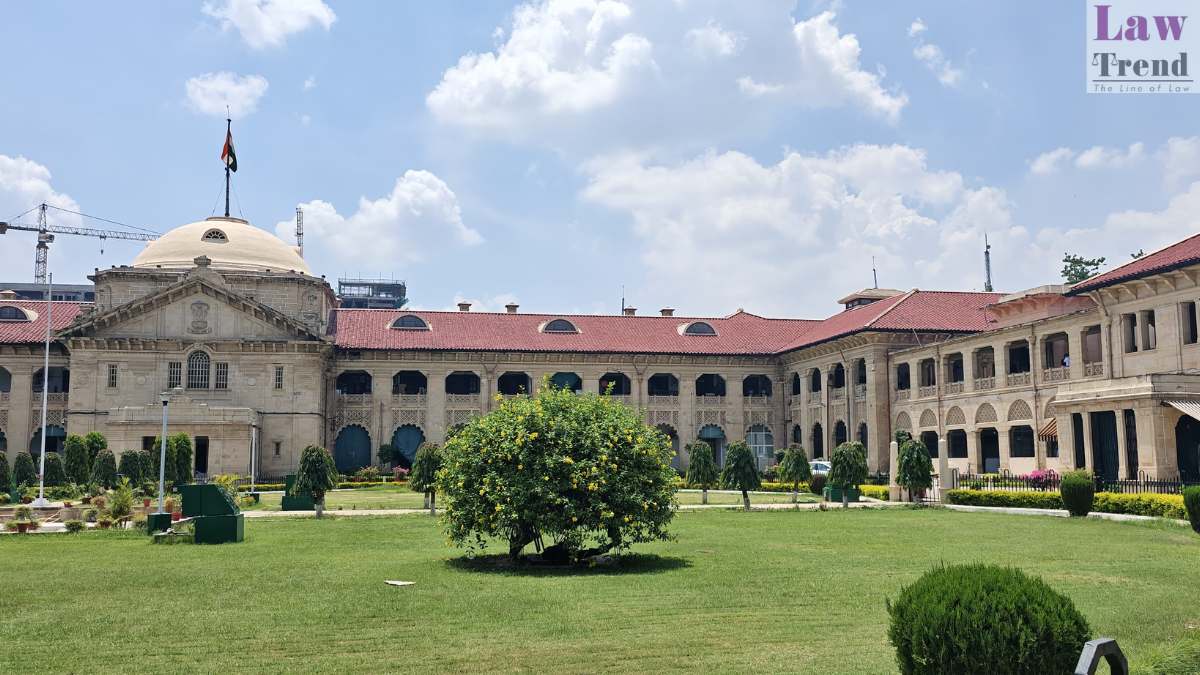
The Allahabad High Court has strongly rebuked administrative and police authorities across Uttar Pradesh for failing to comply with statutory rules and government orders regarding the regulation of firearms. Hearing a plea seeking a comprehensive audit of firearms in the state, the court warned that a society dominated by armed individuals wielding visible force and threats weakens public safety, erodes civic peace, and disrupts social harmony.
Justice Vinod Diwakar observed that District Magistrates (DMs), Commissioners of Police, and Senior Superintendents of Police (SSPs) across all 75 districts of Uttar Pradesh have systematically failed to adhere to the Arms Act, 1959, and subsequent government directives in their “true letter and spirit.”
Background of the Case
The judicial intervention comes in response to a petition filed by Jai Shankar against the State of Uttar Pradesh and others, which sought a rigorous audit of arms licences issued within the state.
During the proceedings, a compliance affidavit was submitted by the Joint Secretary (Home) on May 20, following a specific High Court directive issued on May 11. Earlier, on March 23, the court had laid down explicit guidelines and requirements that DMs and SSPs must satisfy when processing, renewing, or transferring arms licences.
Court’s Observations on Weapon Display and Dominance
Reviewing the state’s compliance, Justice Diwakar expressed deep concern over the visible show of armed strength in society. In the court’s prima facie view, the public display of weaponry serves to create a false sense of security while actively intimidating the public.
“A society in which armed individuals assert dominance through visible force and threats does not become freer or more peaceful; rather, it erodes public trust, weakens the sense of safety, and disturbs civic peace,” the court observed.
“The public display of weapons may create an illusion of dominance, strength, and protection, but it often disrupts social harmony and generates fear and insecurity among ordinary people.”
Authorities Accused of Concealing Details of Influential Persons
The High Court raised serious concerns over the local police authorities’ failure to provide transparent records of politically and socially influential individuals holding firearms.
Justice Diwakar noted that the local police had actively concealed crucial particulars regarding highly influential individuals. The court explicitly named several prominent figures in its order:
“Local police authorities have failed to furnish details of certain influential individuals wielding substantial social and political influence, and that relevant particulars concerning such persons have been concealed. The list included influential persons, such as Brij Bhushan Singh, Raghuraj Pratap Singh, Dhananjay Singh, Upendra Singh Guddu, and others.”
Key Findings and Statistics
The court pointed out that the affidavit submitted on May 20 is “self-explanatory” in revealing widespread administrative lapses. It highlights a critical gap between the statutory requirements of the Arms Act, 1959, and their execution on the ground.
Data previously disclosed to the court by the Additional Chief Secretary (Home) underscores the scale of firearm ownership and the administrative backlog in Uttar Pradesh:
- Total Active Licences: 10,08,953 arms licences have been granted in the state.
- Pending Applications: 23,407 applications across various categories are currently awaiting consideration.
- Pending Appeals: 1,738 appeals challenging the decisions of District Magistrates remain pending before regional Commissioners.
- Multiple Licences: 20,960 families in the state possess more than one arms licence.
- Criminal History: In 6,062 cases, arms licences have been granted to individuals who have a criminal history involving two or more criminal cases.
The High Court’s findings highlight a severe lack of oversight and raise critical questions regarding how arms licences are vetted, renewed, and monitored in India’s most populous state.




