

Can Regularisation be Denied Only Because Initial Appointment was Not Against Sanctioned Post? SC Answers
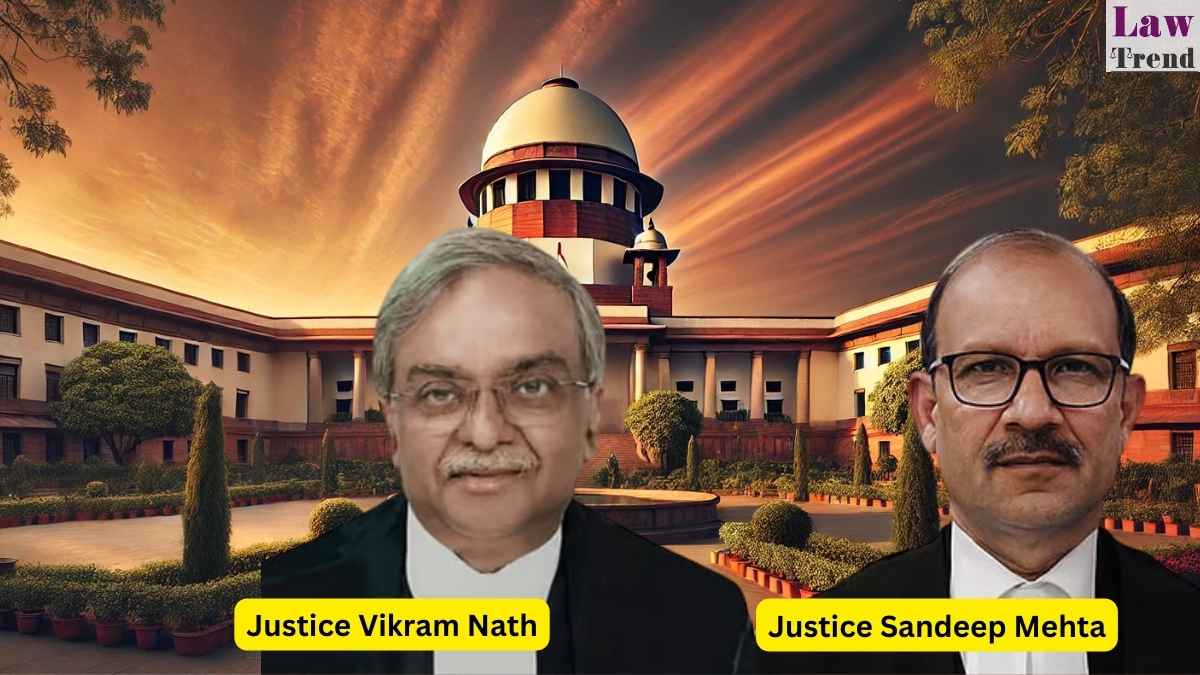

The Supreme Court of India has answered whether the lack of initially sanctioned vacant posts can be a valid ground to deny regularization to long-serving temporary employees. In a major ruling on public employment and administrative fairness, a Bench of Justice Vikram Nath and Justice Sandeep Mehta held that the State cannot refuse regularization by arguing that employees were not initially appointed against sanctioned vacant posts, especially when the State itself created posts and regularized a vast majority of an identical class under a declared policy.

The Court set aside a Gauhati High Court Division Bench judgment and restored a 2013 Single Judge order directing the State of Assam to regularize a left-out group of Muster Roll, Work Charged, and Casual workers who were engaged prior to April 1, 1993.

Background of the Case

Beginning in the year 1980, the Government of Assam engaged a large number of Muster Roll and Work Charged workers across different departments to meet the growing manpower demands for public works development and road maintenance. On September 23, 1983, the Assam Cabinet decided to regularize all Muster Roll workers who had completed 15 years or more of service as Grade-IV employees. This was followed by an Office Memorandum (O.M.) dated April 20, 1995 (the “1995 O.M.”), which directed all departments to initiate steps to regularize Work Charged and Muster Roll workers engaged prior to April 1, 1993.

While the legal validity of the 1995 O.M. was litigated before a Full Bench of the Gauhati High Court in Jitendra Kalita & Ors. v. State of Assam & Ors., the State Cabinet on July 22, 2005, took a conscious policy decision to regularize the services of all Work Charged and Muster Roll workers engaged prior to April 1, 1993, who were in continuous service without interruption. To implement this policy, the Finance Department concurred with the creation of 5,892 Work Charged grade posts and 25,069 Grade-IV posts, resulting in the regularization of approximately 30,000 workers.

However, a small fraction of eligible workers was left out of this exercise due to administrative lapses, clerical errors, and spelling mistakes in the list of eligible workers. In subsequent writ petitions filed by these left-out workers—such as Ramani Deka and Others v. State of Assam and Others—the State filed undertakings and affidavits through its Chief Secretary, admitting that approximately 3,720 eligible workers remained and that a draft policy was being framed to regularize them against personal posts.

READ ALSO  सुप्रीम कोर्ट ने कर्नाटक हाई कोर्ट के न्यायाधीश के मामले से खुद को अलग करने की जांच करने की याचिका खारिज की

Despite these commitments, the State in 2012 filed a miscellaneous application arguing that the Supreme Court’s ruling in Secretary, State of Karnataka v. Umadevi (2006) created a legal embargo on such regularizations. On June 16, 2012, the Finance Department issued a fresh O.M. (the “2012 O.M.”) declaring that no further regularizations would be undertaken. The State defended the 2012 O.M. on the ground that the left-out workers were appointed de hors the regular cadre and without initially sanctioned vacant posts.

While a Single Judge of the High Court quashed the 2012 O.M. and ordered regularization, a Division Bench reversed the decision in State of Assam v. Upen Das. The Division Bench accepted the State’s defense, holding that because the appellants were never appointed against sanctioned posts, they did not satisfy the threshold condition required to invoke the “one-time measure” exception under Paragraph 53 of Umadevi.

Arguments of the Parties

For the Appellants

Senior Counsel Shri Manish Goswami and Ms. Anitha Shenoy, representing the left-out workers, argued that their clients were identically placed to the 30,000 workers regularized under the 2005 Cabinet decision. They contended that excluding a small fraction of an identical class due to the State’s own clerical errors was highly discriminatory and violated Article 14 of the Constitution. They further asserted that the “one-time measure” under Umadevi, as clarified in State of Karnataka v. M.L. Kesari (2010), is not exhausted if the State’s initial exercise was partial or incomplete due to administrative oversight.

For the Respondent (State of Assam)

Senior Counsel Shri Jaideep Gupta, appearing for the State, defended the Division Bench’s ruling. He argued that the appellants were engaged de hors the regular cadre and without a legally recognized selection process. The State contended that Umadevi strictly bars the regularization of employees appointed to unsanctioned positions and that executive policies or Cabinet decisions cannot override these constitutional mandates.

The Court’s Analysis: SC Answers on the “Sanctioned Posts” Defense

The Supreme Court directly addressed and rejected the State’s argument that the lack of initially sanctioned vacant posts was an absolute barrier to regularization under these circumstances.

The Court directed its focus to the specific injustice of the State using initial hiring technicalities to exclude workers after extracting decades of service. The Bench explicitly rejected the State’s contention, observing in Paragraph 78 of the judgment:

READ ALSO  In Case Difficult and Complex Questions Regarding Custody of Minor Arise, Things Have to be Balanced Between Right of Parties and Welfare of Child: Allahabad HC

“In the aforesaid backdrop, we are unable to accept the contention of the State that the appellants cannot be granted regularization on the ground that they were not initially appointed against duly sanctioned posts. The State, having engaged the appellants prior to 1st April, 1993, utilised their services continuously for decades, and having itself framed and implemented a Cabinet policy regularizing nearly 30,000 similarly situated workers, cannot now exclude the appellants by taking shelter behind a rigid or technical reading of Umadevi (supra). In absence of any cogent distinction or reasoned decision justifying such exclusion, the action of the State is manifestly arbitrary. It is inconsistent with its obligation to function as a model employer and does not withstand scrutiny under Article 14 of the Constitution.”

The Court clarified that the appellants’ claim was not rooted in the court-mandated exception under Paragraph 53 of Umadevi, but was instead based on equal treatment under Article 14. Once the State chose to regularize 30,000 workers under its own 2005 policy, it was constitutionally obligated to treat all eligible members of that class alike.

On the Misinterpretation of Umadevi

The Bench emphasized that Umadevi was intended to prevent “backdoor entries” that bypass regular recruitment, not to serve as a tool to exploit workers who have dedicated decades of service to the State. Citing its recent rulings in Jaggo v. Union of India (2024) and Bhola Nath v. State of Jharkhand (2026), the Court reiterated that the State cannot rely on nominal or temporary labels to indefinitely evade its obligations.

The Court pointed out that the State itself had created the necessary posts to accommodate the 30,000 regularized workers. Therefore, denying the same benefit to a remaining fraction because of spelling mistakes or bureaucratic errors—under the guise of a lack of sanctioned posts—amounted to treating equals unequally.

The State’s Duty as a Model Employer

The Court severely criticized the State’s decision to seek judicial “leave” in 2012 to implement its own policy under the guise of Umadevi obstacles, calling it an “unwarranted surrender of executive authority.” The Bench remarked that as a model employer, the State bears a higher constitutional obligation to act with fairness and probity, and it cannot continuously provide undertakings to constitutional courts only to later resile from them.

The Decision

Allowing the appeals, the Supreme Court set aside the Gauhati High Court’s Division Bench judgment and affirmed the Single Judge’s directions:

  1. Uniform Regularization: The appellants shall be treated as regularized in service under the Cabinet decision of July 22, 2005, from the same date on which the other 30,000 employees received the benefit.
  2. Creation of Supernumerary Posts: The State of Assam must identify eligible appellants and, where necessary, create supernumerary posts personal to them to facilitate their regularization.
  3. Consequential and Retiral Benefits: Regularized workers are entitled to full consequential benefits, including regular scale pay fixation, continuity of service, and all applicable pensionary/post-retiral benefits.
  4. Relief for Retired and Deceased Employees: Retired appellants will receive notional regularization with financial arrears to recalculate pensions, while deceased appellants’ arrears will be released to their legal heirs.
  5. Strict Cut-Off: The benefits are limited strictly to those appellants who were continuously working in State departments before the cut-off date of April 1, 1993.
  6. Execution Timeline: The entire verification, post creation, and payment of financial arrears must be completed within one year from the date of the judgment.
READ ALSO  किशोर अपराधी जन्मजात अपराधी नहीं, नागरिकों को सहायता करने का संकल्प लेना चाहिए: न्यायमूर्ति बी वी नागरत्ना

Connected Appeals

  • Work Charged Employees (Civil Appeal Nos. 4519 & 4520 of 2025): The Court clarified that Work Charged employees constitute a distinct class from Muster Roll workers. It set aside the adverse findings against them in the 2017 judgment and gave members of the All Assam Work Charge Employee Association liberty to independently agitate their pensionary and retiral claims before the State Government.
  • Inland Water Transport Workers (Civil Appeal No. 4523 of 2025): The Court set aside the High Court’s orders dismissing the pension claims of Muster Roll ferry workers appointed between 1993 and 1995, giving them liberty to pursue their claims before appropriate forums under the applicable policy framework.

Case Details

  • Case Title: Sukhendu Bhattacharjee and Others v. The State of Assam and Others
  • Case No.: Civil Appeal No. 4514 of 2025 (with Civil Appeal Nos. 4515, 4516, 4517, 4518, 4519, 4520, and 4523 of 2025)
  • Bench: Justice Vikram Nath and Justice Sandeep Mehta
  • Date of Judgment: May 21, 2026

Law Trend
Law Trendhttps://lawtrend.in/
Legal News Website Providing Latest Judgments of Supreme Court and High Court

Related Articles

Latest Articles

