

Trial Courts Become ‘Functus Officio’ After Disposing Bail Applications; Cannot Order Departmental Enquiries Against Police Officers: Delhi High Court
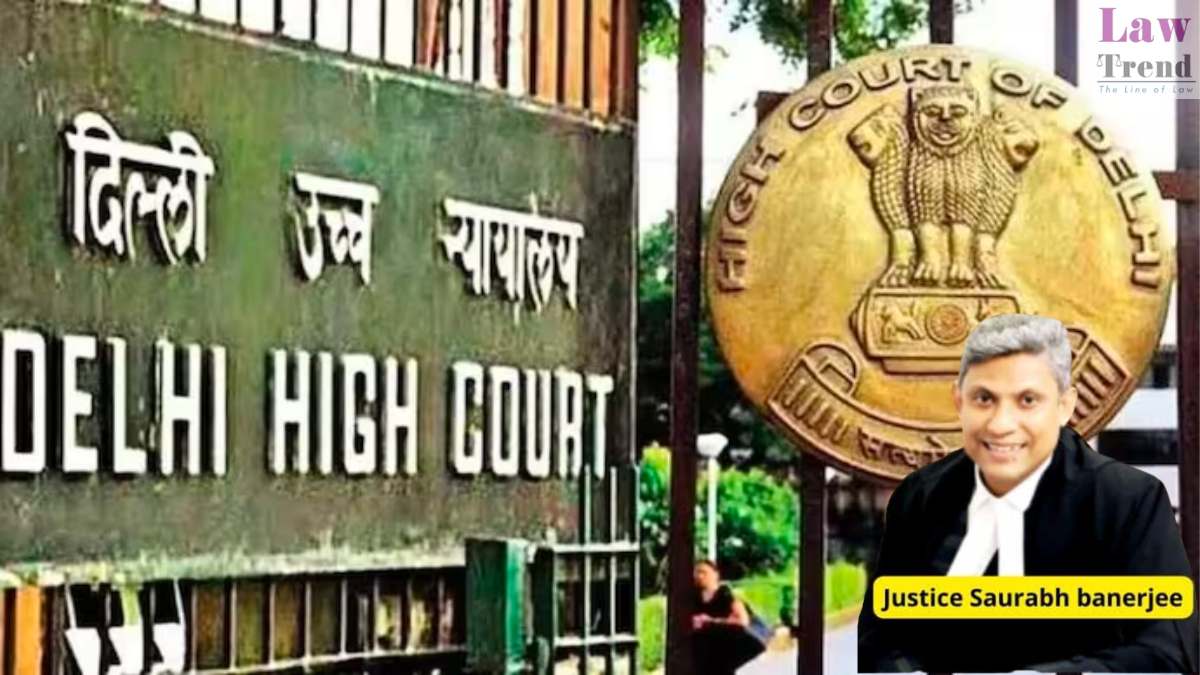

The High Court of Delhi has ruled that a trial court exceeds its jurisdiction and becomes functus officio once it has disposed of an application for the grant of anticipatory bail. The High Court clarified that trial courts do not possess the authority to continue monitoring investigations, summoning police officials, or ordering departmental enquiries after a bail application has been decided.

Consequently, Justice Saurabh Banerjee set aside a series of orders passed by the Additional Sessions Judge (FTSC) (POCSO)-02, Dwarka Courts, New Delhi, which had directed departmental actions and sought explanations from several high-ranking police officers over delays in an investigation. The High Court also expunged all adverse remarks passed against the officials involved.

Background of the Case

The matter originated from an FIR registered on June 21, 2019, under Section 363 of the Indian Penal Code (IPC), 1860, following a complaint by a mother regarding her missing minor daughter. Upon the recovery and medical examination of the victim, her statements were recorded under Sections 161 and 164 of the Code of Criminal Procedure (CrPC), 1973. Consequently, serious charges under Sections 328 and 376 of the IPC, as well as Section 4 of the Protection of Children from Sexual Offences (POCSO) Act, 2012, were added to the case.

The initial investigation was led by ASI Ram Lal, and the case was subsequently transferred to several Investigating Officers (IOs) over time. The petitioner in CRL.M.C. 5769/2022, who was the then IO, and the petitioner in CRL.M.C. 1664/2024, the then Head Constable, asserted that they had discharged their duties lawfully and achieved substantial progress during their respective postings.

During the ongoing investigation, a co-accused filed an application seeking anticipatory bail before the learned Additional Sessions Judge (ASJ). Although the ASJ disposed of the bail application via an order dated February 22, 2022, the court kept the proceedings alive to monitor the pace of the investigation. The ASJ called for a written Status Report from the previous IO and the concerned SHO regarding the causes of the delay, directing them to appear in person.

In a subsequent order dated April 12, 2022, the ASJ ordered a departmental enquiry against Inspector Aishvir Singh and Inspector Gyanender Rana (the then SHOs), and Head Constable Sunil (the then MHCR PS Chhawla). Furthermore, the ASJ called for explanations regarding supervisory lapses from senior IPS officers who had served as DCP/Dwarka during the relevant period—namely Mr. Anto Alphone (IPS), Mr. Santosh Kumar Meena (JPS), and Mr. Shankar Choudhary (IPS)—as well as ACPs Mr. Kulbir Singh and Mr. Manoj Kumar Meena.

The High Court of Delhi subsequently stayed the directions for the departmental enquiry and the orders to expedite the investigation via an interim order dated December 16, 2022.

READ ALSO  दिल्ली हाईकोर्ट ने DGCA की कथित अवमानना पर सबूत मांगे, पायलट ड्यूटी टाइम नियमों के पूर्ण पालन पर उठे सवाल

Arguments of the Parties

Petitioners’ Submissions

The learned senior counsel appearing for the petitioners argued that the trial court’s actions constituted clear “judicial overreach.” They submitted that upon the disposal of the anticipatory bail application, the ASJ became functus officio and had no legal authority to continue proceedings, demand status reports, summon police officials, or monitor disciplinary matters.

Additionally, the petitioners’ counsel contended that directing a departmental enquiry and making adverse observations against Inspector Aishvir Singh without giving him an opportunity to be heard violated the core principles of natural justice. They argued that these observations practically prejudged the officer’s conduct, rendering any domestic enquiry a mere formality.

To support their arguments on natural justice and adverse remarks, the petitioners relied on several landmark rulings of the Supreme Court, including:

  • State of West Bengal v. Mir Mohammad Omar (2000) 8 SCC 382
  • Om Prakash Chautala v. Kanwar Bhan (2014) 5 SCC 417
  • Teesta Setalvad v. State of Gujarat (2004) 10 SCC 88
  • Dr. Dilip Kumar Deka v. State of Assam (1996) 6 SCC 234

To contend that trial courts cannot encroach upon the administrative functions of the police by directing and monitoring disciplinary proceedings, they cited:

  • Pramod Kumar Jha v. State of Bihar (Criminal Appeal No. 1092/2022)
  • State v. Yogender Singh (2015 SCC OnLine Del 14203)
  • Rakesh Chand v. State (2015 SCC OnLine Del 14193)

Respondent’s Submissions

The learned Additional Public Prosecutor (APP) appearing for the State supported the submissions of the petitioners. The State concurred that the final outcome of disciplinary proceedings against police officers fell entirely outside the trial court’s jurisdiction. The APP further argued that passing adverse remarks against public servants without granting them an opportunity to respond was a clear violation of the principles of natural justice.

Court’s Analysis & Findings

The Delhi High Court focused on the exact scope and extent of a trial court’s jurisdiction when adjudicating bail applications. The Court observed:

READ ALSO  Delhi HC Overturns CIC Directive to Reveal Ram Temple Trust's Tax info

“It is well settled position of law that whilst considering an application for grant of bail, the Court is only required to, based on the records available before it and upon its satisfaction, take a decision qua either grant and/or dismissal thereof.”

Expressing strong disapproval of judicial overreach, the High Court held:

“The Court, under no circumstances, is to spread its wing far beyond the reach by leaning towards something which is not within its purview while adjudicating an application for grant of bail. In effect, it is not the domain of the Court to pass directions/ strictures beyond its jurisdiction while considering an application for grant of bail.”

The Court drew support from the Supreme Court’s ruling in State v. M. Murugesan (2020) 15 SCC 251, which held that the jurisdiction under Section 439 of the CrPC is strictly confined to deciding whether to grant bail, and trial courts cannot issue directions under the guise of improving the criminal justice system.

Applying these principles to the current case, the High Court held that once the ASJ had disposed of the anticipatory bail application through a final order, the proceedings stood concluded and closed. The Court observed:

“…once the proceedings before the learned ASJ stood concluded/ closed, there was nothing surviving/ alive and/ or pending before him for whatever reason(s). As such, for all purposes, the learned ASJ was ‘functus officio’ after disposing of the application for grant of anticipatory bail.”

The Court declared that directing a departmental enquiry and continuing to follow up on it, while simultaneously passing adverse remarks without issuing prior notices or calling for responses, was “completely unwarranted and impermissible.”

Justice Banerjee cited the Supreme Court’s observations in Mir Mohammad Omar (supra) to emphasize that courts should not spend their time pointing out investigative flaws to criticize officers. The High Court also noted that under the existing system, police officers face severe time constraints and work with ill-equipped machinery.

READ ALSO  Requiring Jamabandi Proof for Property Registration is Ultra Vires and Arbitrary: Supreme Court Quashes Bihar Rules

Furthermore, the Court referred to its recent coordinate bench rulings in Ajit Kumar v. State (NCT of Delhi) (2022) and State (NCT of Delhi) v. Nilesh Mishra and Ors. (2025), highlighting the lasting impact of judicial remarks:

“For this reason, strong criticism, vituperative remarks, may have a devastating impact on the reputation and career of the officials involved in the case. Such remarks, as has been observed by Courts in a catena of decisions, are not only unnecessary but also have serious consequences on the careers of public servants.”

Decision of the Court

While appreciating the trial judge’s concern regarding the delay in the investigation, the High Court held that the means and manner adopted by the ASJ were entirely beyond his legal scope and ambit.

The High Court allowed both petitions and set aside the impugned order dated February 22, 2022, passed by the ASJ (FTSC) (POCSO)-02, Dwarka Courts, along with all consequential directions. Any adverse remarks recorded against the petitioners and other police officers were ordered to be expunged.

Recognizing that trial courts frequently pass similar orders exceeding their jurisdiction, the High Court directed that a copy of this judgment be sent to the Principal & District Judges of all districts in Delhi. This is for onward circulation to all trial judges to ensure that they proceed strictly within the legal boundaries and understand the limited scope of bail and anticipatory bail applications.

Case Details:

  • Case Title: Aishvir Singh (Inspector) v. State (with Gyanender v. State)
  • Case No.: CRL.M.C. 5769/2022 & CRL.M.C. 1664/2024
  • Bench: Justice Saurabh Banerjee
  • Date: May 20, 2026

Law Trend
Law Trendhttps://lawtrend.in/
Legal News Website Providing Latest Judgments of Supreme Court and High Court

Related Articles

Latest Articles

