

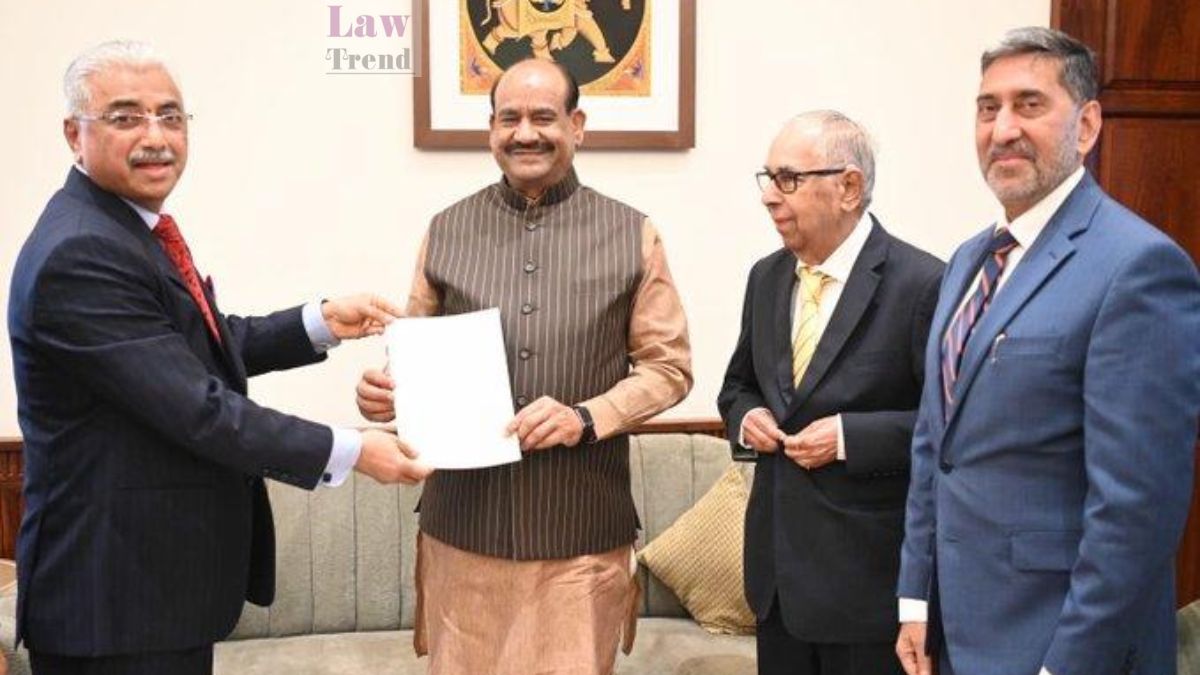
In a major development in one of the most high-profile judicial controversies in recent years, the Judges Inquiry Committee investigating allegations against former Allahabad High Court Judge Yashwant Varma submitted its official report to Lok Sabha Speaker Om Birla on Monday.
The submission, completed in accordance with the Judges (Inquiry) Act, 1968, marks a crucial milestone in a process that began after a bizarre fire incident exposed piles of burnt currency at the judge’s official residence. According to Lok Sabha Secretariat sources, the findings are expected to be tabled before both Houses of Parliament during the upcoming Monsoon Session, scheduled to take place between July and August.
The Delhi Residence Fire and the Impeachment Motion
The controversy traces back to March 2025, when a fire broke out at Justice Varma’s official residence in Delhi. In the aftermath of the incident, investigators made a startling discovery: piles of burnt currency notes stashed inside a storeroom.
An subsequent in-house committee, constituted by then Chief Justice of India Sanjiv Khanna, concluded that Justice Varma maintained “active or tacit control” over the specific storeroom where the cash had been concealed.
The findings triggered swift political and constitutional reactions. By July 2025, more than 200 Members of Parliament had signed a formal motion to impeach the High Court judge, setting the stage for a rare parliamentary trial.
A High-Level Probe and a Sudden Resignation
To investigate the charges formally, Lok Sabha Speaker Om Birla constituted a three-member inquiry committee on August 12, 2025. The panel brought together prominent legal minds, including:
- Justice Aravind Kumar of the Supreme Court
- Shree Chandrashekhar, Chief Justice of the Bombay High Court
- B V Acharya, Senior Advocate of the Karnataka High Court
However, the proceedings took a dramatic turn last month when Justice Varma abruptly stepped down, sending his resignation letter to President Droupadi Murmu and Chief Justice of India Surya Kant. Although his resignation has still not been formally accepted, the move has ignited significant debate over the status of the ongoing inquiry.
In his letter, Varma expressed “deep anguish” over the circumstances, writing:
“While I do not propose to burden your august office with the reasons which have constrained me to submit this missive, it is with deep anguish that I hereby tender my resignation…”
Judge Boycotted Probe, Citing Lack of Fair Trial
Alongside his resignation, Justice Varma also formally withdrew his participation from the three-member committee’s proceedings. In a letter addressed to the panel, he defended his decision to step away, arguing that the investigation lacked procedural fairness.
“While I do not even for a moment seek to question the expectation that the conduct of judges be examined against standards higher than those that may apply to others, even that would not justify the adoption of standards which result in a deprivation of a reasonable and fair opportunity to defend or a fair trial itself,” Varma wrote.
He further asserted that continuing to take part in the investigation under the prevailing circumstances would be doing the “greatest disservice” to both himself and the judicial institution.
What Lies Ahead for Parliament
Despite the judge’s resignation and the fact that it has not been officially accepted, the parliamentary process has continued unabated.
Now that Speaker Om Birla has received the statutory report, the focus shifts to Parliament. When the Monsoon Session begins this summer, lawmakers will finally review the committee’s findings, potentially bringing a definitive close to a scandal that has gripped the nation’s legal establishment.




