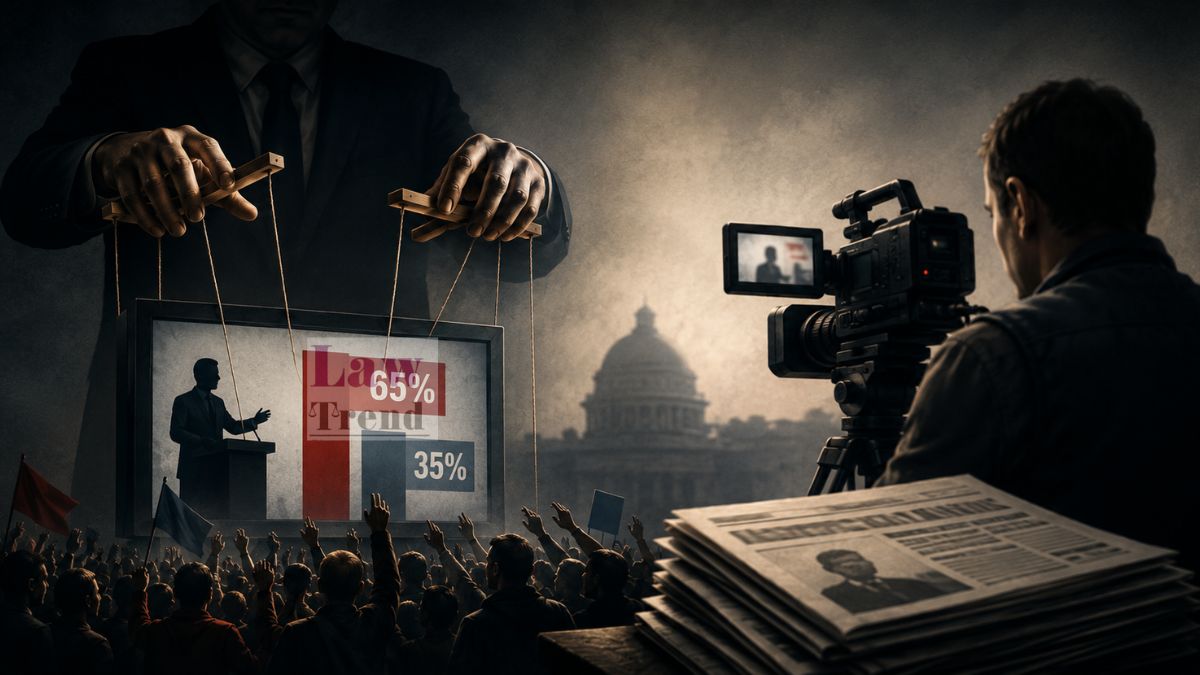
The Menace of Phantom Polls: When Journalism Becomes a Political Weapon

On the urgent necessity of banning fabricated survey reports and holding the press accountable to the constitutional republic it claims to serve.
S.M.Haider Rizvi
Advocate, High Court, Lucknow 

There is a particular species of malice that wears the vestments of public service. It announces itself as journalism, adorns its fabrications with the respectable vocabulary of surveys and data, and then, with surgical precision, drives its blade into the reputation of a chosen target. In recent times, India has witnessed a proliferation of such phantom polls, i.e. surveys that materialize without methodology, without participants, without transparency, and without truth , yet which circulate freely across digital platforms, poisoning the democratic well from which every election must ultimately draw.

The present article arises from a specific and egregious instance of this practice. A prominent national newspaper published a so-called survey report on its digital platform https://dainik.bhaskar.com/EeehMmSDD2b claiming that voters of various assembly constituencies of the State are deeply dissatisfied with their elected representatives, and that they would deny them heir vote in the next election. No names of respondents were given. No demographic breakdown was offered. No date, no venue, no journalist’s byline attended the survey. The sample size, questionnaire, margin of error, and confidence interval, the elementary cartography of any credible survey, were wholly and conspicuously absent.

The press is not an island unto itself, exempt from the ordinary laws of the land. The freedom that protects it is the same Constitution that protects the citizen from it.

This is not responsible journalism. This is the literary equivalent of anonymous poison-pen correspondence, dressed up in the language of democratic discourse. And it demands not merely a legal rejoinder, but a sustained national conversation about whether such practices should be permitted to continue in a constitutional democracy.

Any survey that aspires to inform the public mind must possess at its core a transparent and replicable methodology. The celebrated norms of the Press Council of India, constituted under the Press Council Act and charged with maintaining the standards of journalistic conduct, explicitly require that any opinion poll or survey, before publication, must disclose the conducting agency, the sample size and selection method, the questionnaire, the time and place of conduct, and the statistical margin of error.

The report in question satisfies none of these elementary criteria. It names no agency. It identifies no participant by any descriptor whatsoever, not by age, gender, caste, education, or constituency residence. It discloses no date on which the survey was conducted, no journalist who conducted it, no team that administered it. It is, in short, a document that proves its own falsity by its very silence on the basic facts that alone could have redeemed it.

When a publication, in the exercise of what it claims to be press freedom, produces a survey that is methodologically void, the inescapable inference is not merely sloppiness , it is premeditation. A survey designed to produce a predetermined conclusion has no need for participants, because it has no interest in truth.

The Indian Constitution, in Article 19(1)(a), guarantees to every citizen the freedom of speech and expression. This liberty is precious, hard-won, and foundational to democratic life. But the Constitution is not a document of absolutes. Article 19(2) expressly empowers the State to impose reasonable restrictions on this freedom in the interests of, among other things, public order, decency, and defamation.

Shreya Singhal v. Union of India, (2015) 5 SCC 1

The Supreme Court of India affirmed that freedom of speech and expression, while a fundamental right, is not unlimited in its compass. The State retains the constitutional authority to restrict expression that causes harm to the reputation of persons, disturbs public order, or imperils national security , and these restrictions, when proportionate and prescribed by law, do not violate the Constitution.

The liberty of the press, in particular, has been the subject of careful judicial calibration. In the landmark judgment of Indian Express Newspapers v. Union of India, (1985) 1 SCC 641, the Supreme Court, while recognising that press freedom is a cornerstone of democratic society, laid down with equal clarity that the press is not free from accountability. The Court held that the press bears a solemn duty to publish only what is factual, verified, and fair.

Indian Express Newspapers v. Union of India, (1985) 1 SCC 641

The Supreme Court held that press freedom is a cherished right, but one that carries with it an inseparable obligation of accuracy and fairness. A newspaper that publishes falsehoods cannot take shelter behind the constitutional guarantee of free speech; the guarantee was never intended to be a shield for defamation or deliberate misinformation.

The publication of a demonstrably fabricated survey, designed to injure the public reputation of a named elected representative, constitutes defamation in its most classical form. Section 356(2) of the Bharatiya Nyaya Sanhita, 2023 , the successor provision to Sections 499 and 500 of the Indian Penal Code defines as defamatory any written or published matter that is made with the intention of harming the reputation of a person, or with the knowledge that such publication would cause such harm.

READ ALSO  Indian Legal Education and Profession: Reforms Required to Tune with Modern World

The constitutional dimension of this right was beautifully articulated by the Supreme Court in Subramanian Swamy v. Union of India, (2016) 7 SCC 221, where the Court held that the right to reputation is an inalienable facet of the right to life under Article 21.

Subramanian Swamy v. Union of India, (2016) 7 SCC 221

The Court affirmed that the right to reputation is an intrinsic component of the right to life and personal liberty guaranteed by Article 21 of the Constitution. Defamatory publication is therefore not merely a wrong against the individual , it is an assault upon a fundamental right. The Court upheld criminal defamation as a constitutionally valid restriction upon free speech, finding that the protection of individual dignity from calculated falsehood is a compelling state interest.

In Sewakram Sobhani v. R.K. Karanjia, AIR 1981 SC 1514, the Supreme Court was unequivocal: the fact that a person occupies public office does not render him a fair target for the publication of untruths. A newspaper that defames a public servant on the basis of false facts cannot invoke the defence of qualified privilege or press freedom.

In a democracy like India where public opinion is easily manipulated, it is well known that the injury inflicted by phantom polls extends far beyond the individual whose reputation is targeted. It reaches into the very heart of the democratic process. When voters are presented with a fabricated survey that tells them their chosen representative is unpopular, their electoral confidence is shaken by a lie. Their political preferences are manipulated, not by argument, but by manufactured consensus.

Section 123 of the Representation of the People Act, 1951 classifies as corrupt practice the dissemination of false statements of fact with respect to a candidate. A survey that falsely depicts an elected representative as overwhelmingly unpopular, published in the run-up to a future election, is precisely the kind of corrosive falsehood that electoral law was designed to prohibit.

R. Rajagopal v. State of Tamil Nadu, AIR 1995 SC 264

The Supreme Court laid down that a citizen, whether private or public ,  retains the right to have their reputation protected from the publication of false facts. The press enjoys wide latitude in commenting upon public conduct, but this latitude does not extend to falsehood. Where false statements of fact are published, the constitutional guarantee of press freedom provides no sanctuary.

It is the submission of this article that the time has come for Parliament, the Press Council of India, and the Election Commission to act in concert to prohibit the publication of surveys and opinion polls that do not comply with verifiable minimum standards of methodology. The argument for such a ban rests on three incontrovertible pillars.

The first is the principle of epistemic integrity. Democracy is a system that processes information into decisions. It functions only when the information it processes is honest. A survey that is methodologically void is not information  it is noise disguised as signal.

READ ALSO  Divorce by Mutual Consent: Step by Step Procedure

The second is the principle of accountability. The Information Technology (Intermediary Guidelines and Digital Media Ethics Code) Rules, 2021, under Rule 9, impose upon digital news publishers a special obligation to ensure that their content does not harm the dignity of individuals or mislead the public. The law already exists , what is required is its vigorous enforcement.

The third is the principle of proportionality in restriction. The phantom poll- groundless, anonymous, targeted  is the journalistic equivalent of slander, and there is no more reason to permit it in the name of press freedom than there is to permit a doctor to practice without a medical degree in the name of economic freedom.

This article respectfully urges the following remedial measures upon those charged with the governance of public communication in India:

That the Press Council of India prescribe mandatory minimum disclosure norms for all surveys and opinion polls published in any medium, print or digital, and that publication without such disclosure be treated as a cognizable breach of journalistic ethics, attracting suspension of accreditation.

That the Ministry of Information and Broadcasting, exercising its powers under the IT (Intermediary Guidelines and Digital Media Ethics Code) Rules, 2021, issue a formal advisory requiring digital news publishers to remove unverified survey reports within a prescribed period and publish corrections of equal prominence.

That the Election Commission of India, which has wide powers to ensure the integrity of the electoral process under Article 324 of the Constitution, treat the publication of demonstrably fabricated political surveys as a form of electoral malpractice subject to its regulatory jurisdiction.

That civil society and the legal fraternity hold the press to account through the full arsenal of legal remedies available under the Bharatiya Nyaya Sanhita, 2023, including Sections 356(2) (defamation), 353 (public mischief), 318 (cheating by false representation), and 61 (criminal conspiracy).

The phenomenon of the phantom poll cannot be fully understood in purely legal terms. Its deeper pathology is political and epistemological. In their seminal 1988 work, Manufacturing Consent: The Political Economy of the Mass Media, Noam Chomsky and Edward S. Herman offered a rigorous structural diagnosis of how mass media, in liberal democracies, does not merely report the world but actively constructs a version of it that serves the interests of those who own and finance the press. Their “Propaganda Model” identifies five hierarchical filters through which all news must pass before it reaches the public: ownership, advertising revenue, official sourcing, the disciplining power of flak, and the mobilisation of ideological consensus. A fabricated survey, released by a large media conglomerate with commercial and political interests, passes through every one of these filters with dangerous ease. It is precisely the kind of output the Propaganda Model predicts: laundered through institutional authority, dressed in the vocabulary of social science, and designed not to inform but to shape.

Noam Chomsky & Edward S. Herman — Manufacturing Consent: The Political Economy of the Mass Media (1988)

“The mass media serve as a system for communicating messages and symbols to the general populace. It is their function to amuse, entertain, and inform, and to inculcate individuals with the values, beliefs, and codes of behaviour that will integrate them into the institutional structures of the larger society. In a world of concentrated wealth and major conflicts of class interest, to fulfil this role requires systematic propaganda.” The authors further observe that the media do not resort to crude falsification alone; far more insidiously, they manufacture consent — the appearance of popular agreement — by presenting as the voice of the public what is, in reality, the voice of power. A phantom poll is precisely this manufacture rendered visible: it substitutes the simulacrum of public opinion for public opinion itself.

Chomsky’s critique acquires particular force in the context of universal adult franchise, which is the cornerstone of the Indian democratic republic. In a democracy, the vote of the most learned jurist and the vote of the most unlettered labourer are, by constitutional design, of precisely equal weight, as Allama Iqbal also laments : 

जम्हूरियत इक तर्ज़-ए-हुकूमत है कि जिस में,
बंदों को गिना करते हैं तौला नहीं करते..

READ ALSO  Live-In Relationship: A Critique on Punjab HC Order

This radical equality is not a defect of democracy; it is its highest aspiration. It rests upon a foundational premise: that each citizen, however varied in education or station, is capable of forming a judgment upon the public good when furnished with honest information. The phantom poll strikes at this premise with surgical malice. It does not persuade through argument; it does not inform through evidence. Instead, it manufactures an artificial social reality, a false consensus, which the ordinary voter, lacking the methodological tools to detect the fraud, absorbs as truth. The intellectual may see through the deception. The average citizen, trusting that a prominent national newspaper would not fabricate the voice of the people, cannot. And it is precisely this asymmetry of epistemic armour that makes the phantom poll so profoundly anti-democratic: it exploits the good faith of the voter whose equality the Constitution most jealously protects.

Chomsky and Herman further draw attention to what they call “the manufacture of marginalisation” – the media’s capacity to render certain politicians or public figures invisible or discredited in the public eye, not by honest criticism but by relentless manufactured negative framing. A fabricated survey declaring a sitting legislator to be unpopular is a textbook instrument of this marginalisation. It does not engage with his legislative record, his policy positions, or his conduct in office. It simply asserts, falsely and without evidence, that “the people” have already judged and condemned him. This is not democratic accountability; it is its precise inversion. It is the capture of democratic language, the language of popular will, of surveys, of voter sentiment, and its deployment in the service of interests that are anything but democratic. Permitting such practices to continue unchecked is to allow the machinery of democracy to be operated from the outside, by those who have never submitted themselves to an election, in service of agendas that the ballot box would never endorse.

The freedom of the press is among the most luminous achievements of the modern constitutional order. It is the oxygen of democracy, the light by which citizens see their governors clearly. But oxygen, misused, feeds the fires of injustice as readily as it sustains the fires of truth. A press that fabricates surveys, targets individuals, and manufactures political narratives without evidence is not the fourth estate , it is the fifth column. The remedy lies not in hostility toward journalism, but in the insistence, rooted in the Constitution, fortified by the Supreme Court, and demanded by every citizen who values the democratic process, that journalism mean what it says: the truthful, verified, and responsible reporting of facts. Nothing more. And nothing less.

Law Trend
Law Trendhttps://lawtrend.in/
Legal News Website Providing Latest Judgments of Supreme Court and High Court

Related Articles

Latest Articles