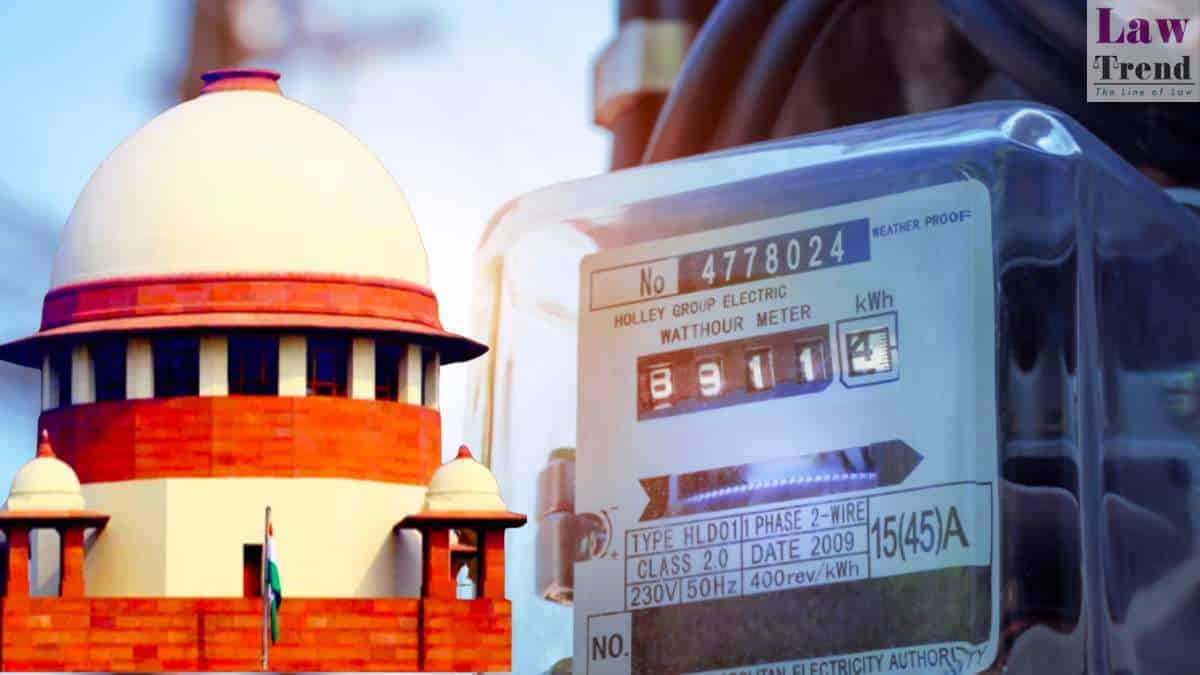
The Supreme Court of India has ruled that electricity consumers cannot be held liable for the capital cost recovery of a power plant through depreciation once it has ceased to supply electricity. Setting aside a judgment by the Appellate Tribunal for Electricity (APTEL), the Court emphasized that safeguarding consumer interest is a central statutory principle in tariff determination under the Electricity Act, 2003.
Background
The case pertains to the Rithala Combined Cycle Power Plant, established by Tata Power Delhi Distribution Limited (TPDDL). Conceived as a short-term measure to augment power supply for the 2010 Commonwealth Games, the plant was initially intended for an operational tenure of 5 to 6 years.
While the Delhi Electricity Regulatory Commission (Commission) determined the plant’s technical useful life to be 15 years, it restricted the operational and tariff recovery framework to six years, ending in March 2018. TPDDL did not challenge this 2017 order. However, in subsequent true-up proceedings, TPDDL sought to recover the remaining capital cost (approximately ₹94.59 crores) through depreciation over 15 years, even though the plant stopped supplying electricity to Delhi consumers after March 2018.
APTEL had previously ruled in favour of TPDDL, directing the Commission to allow recovery over the full 15-year technical life. The Commission challenged this before the Supreme Court.
Arguments of the Parties
The Delhi Electricity Regulatory Commission argued that fastening liability on consumers for a period beyond March 2018—during which no electricity was supplied—is contrary to Section 61(d) of the 2003 Act. They contended that TPDDL was free to exploit the plant as a merchant generator beyond the six-year period to recover its costs independently.
TPDDL argued that Regulation 6.32 of the DERC Regulations, 2011, mandates depreciation over the “useful life” of the asset and does not admit exceptions based on operational life or the duration of a Power Purchase Agreement (PPA). They characterized the denial of these costs as a “regulatory failure” with serious consequences for stakeholders.
Court’s Analysis
A bench comprising Justice Pamidighantam Sri Narasimha and Justice Alok Aradhe identified that tariff determination is a “regulatory balancing act” rather than a mere mathematical exercise.
The Court observed:
“The object of enabling reasonable cost recovery for utilities must be weighed against and calibrated with, paramount obligation to safeguard consumer interest. In the instant case, admittedly, electricity has not been supplied to the consumers beyond March-2018. The consumers cannot be required to pay for a service which they no longer received.”
The Bench further clarified the relationship between technical life and regulatory recovery:
“The APTEL ought to have appreciated that distinction between 15 years technical useful life and 6 years regulatory recovery period is not merely semantic but the tariff framework drew the distinction clearly.”
Regarding the interpretation of Regulation 6.32, the Court held that it must be read harmoniously with Regulation 4.1 and Section 61(d) of the 2003 Act. The Court noted that since TPDDL was informed it could operate as a merchant generator after March 2018, there was no legal impediment to them recovering costs through other means without burdening retail consumers.
Decision
The Supreme Court concluded that Regulation 6.32 does not confer an “absolute and unconditional right” to recover depreciation for periods when the asset is not utilized for supply.
The Court set aside the APTEL judgment dated February 10, 2025, and restored the Commission’s order dated November 11, 2019. The appeal was allowed with no order as to costs.
Case Details:
- Case Title: Delhi Electricity Regulatory Commission v. Tata Power Delhi Distribution Limited
- Case No.: Civil Appeal No. 6388 of 2025
- Bench: Justice Pamidighantam Sri Narasimha, Justice Alok Aradhe
- Date: May 7, 2026