

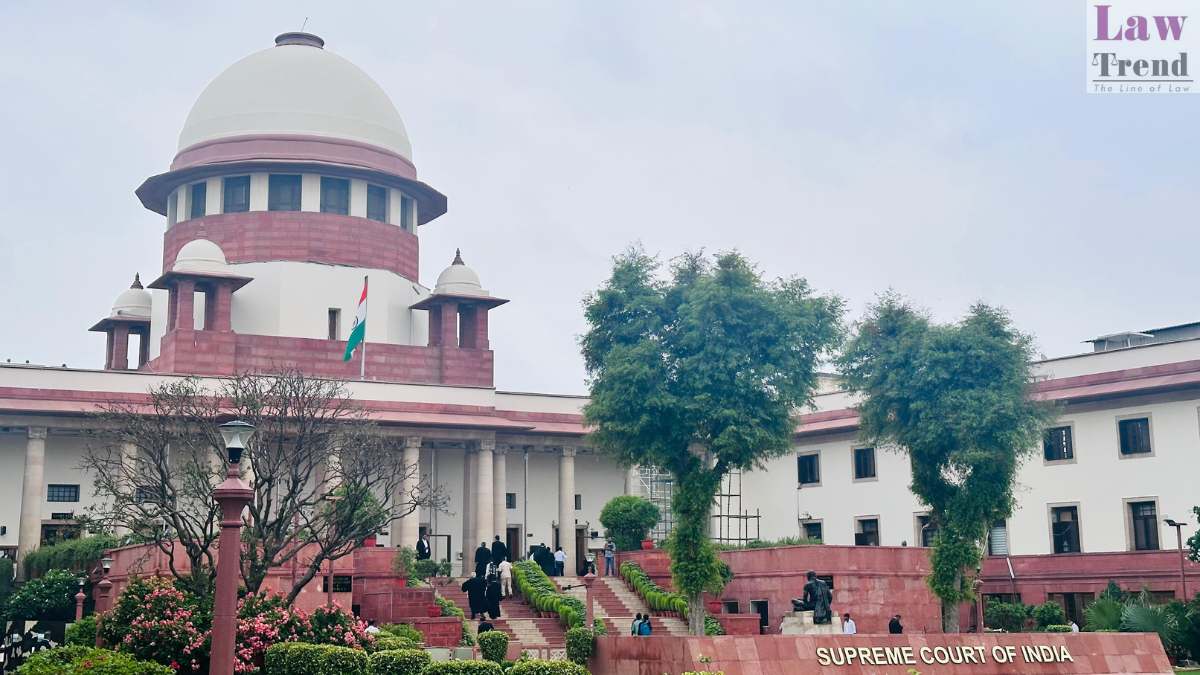
The Supreme Court of India on Wednesday declined the Central Government’s request to postpone the hearing of petitions challenging the Chief Election Commissioner and Other Election Commissioners (Appointment, Conditions of Service and Term of Office) Act, 2023. The bench emphasized the importance of the matter, noting that the hearing date had been fixed well in advance.
Background
In March 2023, a Constitution Bench of the Supreme Court ruled that the Chief Election Commissioner (CEC) and Election Commissioners (ECs) should be appointed by the President based on the advice of a committee comprising the Prime Minister, the Leader of the Opposition in the Lok Sabha, and the Chief Justice of India (CJI).
However, later in 2023, the Centre enacted a new law that replaced the Chief Justice of India on the selection panel with a Union Cabinet Minister nominated by the Prime Minister. Multiple petitions were subsequently filed challenging the validity of this law, contending that it grants the executive an overwhelming influence over the selection of officials responsible for conducting free and fair elections.
Request for Adjournment
During the proceedings on Wednesday, Solicitor General Tushar Mehta, appearing for the Centre, sought an adjournment. He informed the court that he was currently occupied before a nine-judge bench hearing the challenge to the court’s verdict regarding the entry of women into the Sabarimala temple.
“Kindly keep it next week. I am stuck in the nine-judge bench. I want to be present when the petitioners present their arguments,” the Solicitor General submitted.
Court’s Observations and Refusal
Justice Dipankar Datta turned down the request for an adjournment, describing the present hearing as “most important.” The bench pointed out that the date had been scheduled a month ago.
“If you had told us one week back, we could have accommodated. But we fixed this hearing a month back,” Justice Datta observed.
Addressing the conflict with the Sabarimala hearing, Justice Datta referred to media reports regarding observations made by the nine-judge bench: “We read in the newspaper that there is an observation that the PIL in Sabarimala should not have been entertained by the court. So with due respect to the judges, nine judges are occupied in a matter where there is an observation it should not have been entertained in the first place.”
The court directed the Solicitor General’s associates to take notes during the day’s proceedings, stating, “Let the petitioners start. All matters are important.”
Recusal and Bench Composition
The petitions were originally slated to be heard by a bench led by Chief Justice Surya Kant. However, in March, Chief Justice Kant recused himself to avoid any perception of a conflict of interest.
“Should I even hear this matter? Perhaps somebody will accuse me of having a conflict of interest,” the Chief Justice had remarked during an earlier hearing.
Advocate Prashant Bhushan, representing the petitioners, agreed with the suggestion that the matter be heard by a bench that does not include any judge in the line of succession for the post of Chief Justice of India, as the law in question specifically deals with the exclusion of the CJI from the selection process.




