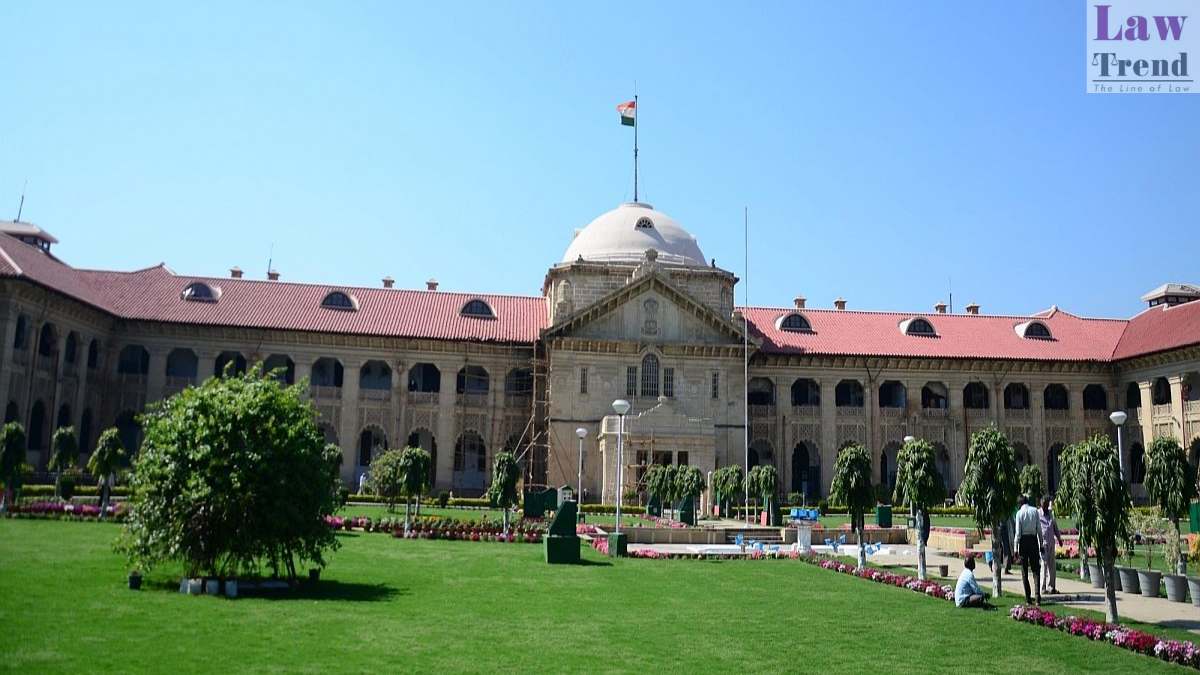
The Allahabad High Court has affirmed that a trial court possesses the authority to alter or add charges, including the addition of a murder charge (Section 302 IPC) in a dowry death case, even at the stage of final arguments, provided there is material evidence such as a viscera report indicating poisoning. Justice Nand Prabha Shukla, presiding over the matter, dismissed an application challenging a trial court’s order that allowed the prosecution to bring a years-old viscera report on record and frame an alternate charge of murder.
Background of the Case
The case originated from an FIR lodged by Shri Krishan Sharma (Opposite Party No. 2) in 2015 at Police Station Vrindavan, Mathura. It was alleged that his daughter’s marriage to the applicant, Arun Kumar, took place in 2011, during which significant dowry was provided. However, additional demands for Rs. 5 lakhs and a vehicle were made. On November 4, 2015, the daughter died at her matrimonial home.
Initially, the applicant was charge-sheeted under Sections 498A (cruelty), 304B (dowry death) of the IPC, and Sections 3/4 of the Dowry Prohibition Act. During the autopsy, no ante-mortem injuries were found, and the cause of death could not be ascertained, leading to the preservation of the viscera. Charges were framed in 2018, eight prosecution witnesses were examined, and the accused’s statement under Section 313 Cr.P.C. was recorded in July 2025.
The Procedural Turn
At the stage of final arguments, the Additional District Government Counsel (Criminal) moved an application on December 5, 2025, to bring the viscera report—which had been chemically examined in December 2016—on record and to frame an alternate charge under Section 302 (murder) IPC. The trial court allowed this application on February 10, 2026, leading to the current challenge before the High Court.
Arguments of the Applicant
Learned counsel for the applicant, Sri Sanjeev Kumar Pandey, contended that the trial court’s order was arbitrary and illegal. The primary arguments were:
- The viscera report was placed before the court after a “grossly inordinate delay” of ten years without a plausible explanation.
- Taking such evidence on record at the stage of final arguments, after the closure of prosecution evidence and Section 313 statements, was highly belated.
- No opportunity for cross-examination regarding the report was provided, causing prejudice to the defence.
- There was no sufficient material to frame an alternate charge under Section 302 IPC.
The applicant relied on the Supreme Court judgment in Jasvinder Saini and Others v. State (Govt of NCT of Delhi) (2013), arguing that a charge under Section 302 should not be added mechanically in every dowry death case.
Court’s Analysis and Observations
The High Court examined the scope of Section 216 of the Code of Criminal Procedure (now relevant under the Bharatiya Nagarik Suraksha Sanhita – BNSS), which governs the alteration of charges.
Citing Jasvinder Saini, the Court noted:
“If there is evidence whether direct or circumstantial to prima facie support a charge under Section 302 IPC the trial Court can and indeed ought to frame a charge of murder punishable under Section 302 IPC, which would then be the main charge and not an alternative charge as is erroneously assumed in some quarters.”
The Court further referenced Dr. Nallapareddy Sridhar Reddy v. The State of Andhra Pradesh, emphasizing that the power to alter charges is “exclusive and wide-ranging.” The Court observed:
“The use of the words ‘at any time before judgment is pronounced’… empowers the court to exercise its powers of altering or adding charges even after the completion of evidence, arguments and reserving of the judgment.”
Regarding the facts of the present case, the Court found that although the viscera report was ready in 2016, the Investigating Officer had failed to bring it on record earlier. The report indicated the presence of “organophosphorus insecticide poison.”
The Court remarked:
“As the viscera preserved was examined in time, the poison was detected which is a material evidence to be taken into account for just decision of the case… it is a material evidence which needs to be taken into account for reaching the just conclusion.”
Decision
The High Court concluded that there was no illegality in the trial court’s impugned order. It held that since the material evidence (the viscera report) directly linked the facts to the ingredients of the alleged offence, the addition of the charge was justified to ensure a fair trial. The application was accordingly dismissed, and the Court declined to interfere with the trial proceedings.
Case Details:
Case Title: Arun Kumar vs. State of U.P. and Another
Case No.: APPLICATION U/S 528 BNSS No. 11808 of 2026
Bench: Justice Nand Prabha Shukla
Date: May 4, 2026