The Supreme Court of India has granted leave and suspended the substantive order of sentence passed against Aruna Kumari, a former Child Development Programme Officer, who was convicted by the High Court of Judicature at Patna in a corruption case. While granting bail, the Court expressed significant concern over the prosecution’s claim that currency notes seized as evidence were destroyed by rodents while in police custody.
Background of the Case
The petitioner, Aruna Kumari, was serving as a Child Development Programme Officer when she was put to trial for offences punishable under Sections 7 and 13(2) of the Prevention of Corruption Act, 1988. The Trial Court had initially acquitted the petitioner of all charges.
However, the department challenged this acquittal before the High Court of Judicature at Patna. The High Court reversed the acquittal, holding the petitioner guilty. Consequently, she was sentenced to undergo four years of rigorous imprisonment under Section 13(2) and three years of rigorous imprisonment under Section 7 of the Act, 1988. The petitioner subsequently approached the Supreme Court seeking special leave to appeal against this conviction.
High Court’s Observations on Evidence Destruction
The Supreme Court took specific notice of paragraph 53 of the High Court’s impugned judgment, which addressed the failure of the prosecution to produce the seized bribe money during the trial. The High Court had observed:
“It is true that the prosecution failed to produce the currency notes that were seized from the possession of the accused on the ground that the envelop containing seized money was destroyed by rats and rodents. But during trial, P. S. Malkhana register was produced and proved as exhibit… as a result of improper condition of Malkhana and lack of up to date preservation system, the envelop along with currency notes were destroyed by rodents.”
The High Court further noted that even if the corpus delicti is destroyed, an accused can be convicted if surrounding circumstances point to guilt beyond reasonable doubt.
Analysis by the Supreme Court
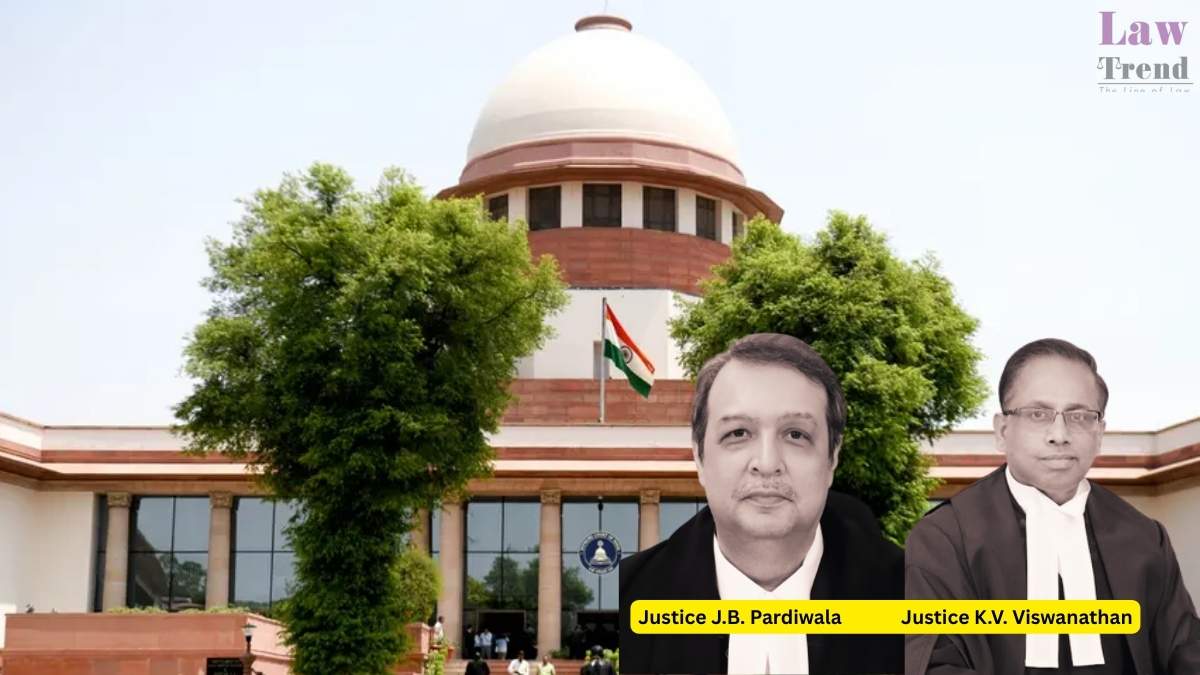
The bench comprising Justice J.B. Pardiwala and Justice K.V. Viswanathan expressed skepticism regarding the explanation provided for the disappearance of the physical evidence.
The Court remarked, “We are taken by surprise that the currency notes got destroyed by rodents.”
The bench further questioned the safety protocols for storing such recovered assets, stating, “We wonder how many such currency notes recovered in this type of offences get destroyed as they are not kept at a safe place. Its a huge revenue loss for the State.”
Critically, the Court noted that “the explanation offered for the destruction of the currency notes also does not inspire any confidence.” The bench indicated that it intends to delve deeper into this specific issue when the main matter is heard.
The Decision
After hearing Senior Advocate Mr. S. Nagamuthu for the petitioner, the Court passed the following orders:
- Leave Granted: The Court formally admitted the appeal against the High Court’s judgment.
- Suspension of Sentence: The substantive order of sentence passed by the High Court was ordered to be suspended.
- Grant of Bail: The appellant is to be released on bail subject to terms and conditions to be imposed by the Trial Court.
The Court has already granted the petitioner exemption from surrendering. The broader issue regarding the preservation of seized currency notes remains open for further consideration.
Case Details
Case Title: Aruna Kumari v. The Economic Offences Unit
Case No.: Special Leave to Appeal (Crl.) No. 7601/2025
Bench: Justice J.B. Pardiwala and Justice K.V. Viswanathan
Date: April 24, 2026