

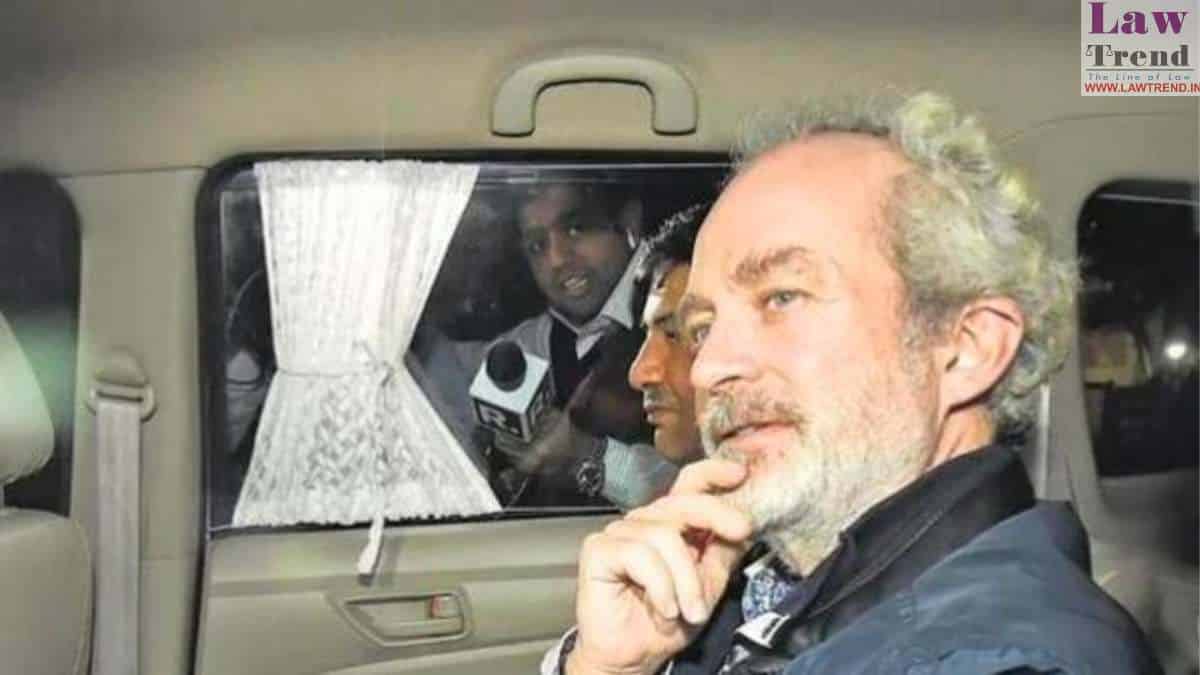
The Supreme Court on Monday agreed to examine a petition filed by Christian Michel James, the alleged middleman in the ₹3,600-crore AgustaWestland VVIP chopper scam, seeking his release from custody. A bench of Justices Vikram Nath and Sandeep Mehta issued notices to the Union Government, the Central Bureau of Investigation (CBI), and the Enforcement Directorate (ED), seeking their responses within four weeks.
The legal challenge centers on the interpretation of the 1999 India-UAE Extradition Treaty and James’ claim that his continued detention is illegal, having already exceeded the maximum possible sentence for the offences for which he was extradited.
Christian Michel James, a British national, was extradited from Dubai in December 2018. He is one of three alleged middlemen, alongside Guido Haschke and Carlo Gerosa, investigated for their roles in the 2010 deal for the supply of 12 VVIP helicopters. The CBI alleges the deal resulted in a loss of approximately 398.21 million euros (₹2,666 crore) to the exchequer. The ED further alleges that James personally received 30 million euros (₹225 crore) from AgustaWestland.
While James was granted bail by the Supreme Court in the CBI case in February 2025 and by the High Court in the ED case in March 2025, he remains in jail due to his inability to fulfill the financial conditions of the bail bonds, which include multiple personal bonds and sureties totaling ₹25 lakh.
The petitioner has specifically challenged the validity of Article 17 of the India-UAE Extradition Treaty. His counsel argued before the Supreme Court that the Delhi High Court had incorrectly held that the treaty prevails over existing domestic laws.
The core of the legal argument is that an extradited person should only be prosecuted for the specific offences for which extradition was granted. Article 17, however, allows the requesting state to prosecute for “connected offences.” James contends that this provision is being used to extend his detention unlawfully.
In his petition, James asserted that as of December 4, 2025, he had completed seven years in prison. He argued that he has “already undergone the maximum sentence possible for the offences for which he was extradited,” rendering his continued incarceration in India a violation of his rights.
The petitioner also assailed a trial court order dated August 7, 2025, which rejected his application for release under Section 436A of the Code of Criminal Procedure (CrPC). Section 436A allows for the release of an undertrial prisoner who has served half of the maximum imprisonment period for the alleged offence.
The matter reached the top court after the Delhi High Court dismissed James’ petition on April 8, stating there was “no merit” in the plea. The High Court had ruled that James was extradited to face trial for offences directly arising from the factual background of the case, falling squarely within the scope of the treaty.
The High Court further noted that James could not re-agitate issues regarding the treaty that had already been prima facie considered by the Supreme Court.
The Supreme Court bench noted that the matter will now be listed for further hearing in July. In earlier proceedings on April 24, the top court had referred the plea to the current bench after noting that previous petitions by the accused had been heard by a bench led by Justice Vikram Nath.
While the court considers the treaty’s validity, James remains under the watch of the Foreigners Regional Registration Office (FRRO) to ensure he does not leave the country, with instructions for his fresh passport to be deposited with the trial court once ready.




