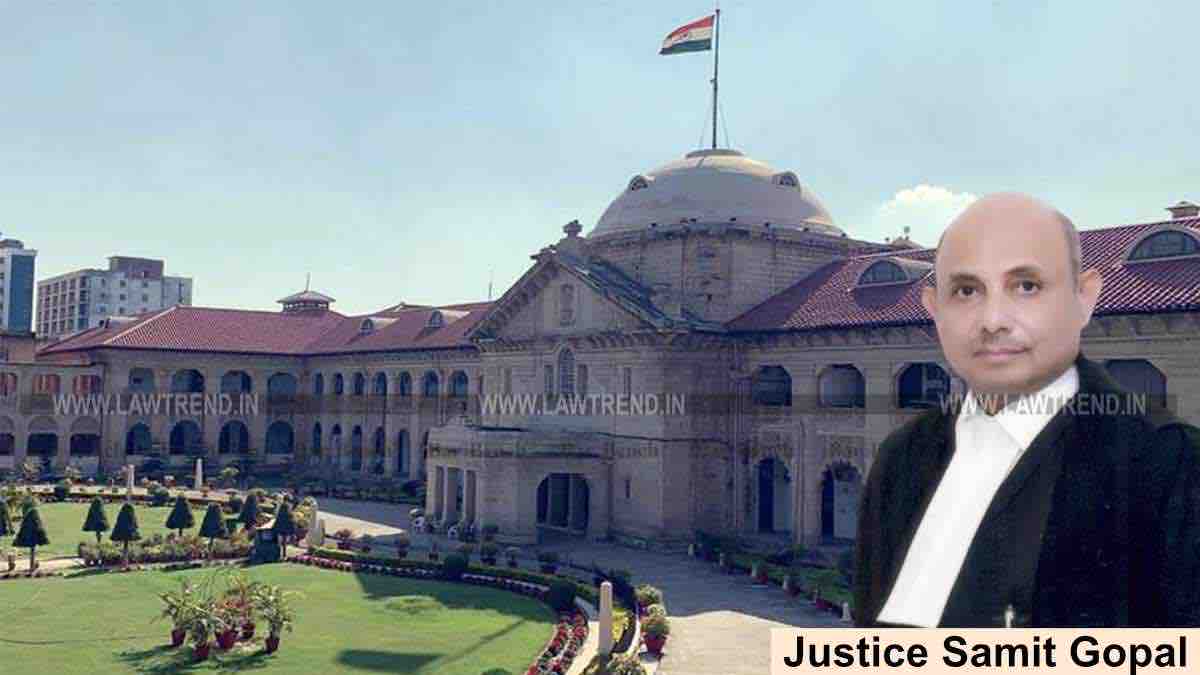
The High Court of Judicature at Allahabad has set aside the conviction of an appellant under Section 323 read with Section 149 of the Indian Penal Code (IPC), holding that a conviction with the aid of vicarious liability under Section 149 cannot be sustained when the number of convicted persons falls below the statutory minimum of five required to constitute an “unlawful assembly.”
Justice Samit Gopal, presiding over the matter, emphasized that the existence of an unlawful assembly—as defined under Section 141 of the IPC—is a “necessary postulate” for invoking Section 149. The court ruled that if the prosecution fails to prove the assembly was unlawful (consisting of five or more persons), the charge under Section 149 must necessarily fail.
Background of the Case
The case originated from an incident on March 13, 1986, in District Basti. The informant, Ramdas Upadhyay, alleged that his son, Raghuvansh Upadhyay, was assaulted by Ram Palat and six others following a boundary dispute over a plot of land. It was alleged that the accused, armed with lathis and dandas, assaulted the victims and forcibly took away personal belongings, including jewelry and cash.
Seven accused were committed to the Court of Sessions for offences under Sections 147, 307/149, and 379 IPC. During the trial:
- One accused, Raja Ram, died, and his trial abated.
- Four other accused (Paras Nath, Suresh, Mata Badal, and Bigrail @ Janardan) were acquitted of all charges.
- The remaining two, Ram Palat and Bigranchhu, were acquitted of Sections 147, 307/149, and 379 IPC but were convicted by the Vth Additional Sessions Judge, Basti, for the offence under Sections 323/149 IPC on May 3, 1989.
The appellants, Ram Palat and Bigranchhu, subsequently moved the High Court. During the pendency of the appeal, Ram Palat died, leading to the abatement of the appeal in his regard, leaving Bigranchhu as the sole surviving appellant.
Arguments of the Parties
The counsel for the appellant argued that the conviction with the aid of Section 149 IPC was “totally illegal.” They contended that an unlawful assembly must consist of a minimum of five persons. Since four accused were acquitted and one died, the conviction of only two persons under Section 323/149 IPC was unsustainable in law.
The Additional Government Advocate (A.G.A.), representing the State, opposed the appeal, asserting that seven persons were originally named and tried. The State argued that the presence of an injured witness (Raghuvansh Upadhyay) established the occurrence of the incident beyond doubt and that the specific roles assigned to the appellants justified their conviction.
Court’s Analysis and Cited Precedents
The Court focused its analysis on the legal threshold for “unlawful assembly” under Section 141 and “vicarious liability” under Section 149. Justice Gopal observed:
“For constituting an unlawful assembly one of the main and important ingredient is that the said assembly should consist of 5 (five) or more persons.”
The Court relied on several landmark decisions of the Supreme Court to clarify the applicability of Section 149:
- Mohan Singh v. State of Punjab (1962): The five-judge Bench held that “as soon as two of the five named persons are acquitted, the assembly must be deemed to have been composed of only three persons and that clearly cannot be regarded as an unlawful assembly.”
- Subran v. State of Kerala (1993): The Apex Court noted that “an assembly of less than five members is not an unlawful assembly within the meaning of Section 141 and cannot, therefore, form the basis for conviction for an offence with the aid of Section 149 IPC.”
- Mahendra v. State of M.P. (2022): The Court reiterated that when specifically named co-accused are acquitted, it is not permissible to invoke Section 149 against the remaining accused if their number is less than five.
The High Court noted that the prosecution did not allege the involvement of any “unidentified” or “unnamed” persons. Since the trial court had acquitted four out of the six individuals who faced trial, only two persons remained.
The Decision
The Court held that the acquittal of the four co-accused rendered Section 149 IPC inapplicable to the appellants. The judgment stated:
“This Court holds that the accused-appellants cannot be convicted with the aid of Section 149 I.P.C. as only two (2) accused were convicted by the trial court. This Court thus finds that the impugned judgement and order is totally illegal.”
Consequently, the High Court allowed the appeal and acquitted the surviving appellant, Bigranchhu. His bail bonds were cancelled, and the sureties were discharged.
Case Details:
- Case Title: Ram Palat and another v. State
- Case No.: Criminal Appeal No. 1158 of 1989
- Bench: Justice Samit Gopal
- Date: April 24, 2026