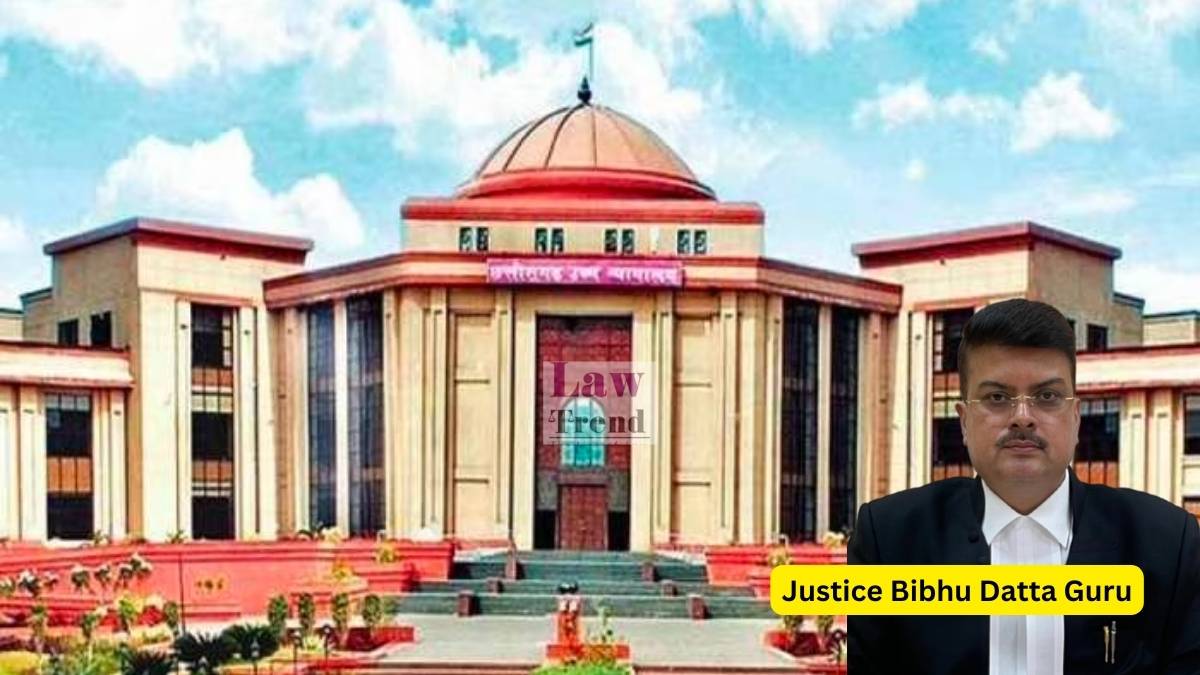
The High Court of Chhattisgarh has ruled that when deciding on temporary injunctions, courts must exercise sound judicial discretion to measure the “substantial mischief or injury” likely to be caused to the parties. Justice Bibhu Datta Guru delivered this observation while setting aside a trial court’s order and granting a status quo order in a property dispute where the sale consideration was found to be grossly disproportionate to the market value.
The case involved an appeal against a trial court’s refusal to grant a temporary injunction to the plaintiffs who challenged a sale deed they alleged was fraudulent. The High Court was tasked with determining whether the three essential ingredients for an injunction—prima facie case, balance of convenience, and irreparable injury—were met, specifically in the context of a disputed property transaction involving a nonagenarian seller and significant valuation discrepancies.
Background of the Case
The appellants/plaintiffs filed a civil suit seeking declaration, permanent injunction, and cancellation of a sale deed dated June 18, 2021, for Nazul land (6,932 sq. ft.) in Bilaspur. The plaintiffs contended that the property, originally belonging to Nirmal Kumar Samuel (Plaintiff No. 1, now deceased), had been orally partitioned in 1998 among his children.
The dispute arose when Defendant No. 2 (son of Plaintiff No. 1) allegedly conspired with Defendant No. 1 (the purchaser) to execute a sale deed for the entire property area. The plaintiffs alleged that Plaintiff No. 1 was nonagenarian and suffered from serious visual impairment at the time of the transaction. The 2nd Additional District Judge, Bilaspur, had rejected the injunction application on July 5, 2025, prompting this appeal.
Arguments of the Parties
For the Appellants: Senior Advocate Abhishek Sinha argued that the plaintiffs are in “settled possession” and have constructed residential and commercial structures on their respective shares. He questioned the genuineness of the sale deed, noting that the market value was approximately ₹4 crore, while the sale consideration mentioned was only ₹65 lakh. He argued that possession was never delivered to the purchaser.
For Respondent No. 1 (Purchaser): Senior Advocate Vivek Ranjan Tiwari contended that the sale deed was a registered document carrying a presumption of genuineness. He argued that under Section 92 of the Indian Evidence Act, oral evidence cannot contradict the terms of a registered deed and that the mutation was already completed in the revenue records.
For Respondent No. 2 (Son of Plaintiff No. 1): Supporting the appellants, Respondent No. 2 filed an affidavit admitting that he only intended to sell his 1,500 sq. ft. share to Respondent No. 1. He claimed the sale consideration of ₹65 lakh was for his portion only and was deposited into a joint account he operated with his father.
Court’s Analysis
The Court focused on the duty of the judiciary to evaluate the “substantial mischief” involved in such disputes. Justice Guru noted that the Collector of Stamps had already registered a revenue case regarding deficit stamp duty.
The Court observed: “From these facts, in considered view of the Court, there is a prima facie case in favour of the appellants herein to extend the benefit of temporary injunction under Order 39 Rule 1 & 2 of the CPC.”
Regarding the balance of convenience, the Court noted: “Even from the stamp duty paid by defendant No. 1, it can safely be inferred that the same has been paid only in respect of 1500 sq. ft. of land. Had it been a case that defendant No. 1 had purchased the entire suit property… he would have been required to pay stamp duty… which would have been substantially higher.”
The Court explicitly discussed the legal standard for injunctions as established in Dalpat Kumar vs. Prahlad Singh (1992):
“The Court while granting or refusing to grant injunction should exercise sound judicial discretion to find the amount of substantial mischief or injury which is likely to be caused to the parties, if the injunction is refused and compare it with that which is likely to be caused to the other side if the injunction is granted.”
The Court also cited Rame Gowda vs. M. Varadappa Naidu (2004) and Krishna Ram Mahale vs. Shobha Venkat Rao (1989), affirming that even a person in settled possession cannot be dispossessed except by due process of law.
Decision
The High Court held that the plaintiffs had successfully established a prima facie case and that the balance of convenience lay heavily in their favor. The Court found that refusing the injunction would result in irreparable loss and injury that could not be adequately compensated by money.
The Court set aside the impugned order dated July 5, 2025, and allowed the application under Order 39 Rules 1 and 2 of the CPC. The parties were directed to maintain status quo regarding the suit property until the final disposal of the suit.
Case Details:
- Case Title: Nirmal Kumar Samuel (Dead) & Ors. Vs. Atul Kumar Shukla & Ors.
- Case No.: MA No. 155 of 2025
- Bench: Justice Bibhu Datta Guru
- Date: April 7, 2026