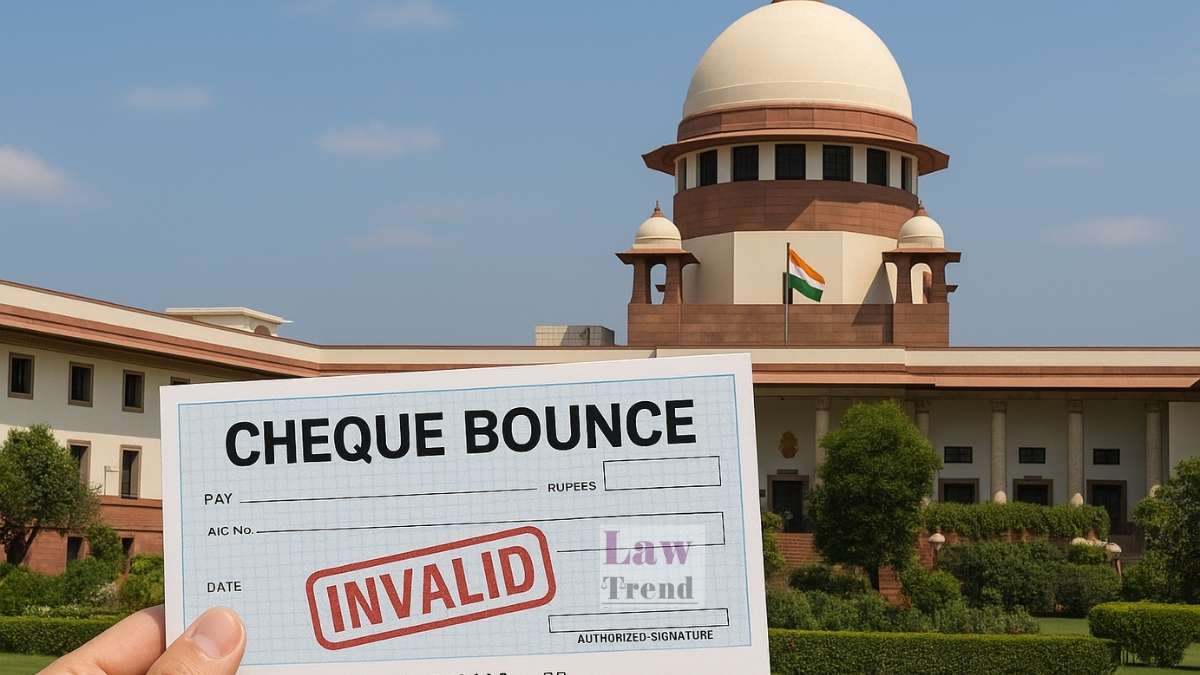
The Supreme Court of India has held that once the basic ingredients of Section 138 of the Negotiable Instruments (N.I.) Act, 1881 are satisfied, the statutory presumption regarding the existence of a legally enforceable debt cannot be dismissed at a pre-trial stage. The Bench, comprising Justice J.K. Maheshwari and Justice Atul S. Chandurkar, set aside orders from the Sessions Court and the High Court of Bombay that had quashed the issuance of process against a drawer of a dishonoured ₹50 crore cheque.
Background of the Case
The appellant, Renuka, was involved in a dispute with her husband, Mr. Ashwin Natwarlal Sheth, regarding the allegedly fraudulent transfer of shares in Sheth Developers and Realtors (India) Limited and Sheth Developers Private Limited. Following negotiations for an amicable settlement, a draft agreement was finalized on January 12, 2022.
Under the terms, the husband agreed to gift certain real estate properties and pay the appellant ₹50 crores upon the execution of a ‘Declaration-cum-Indemnity’ document to withdraw her complaints. To safeguard the appellant’s interest, the second respondent—a close friend of the husband—acted as a mediator and issued a cheque for ₹50 crores from an escrow account.
The appellant alleged that the share sale was completed contrary to the agreement. When she presented the cheque for encashment, it was dishonoured on April 6, 2022, with the remark “payment stopped by drawer.” After the second respondent failed to comply with a statutory notice, a complaint was filed under Section 138 of the N.I. Act.
Procedural History
On June 17, 2022, a Metropolitan Magistrate issued process against the second respondent, finding prima-facie material to proceed. However, the Sessions Court later set aside this order, ruling that no legally enforceable debt existed on the date the cheque was issued. This decision was subsequently upheld by the High Court of Bombay, which found no jurisdictional error in the Sessions Court’s intervention.
Arguments of the Parties
For the Appellant: Senior Advocate Mr. Mukul Rohatgi argued that the Sessions Court erred by scuttling the proceedings at a pre-trial stage. He contended that at the stage of issuing process, the court only needs to see if the basic ingredients of Section 138 are met. He emphasized that the presumption under Section 139 of the N.I. Act—that the holder of a cheque received it for the discharge of a debt—can only be dislodged during a trial, not through a summary finding before evidence is led.
For the Respondent: Senior Advocate Dr. A. M. Singhvi argued that the cheque was not issued toward any legally enforceable debt because the settlement agreement was never signed by the second respondent. He relied on the decision in Sunil Todi and others Vs. State of Gujarat and another, asserting that since the payment was dependent on an event that never occurred, there was no recoverable liability, and continuing the proceedings would be an abuse of the process of law.
Court’s Analysis
The Supreme Court observed that the Sessions Court and High Court misdirected themselves by weighing the underlying document (the settlement agreement) more heavily than the statutory requirements of the N.I. Act.
The Court noted:
“If the drawer does not dispute issuance of such a cheque nor does he deny his signature on the dishonoured cheque, the statutory presumption as contemplated under Section 139 of the N.I. Act comes into play. As a result, the burden would shift on the drawer of the cheque to prove that the cheque was not issued for any legally enforceable debt or liability.”
Referring to the precedents in Rangappa Vs. Sri Mohan and Rajesh Jain Vs. Ajay Singh, the Bench reiterated that Section 139 is a “reverse onus clause” intended to improve the credibility of negotiable instruments. The Court emphasized:
“At the stage of issuance of process, the statutory presumption under Section 139 of the N.I. Act cannot be dislodged in a summary manner merely by contending that the cheque issued was not for any legally enforceable debt or liability.”
The Bench further clarified that whether an outstanding liability exists is a “question of fact” that must be determined at trial based on evidence, rather than at the threshold of the litigation.
Decision
The Supreme Court concluded that the dismissal of the complaint was “totally unjustified” as it ignored the statutory presumption before the trial even commenced.
“We are of the view that in the facts of the present case, the dismissal of the complaint as a consequence of setting aside the order issuing process is totally unjustified in the absence of any material being brought on record by the second respondent to rebut the statutory presumption…”
The Court set aside the orders of the Sessions Court and the High Court, restored the complaint (CC1831/SC/2022) for adjudication on its merits, and directed that the case be decided in accordance with the law.
Case Details:
- Case Title: Renuka vs. The State of Maharashtra and Another
- Case Number: Criminal Appeal of 2026 (@SLP (Crl.) No. 7829 of 2023)
- Bench: Justice J.K. Maheshwari, Justice Atul S. Chandurkar
- Date of Judgment: April 7, 2026