

No Personal Hearing Required Before Declaring Borrower’s Account as ‘Fraud’; Show Cause Notice, Reply & Reasoned Order Sufficient: Supreme Court
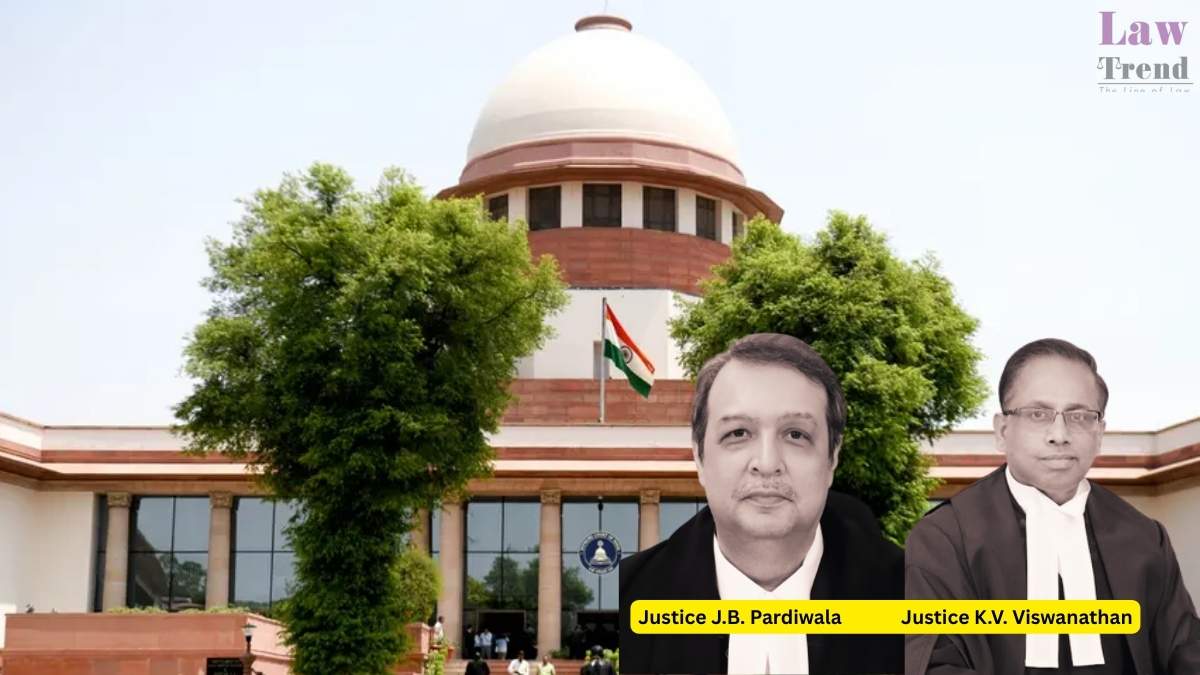

The Supreme Court of India has ruled that while borrowers are not entitled to a personal or oral hearing before their accounts are classified as “fraud” by banks, they must be furnished with the full Forensic Audit Reports (FAR) relied upon for such a classification. The Court clarified that the principles of natural justice are satisfied by the issuance of a detailed show-cause notice, the supply of evidentiary material, the consideration of a written representation, and the passing of a reasoned order.

Background of the Case

The case arose from two sets of appeals filed by the State Bank of India and the Bank of India. In the first instance, the State Bank of India (SBI) had classified the account of Amit Iron Private Limited as fraud on March 13, 2024, following a show-cause notice and a speaking order. In the second instance, the Bank of India classified the account of M/s Liliput Kidswear Limited as fraud on May 14, 2025.

In both cases, the borrowers approached the respective High Courts (Calcutta and Delhi), alleging that they were denied a personal hearing and were not provided with the complete Forensic Audit Reports. Both High Courts ruled in favor of the borrowers, interpreting the Supreme Court’s previous judgment in State Bank of India vs. Rajesh Agarwal (2023) as mandating a personal hearing. The banks subsequently appealed to the Supreme Court.

Arguments of the Parties

The Reserve Bank of India (RBI) and the appellant-banks argued that a personal hearing is not a mandatory requirement under the principles of natural justice. They contended that:

  • Classification of fraud is predominantly based on objective documentary evidence like financial statements and transaction records.
  • Mandating personal hearings would lead to “dilatory tactics,” allowing “recalcitrant borrowers” to dissipate assets or abscond, thereby defeating the objective of timely detection and reporting of fraud.
  • The RBI Master Directions-2024 already incorporate natural justice by providing for a detailed show-cause notice, a 21-day window for reply, and a reasoned order.
READ ALSO  Supreme Court Halts Demolition of Shops Near Taj Mahal

The borrowers, represented by Senior Counsels K. Parameshwar and Parag P. Tripathi, argued that:

  • The classification of an account as “fraud” leads to “civil death” as it blacklists the borrower from institutional finance and triggers criminal proceedings.
  • The judgment in Rajesh Agarwal (2023) used the words “reply and representation,” which they interpreted as including an oral representation.
  • The denial of a personal hearing is a violation of fundamental rights under Article 19(1)(g) and the doctrine of proportionality.

Court’s Analysis

A Bench comprising Justice J.B. Pardiwala and Justice K.V. Viswanathan analyzed the flexibility of the principles of natural justice. Citing A.K. Kraipak vs. Union of India, the Court noted that natural justice is not an “embodied rule” and its application depends on the framework of the law and the nature of the inquiry.

On Personal Hearing: The Court clarified that its previous ruling in Rajesh Agarwal (2023) did not recognize a right to a personal hearing.

READ ALSO  No Life Imprisonment If Kidnapper Took Good Care of the Child or Didn’t Threaten: Supreme Court

“We have analyzed the judgment in Rajesh Agarwal (supra) earlier and we have concluded that the Court did not hold that the borrowers have a right of personal hearing… All that the Court meant was to reply to the Show Cause Notice and represent against the findings in the forensic report.”

The Court further observed that:

“Unnatural expansion of natural justice, without reference to the administrative realities and other factors of a given case, can be exasperating… Oral hearing is bound to convert an administrative process which was intended to be swift, into a protracted one, defeating the very purpose of the exercise.”

On Disclosure of Audit Reports: However, the Court took a firm stand on the disclosure of material. It held that the supply of the Forensic Audit Report is the rule, not the exception.

“Reasons are the links between the materials on which certain conclusions are based and the actual conclusions… the forensic audit reports ought to be disclosed if they are to be considered relevant by the banks in classifying the account as fraud.”

The Court cited T. Takano vs. SEBI to emphasize that the right to disclosure serves to decrease error, protect fairness, and enhance transparency. It ruled that while banks can redact parts of the report that impinge on the privacy of third parties, such redaction must be done for recorded reasons.

READ ALSO  सुप्रीम कोर्ट प्रॉपर्टी डिमोलिशन पर दिशा-निर्देश तय करेगा, फैसला सुरक्षित रखा

The Decision

The Supreme Court partly allowed the appeals filed by the banks with the following directions:

  1. No Right to Personal Hearing: The Court set aside the High Court directions mandating a personal hearing for the borrowers. It affirmed that the RBI Master Directions-2024 correctly understand the scope of the law.
  2. Mandatory Disclosure of FAR: The Court upheld the requirement to furnish copies of the Forensic Audit Reports (including in digital form) to the borrowers to allow them to file an effective representation.
  3. Fresh Consideration: The appellant-banks were directed to furnish the audit reports to the respondents, allow them to file a reply, and then pass fresh orders in accordance with the RBI Master Directions.

Case Details:

  • Case Title: State Bank of India vs. Amit Iron Private Limited & Ors. (with connected matters)
  • Case Number: Civil Appeal Nos. 4243-4244 of 2026
  • Bench: Justice J.B. Pardiwala, Justice K.V. Viswanathan
  • Date: April 7, 2026

Law Trend
Law Trendhttps://lawtrend.in/
Legal News Website Providing Latest Judgments of Supreme Court and High Court

Related Articles

Latest Articles

